
Motion-sensor lights – PIR, microwave, or twilight sensor? A comprehensive guide
The light that greets you at the door when you’re carrying groceries in both hands, keeps out unwanted guests, and never turns on unnecessarily—all thanks to one unassuming component: a sensor. But not all sensors are created equal: PIR sensors react to heat, microwave sensors can see through walls, twilight sensors don’t detect movement at all, and motion sensors can keep the bathroom light on for a full fifteen minutes of inactivity. In this guide, we explain how each type works, which one to choose for which task, how to adjust the sensitivity and light duration, and why a sensor-activated light sometimes “malfunctions”—and how to fix it.

Table of Contents
- Types of sensors: PIR, microwave, twilight, presence
- A lamp with a built-in sensor or a separate sensor?
- Where does a motion sensor work best?
- Installation and settings: height, sensitivity, time
- Sensors and LED bulbs – what to watch out for
- False alarms and blind spots – troubleshooting
- Sensors in a smart home
- Sensors and pets: what to check in the specifications
- Summary
Types of sensors: PIR, microwave, twilight, presence
- PIR (passive infrared) motion sensor – the most popular. Detects a moving heat source (a person, an animal, a car with a warm engine). Requires “eye contact”: it cannot see through glass or walls, but it responds very well to movement across its field of view.
- Microwave sensor – low-power active radar. It detects every movement, even through thin walls, doors, and drywall, and is less sensitive to ambient temperature than a PIR sensor (which has a harder time “seeing” a warm body under a thick jacket in the winter). Ideal for sealed fixtures (works behind the shade) and garages, can be a bit “overzealous”—see the section on issues.
- Twilight sensor – does not detect motion at all: turns the light on when it gets dark and turns it off at dawn. It controls the house number, the entrance lights, and the string lights.
- Presence sensor – more precise than a standard PIR: more sensitive PIR models, especially high-frequency (HF) and mmWave sensors, detect even the slightest movements (turning a page, writing), so the light doesn’t turn off when you’re sitting almost motionless. Designed for bathrooms, offices, and basements.
- Hybrid models – most outdoor lights with motion sensors also have a built-in twilight sensor: the light reacts to motion only after dark and remains off during the day.
Rule of thumb: PIR with twilight outdoors, PIR in high-traffic areas, presence sensors where people stay longer, and twilight sensors alone for decorative lighting and house numbers.
A light with a built-in sensor or a separate sensor?
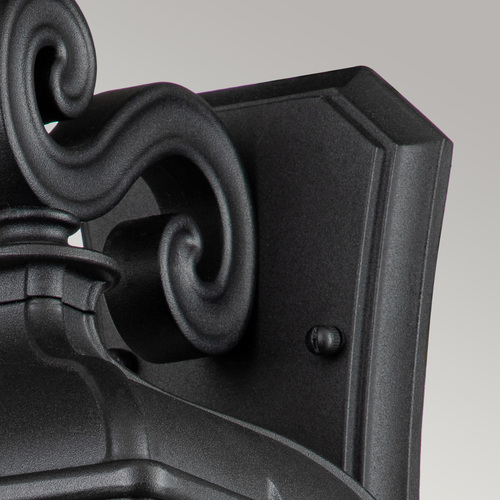
A lamp with a built-in sensor is a “plug-and-play” solution: an outdoor wall sconce with a PIR sensor replaces a standard fixture one-to-one, with no changes to the wiring. Drawbacks? The sensor faces the direction the light fixture is mounted—which isn’t always the best angle—and if it malfunctions, you usually have to replace the entire fixture.
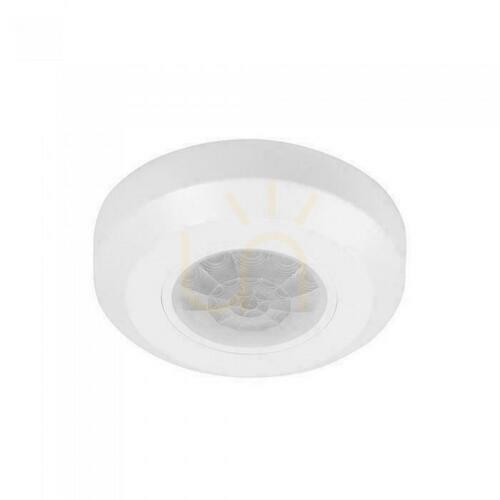
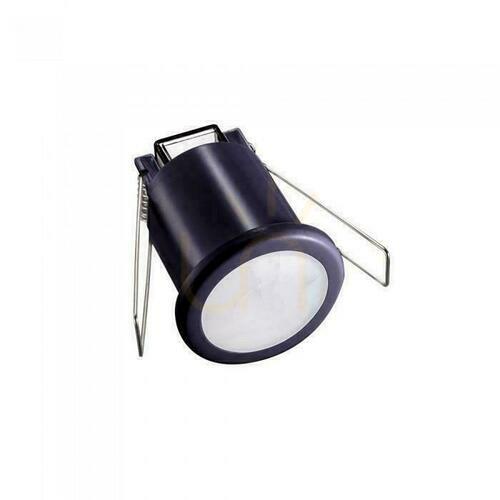
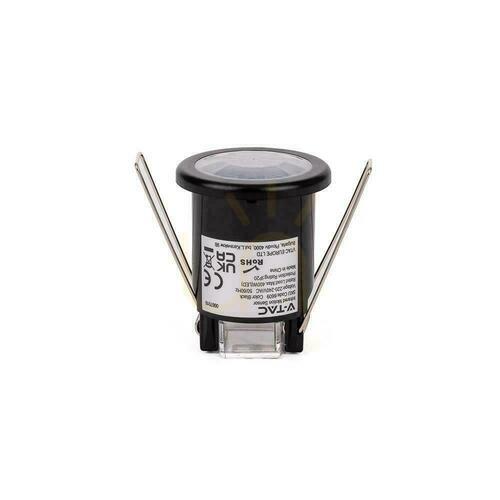
An external (separate) sensor gives you freedom: you can mount it where it “sees” best (e.g. above the corner of the house), and it controls any number of standard lights—even three wall sconces along the facade at once. It is also the only way to add automation to the lighting fixtures you already own. However, it requires running a cable and a little planning.
In new installations, it’s convenient to combine: motion-sensor lights at entrances, separate sensors for different zones (driveway, backyard), and a twilight sensor for all-night lighting.


Where do motion sensors work best?
- Entrance and gate —a classic: the light welcomes residents and the delivery person, while uninvited guests are deprived of the comfort of darkness. Choose a light fixture that also illuminates the door lock.
-
Driveway and garage door – a sensor with a range of 8–12 m and a wide angle, make sure it doesn’t “pick up” the sidewalk behind the fence.
-
Hallway, stairs, entryway – inside the house, a 360° motion sensor mounted on the ceiling solves the age-old problem of a light switch that no one can find in the dark. Set a short timer and low night mode for the stairs.
-
Basement, garage, pantry – rooms you enter with your hands full, a motion sensor prevents the light from turning off while you’re tinkering in the workshop.
-
Guest bathroom and toilet – the light turns on automatically, no one leaves it on for an hour. Here, too, a presence sensor is better than a standard PIR sensor.
- “Security” garden – a PIR-equipped floodlight aimed at the rear of the property, the mere switch from constant lighting to motion-activated lighting acts as a stronger deterrent than a lamp shining all night long.
Installation and settings: height, sensitivity, time
Most disappointments with sensors stem from poor installation, not poor equipment:
- Height: the optimal height for a PIR sensor is 1.8–2.5 m. Higher = greater range, but lower sensitivity to small movements right below the sensor (dead zone).
- Direction: PIR sensors detect movement best when it crosses the beam. A sensor above a door that you walk straight toward will react later than one mounted on the side of the path. Position it so that an approaching person crosses the field of view.
- Twilight threshold (LUX): The LUX knob does not adjust motion sensitivity, but rather the brightness threshold —it determines the level of darkness at which the sensor begins to operate. Set them so that the light doesn’t turn on on a cloudy afternoon (test: set to the “moon” position and adjust it by one notch each evening).
- Sensitivity/Range (SENS): this is a separate knob (often labeled SENS or RANGE) – it adjusts how far away and how slight a movement the sensor detects. Reduce these settings if the motion sensor detects movement from behind the fence.
- Time (TIME): 60–120 seconds is a reasonable starting point for the entrance, 5–10 minutes for the garage and basement.
- Field of view: trim it with the included covers or tape on the lens to exclude the street, branches, and the neighbor’s sidewalk—this is the most effective remedy for false alarms.
The sensor and LED bulbs—what to watch out for
Three technical pitfalls to be aware of before purchasing:
- Minimum load: older relay-based sensors were often designed for 40+ W bulbs, with a single 5 W LED, some electronic models may flicker. Modern sensors with a mechanical relay support LEDs rated at 1 W or higher—check the “min. load” or “LED from…” entry in the specifications.
- Maximum power for LEDs: manufacturers specify a separate limit for LED loads (e.g. 400 W total / 100 W LED) due to the inrush currents of the power supplies. Calculate the total power of the lamps based on the lower value.
- Frequent on/off cycles and lifespan: the lamp at the entrance turns on several dozen times a day. LEDs handle this perfectly (which is their advantage over fluorescent lights, which didn’t like cycling) – but a cheap power supply in the fixture doesn’t necessarily do the same. This is yet another reason to choose brand-name lighting fixtures for high-traffic areas.
False alarms and blind spots – troubleshooting
- The light turns on “by itself” at night → most often caused by cats, hedgehogs, and branches in the wind (PIR) or movement behind a wall/window (microwave). Solution: use a lens cover, reduce sensitivity, and for microwave sensors—reduce the range or switch to PIR.
- The sensor doesn’t work as well in winter as it does in summer → PIR detects temperature differences, a thick jacket “masks” the silhouette. Higher sensitivity in winter and an installation that forces movement across the beam help.
- The light turns off even though someone is in the room → the TIME setting is too short, or a standard PIR sensor is used where a presence sensor is needed.
- The light flickers after turning off → incompatibility between the sensor’s electronics and the LED (see above), replacing the sensor with a model featuring a relay or adding a compensator helps.
- The sensor detects too far (it’s triggered by the street) → lower the mounting, tilt the lens downward, cover the upper segment of the field of view.
Sensors in a smart home
A smart motion sensor (Wi-Fi, Zigbee) is no longer just a switch: the same signal can turn on the door light, send a notification to your phone, and start the camera recording. Lights with a built-in camera and sensor combine these features in a single unit—at the entrance, they replace a doorbell with a video feed. In smart home systems, it’s also a good idea to reverse the logic at night: movement in the hallway after 11:00 PM turns on the lights at 10% brightness with a warm color temperature instead of full 100% brightness — household members appreciate this more than any other automation.



Sensors and pets: what to check in the specifications
Will the sensor react to a dog or a cat? A standard PIR sensor detects any warm, moving body—including animals. If you want the light to turn on only when people are present, look for sensors with a “pet immunity” feature, which ignore objects below a certain weight or height. It also helps to mount the camera higher and direct the field of view above the level at which the animal is moving, as well as to crop the lower portion of the lens with a mask.
When purchasing a light or sensor, check the specifications:
- detection angle – 180/240° for wall mounting, 360° for indoor ceiling mounting,
- actual range (m) and mounting height for which it is specified,
- IP/IK rating for outdoor use (e.g. IP44 under cover, IP65 in full exposure) and operating temperature range,
- connection method – 3-wire models (with neutral wire N) are universal, 2-wire models can be finicky with low LED loads,
- min./max. load for LED – the same limit that causes flickering (see the section on LEDs).
For fixtures with a frosted shade, a microwave sensor is often better because it works from behind the housing, a PIR sensor needs to “see” through a lens on the outside.
Summary
A well-chosen sensor is: PIR with a twilight sensor at the entrance and on the driveway (mounted 1.8–2.5 m high, detecting movement across the beam), a presence sensor in the bathroom, basement, and by the desk, a microwave sensor in weatherproof fixtures and the garage, and a simple twilight sensor for the house number and decorations. Set the LUX so the lamp turns off during the day, set TIME to 1–2 minutes, adjust the field of view—and the light will start thinking for you. You can find lamps with sensors and standalone sensors in the categories Outdoor Wall Lights and Motion Sensors.
Victoria


Maybe you will be interested in products from these categories?
Outdoor Wall Lights, Motion Sensors, Outdoor Spot Lights
Tags & Blog Categories