
Pendant lights – types, placement and installation. The complete guide
Pendant lights are the most visible lighting in your home – they hang at eye level and can define an entire interior. That is exactly why they deserve a conscious choice: a single pendant or a 3-light pendant, a closed shade or an exposed bulb, a plain ceiling canopy or an adjustable suspension. This guide gathers everything in one place: the types of pendant lights, proven spots around the house, installation rules (including sloped ceilings) and what sets an IP44-rated bathroom pendant light apart from a regular one.

Table of contents
- Types of pendant lights
- Where in the home does a pendant light work best?
- Cluster pendants over the table and the 3-light pendant
- Adjustable pendant light – how to get the height right?
- Installation: canopy, hook and sloped ceilings
- Bathroom pendant light – what does IP44 mean?
- Materials and styles
- Bulb, colour temperature and light output
- FAQ: the most common questions about pendant lights
- Summary
Types of pendant lights
The term “pendant light” covers several different constructions – and a good choice starts with telling them apart:
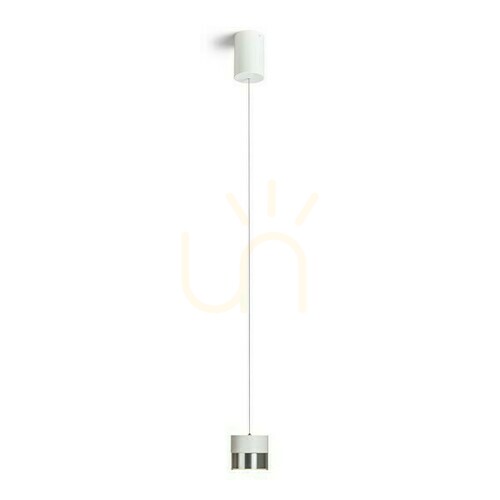
- Single pendant – one shade on a cord or cable. The most universal form: over a small table, in the kitchen, beside the bed.
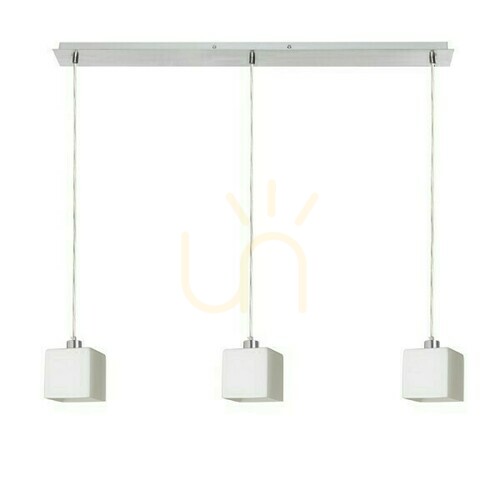
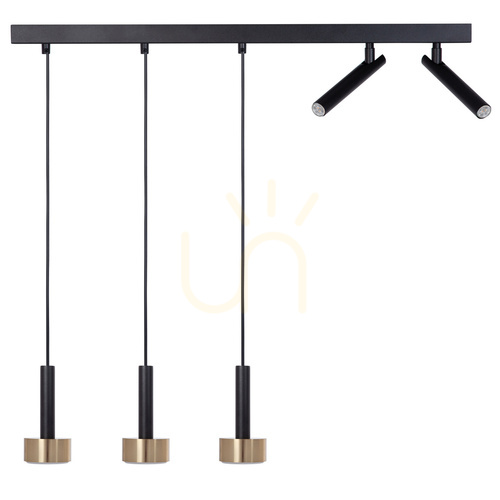
- 3-light pendant – three shades sharing one ceiling plate (round or a bar). A single ceiling connection, yet the effect of three separate lamps – the simplest way to light a longer table or worktop.
- Cluster pendant – several independent fittings hung side by side, often at different heights. It offers the most creative freedom but requires planning the power points.
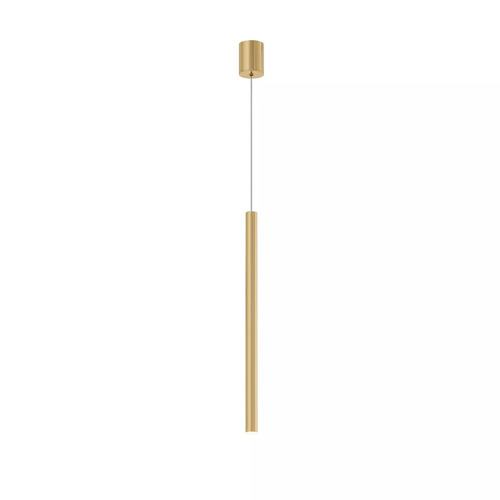
- Linear fitting – an elongated profile (usually LED) running along a table or kitchen island. It shines evenly across its whole length.
- Track pendant – a pendant with an adapter that clicks into a track instead of a canopy. You can add, remove and slide it along the track without drilling into the ceiling; just check the maximum load of the track and the adapter. Browse the range in the Hanging Track Lights category.


Where in the home does a pendant light work best?
- Dining room – the classic. A pendant light over the table should have the bottom edge of the shade 60–80 cm above the tabletop; the detailed rules for height and diameter are covered in our guide to the pendant light over the dining table.
- Kitchen – a row of 2–3 smaller pendants over the island or breakfast bar lights the worktop and marks out the zone. Shades directed downwards put the light exactly where you chop and cook.
- Living room – a large decorative shade over the coffee table or in the corner of the seating area. Mind the walkways: wherever people pass, the bottom edge of the lamp should hang at least 200–210 cm above the floor.
- Bedroom – pendants on both sides of the bed instead of table lamps free up space on the nightstands. They can hang low, about 40–60 cm above the nightstand, because nobody walks underneath them.
- Hallway and staircase – tall, open spaces are the natural home of long pendants; above the stairs a lamp can drop deep down, as long as it stays clear of the tread line and leaves min. 200 cm of headroom along the walking path.
Cluster pendants over the table and the 3-light pendant
Over a long table a single shade leaves the ends of the tabletop in the dark – which is exactly where multi-point pendants earn their keep. Proven layouts:
- Table up to 140 cm – one lamp hung centrally is enough.
- Table 140–200 cm – two identical fittings or a 3-light pendant on a shared bar.
- Table over 200 cm – three pendants spaced 60–80 cm apart, or a linear fitting.
A pendant cluster over a round table looks best as a composition of three shades at different heights, hung within the outline of the tabletop. One rule applies to every configuration: the gaps between the shades must be equal, and the outer fittings should not reach beyond the tabletop.
The practical difference: a 3-light pendant on a single ceiling plate takes up one power point and hangs “ready” straight out of the box, while a group of separate pendants needs either several ceiling outlets or hooks and a decorative run of the cords.



Adjustable pendant light – how to get the height right?
An adjustable pendant light lets you change the drop length – and it is a feature worth checking before the purchase, not after unpacking:
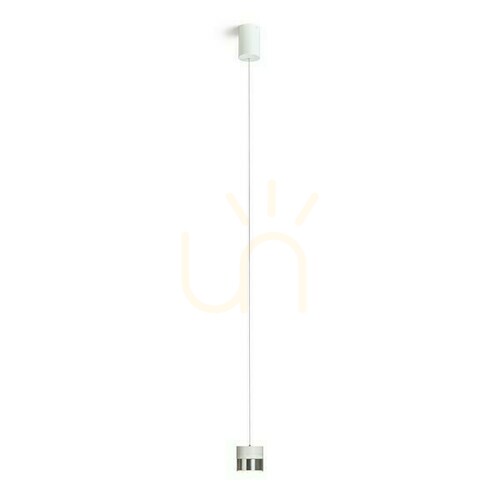
- Cable adjustment – the most common: the cable is shortened inside the canopy or at the shade fitting. The range can be generous (even 100–200 cm) and the excess hides in the ceiling plate.
- Cord adjustment – the excess cord is shortened or pinned up; in loft designs it often becomes part of the decoration.
- Chain – the chandelier classic: the drop is shortened by removing links.
The two numbers you need to know before buying are the maximum and minimum suspension length. With a 250 cm ceiling, a lamp with a short adjustment range can hang too low over a walkway; at 300 cm and above – comically high. An adjustable pendant solves both problems with one lamp, and over a table it lets you bring the light down to exactly 60–80 cm above the top.





Installation: canopy, hook and sloped ceilings
A pendant light is normally mounted through a canopy – the cover that hides the terminal block and the fixing. A few situations call for a plan B, though:
- A heavy lamp – glass shades and large chandeliers can weigh a dozen or more kilograms. That weight must hang on fixings matched to the ceiling structure (concrete, brick), and with a suspended ceiling – on dedicated plasterboard anchors with a specified load rating, or on a fixing that reaches the structural ceiling.
- Canopy on a sloped ceiling – in the attic a regular canopy sits away from the slanted surface. The solution is a canopy with a swivel joint (ball), which lets the cord hang vertically regardless of the slope angle, or hanging the lamp on a hook screwed into a structural element (e.g. a rafter) and running the cord to the ceiling outlet – with an insulated slope, take care not to damage the vapour barrier.
- The power point is in the wrong place – if the outlet does not fall over the centre of the table, use a ceiling hook and run the cord decoratively across the ceiling, or choose a lamp with an offset suspension. Moving the point by a metre is sometimes a matter of a hook and 20 minutes of work – no chiselling. Any work at the outlet itself must always start with switching off the circuit.
Once the lamp is up, check one more thing: whether the shade can be taken off for cleaning without dismantling the whole construction. Shapes open at the top collect dust faster than intuition suggests.
Bathroom pendant light – what does IP44 mean?
A pendant in the bathroom looks spectacular, but hard rules apply here. The IP44 code means protection against solid objects larger than 1 mm and against water splashes from any direction – and that is precisely the minimum for a pendant light in the bathroom.
Where such a lamp may hang is decided by the zones:
- Zone 1 (above the bathtub or shower tray, up to 225 cm from the floor) – the standard requires at least IPX4, and where water jets can occur, IPX5. In practice the safest choice here is a sealed fitting (IP65) – a pendant directly over the bathtub is almost always a bad idea.
- Zone 2 (a 60 cm band around the bathtub and shower, up to 225 cm) – minimum IP44.
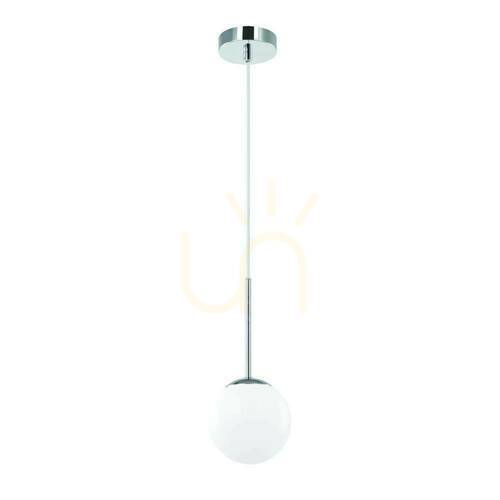
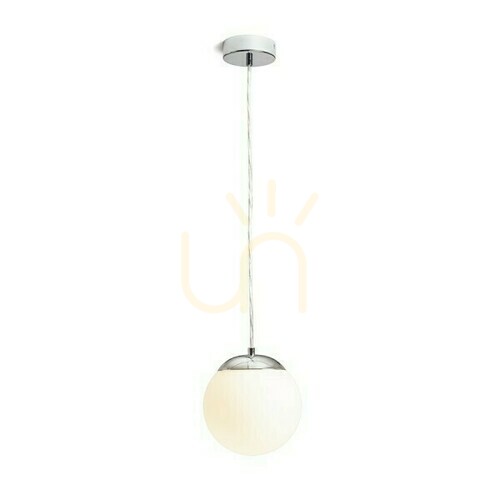
- Outside the zones – over the washbasin, by the mirror or in the middle of the bathroom an IP44 bathroom pendant light feels right at home: splashes cannot harm it and humidity will not shorten its life.
In practice: hang the pendant by the mirror or in the “dry” part, and leave zone 1 to sealed ceiling and recessed fittings. Regardless of the IP rating, bathroom circuits should be protected by a 30 mA residual current device (RCD). You will find the full range of fittings for humid interiors in the Bathroom lighting category.





Materials and styles
The shade material decides both the character of the lamp and the character of its light:
- Glass – from milky spheres to smoked goblets; it lets light through to the sides, so it illuminates rather than merely decorates. You will find an overview of the forms in our post on glass lamps.
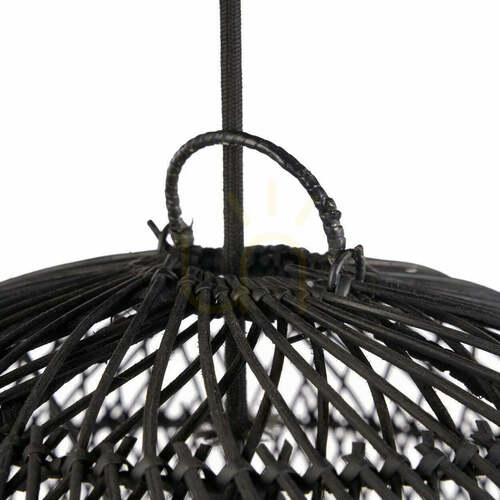
- Rattan, wicker and seagrass – woven boho shades draw soft shadows on the walls; they are light, so easy to mount even on a hook.
- Metal – domes and reflectors in loft and industrial style; directional light, ideal over a worktop.
- Fabric – lampshades visually soften the interior and give a gentle, diffused light – a natural pick for the bedroom.
Bulb, colour temperature and light output
- Socket – lamps with an E27 or E14 socket let you choose the bulb yourself: colour, output and dimmability. A built-in LED module can be more efficient, but it ties you to one colour for years.
- Colour – for relaxation zones and the dining room 2700–3000 K (warm white); leave the cooler tones to worktops. How to read the kelvins on the packaging is explained in our post on light colour.
- Output – over a table aim for a total of roughly 300–500 lm per metre of tabletop length; in the living room mood matters more than lux.
- Dimmer – the same lamp will handle dinner and cleaning, provided the light source is dimmable and the dimmer is LED-compatible.
FAQ: the most common questions about pendant lights
At what height should a pendant light hang over the table? The bottom edge of the shade 60–80 cm above the tabletop – lower for shades closed at the bottom, higher for an exposed light source.
How many pendants over a 200 cm table? Two identical fittings or a 3-light pendant on a bar; over longer tables – three pendants spaced 60–80 cm apart.
Is an IP44 pendant light enough for the bathroom? Yes, outside zone 1: IP44 is the minimum for zone 2, the 60 cm band around the bathtub and shower. Directly over the bathtub choose a sealed fitting instead of a pendant.
What does an adjustable pendant light give you? One lamp handles different situations: over a table you lower the shade to 60–80 cm above the top, and over a walkway you raise it above 200–210 cm.
Summary
A good pendant light comes down to three decisions: form (a single pendant, a 3-light pendant or a cluster), height (60–80 cm above the table, 200–210 cm above walkways, 40–60 cm above the nightstand) and mounting spot (canopy, hook, slope, and in the bathroom the zones and IP44). An adjustable suspension forgives measurement mistakes, and a replaceable bulb – changes of arrangement. The rest is a matter of style: a few thousand candidates await in the Pendant Lights category.
Przemysław Doliński


Maybe you will be interested in products from these categories?
Pendant Lights, Hanging Track Lights
Tags & Blog Categories