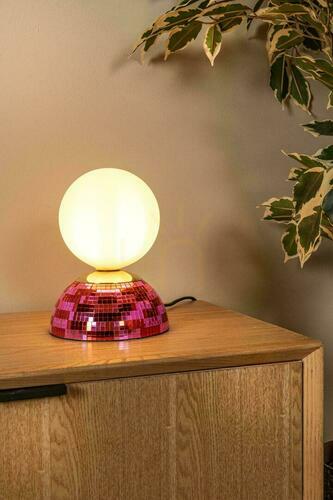
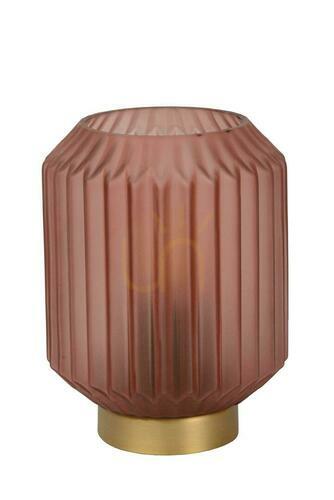
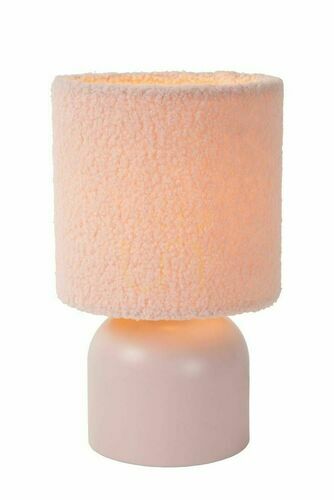
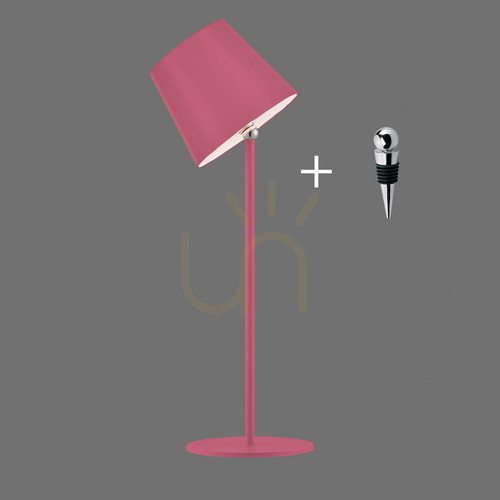
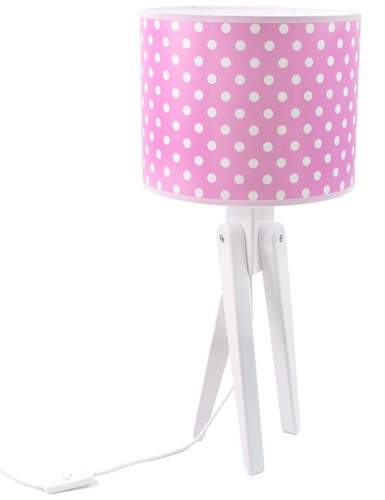
A pink bedside lamp is a small table lamp or night light for the bedside table, chosen as much for how it looks in daylight as for the warm, low light it gives at night. Pink changes more than the décor: a translucent pink shade tints the light itself a soft rose, while a pink ceramic or painted-metal base leaves the light white and keeps the colour for the daytime.
Blush, dusty pink or hot pink: matching the shade to the room
Most bedrooms take pink best in its quieter forms. Blush and dusty pink sit comfortably with grey, oatmeal linen, white bedding and pale oak, and they read as grown-up rather than girly. Hot pink and fuchsia are statement colours that suit a teenager's room or a bold, maximalist scheme. Pink paired with brass or gold – a velvet shade on a slim metal stem, or a fluted glass body with a gilt collar – gives a more luxurious, boutique-hotel look.
Vintage styles are common in pink too: pleated fabric shades, scalloped edges, opaline glass, mushroom-shaped glass lamps and ceramic ginger-jar bases. For a nursery, the same colour turns up in soft silicone or plastic night lights shaped like clouds or animals, often battery powered so they can travel from cot to changing table.
Getting the size right
A common rule of thumb: when you sit up against the headboard, the bottom of the shade should be roughly at chin height, so the bulb lights your book without shining in your eyes. That means the right lamp height depends on your bedside table.
| Setting |
Typical lamp height |
Shade and light |
Brightness |
Colour temperature |
| Low bedside table beside a tall bed |
50–65 cm |
tall drum or empire shade, pale lining |
300–450 lm |
2700 K |
| Standard bedside table |
40–55 cm |
fabric or opal glass, E14 or E27 bulb |
300–450 lm |
2700 K |
| Narrow shelf or floating bedside |
25–35 cm |
compact mushroom or globe lamp |
200–300 lm |
2700 K |
| Nursery or child's room at night |
10–30 cm |
silicone or plastic night light, often dimmable |
a few to a few dozen lumens |
2200–2700 K |
Keep the light warm. Under cool white of 4000 K or more, pink turns chalky and slightly lilac. An LED with a colour rendering index of Ra 90 or above keeps pinks, wood and skin tones looking natural.
Pink lamps for nurseries and children's rooms
For babies and toddlers, a night light should be dim, warm and out of reach, or so stable that it cannot be pulled over by the flex. Cool-running LEDs are the sensible choice. Older children appreciate a big, easy switch they can find in the dark, and a lamp that is bright enough for a bedtime story but can be dimmed afterwards.
Plugs, wiring and care
- Check the plug. UK sockets take a fused three-pin plug, normally with a 3 A fuse for a lamp. A lamp with a European two-pin plug should be fitted with a UK plug or a fused conversion plug, not run from a travel adaptor.
- A hard-wired wall light beside the bed is fixed wiring and must comply with BS 7671, so have it installed by a qualified electrician.
- Never exceed the maximum wattage on the lamp label, particularly under fabric shades. LED bulbs barely warm up and leave plenty of margin.
- Pale fabrics and plastics fade in direct sun, and white plastic may yellow over time. Dust fabric shades with a soft brush or a vacuum upholstery tool; wipe glass and ceramic with a damp cloth when the lamp is off.
Frequently asked questions
What colour should my bedside lamp be?
Pick the colour for the room in daylight and the light for the night. A pink base with a white or ivory shade gives you the colour without tinting the light. A pink fabric shade gives a rosy glow but less reading light, so choose a slightly brighter bulb.
What is the best night lamp for a bedroom?
One that can go very low: a dimmable lamp or a night light with warm light around 2200–2700 K. Bright, bluish light late in the evening makes it harder to fall asleep, so a lamp that dims to a glow does the job better than a bright one.
Does a pink lampshade make the light pink?
Yes, if the shade lets light through. Thin cotton, linen and tinted glass all cast a rosy tone. Lined or opaque shades direct light up and down instead, and the light that reaches the bed stays white.
How big should a large blush pink bedside lamp be?
Big lamps look best on a wide bedside table, with the shade no wider than the table top. As a guide, a lamp of 55–65 cm works on a table that is 60 cm or more across; on anything narrower, it will look top-heavy.
Which styles suit a vintage blush pink lamp?
Pleated or scalloped shades, opaline glass, brass details and ceramic bases with a gloss glaze all have a vintage feel. They sit well with walnut furniture, floral prints and antique-style bedding.
Can I leave a night light on all night in a nursery?
An LED night light designed for that purpose uses very little power and stays cool. Keep it dim and warm, and position it away from the cot so the light is not directly in the baby's eyes. A timer switch is useful once your child no longer needs it all night.
More on shapes, materials and shades beyond colour: bedside lamps. If the period look matters more than the colour, read about vintage bedside lamps.