A vintage bedside lamp borrows its shape, materials and glow from an earlier decade – a brass banker's lamp from the twenties, a fifties ceramic base with a tapered shade, a seventies mushroom in smoked glass. Next to the bed that matters for more than looks: the old designs were made for warm, low, shaded light, which is exactly what you want in the last half hour before sleep.
The trick is to keep the character without giving up the practical bits – a switch you can find in the dark, enough light to read by and a shade that will not dazzle whoever is sleeping next to you.
Antique, vintage or retro?
Shops and sellers use the three words loosely, but they do mean different things. Antique traditionally means a piece around a hundred years old or more. Vintage usually covers originals from roughly the twenties to the eighties. Retro is a new lamp designed to look like one of those. For a bedside table, a new retro piece comes with modern wiring; an original brings patina and a story, and usually a trip to an electrician first.
Eras that suit the bedroom
-
The twenties and thirties – Art Deco geometry, opal glass, chrome or brass, and the green-shaded banker's lamp that throws light straight down onto a book.
-
The fifties and sixties – turned wood, tripod legs, glazed ceramic bases in bold colours, cone and drum shades.
-
The seventies – mushroom lamps, smoked or amber glass, chrome, orange and brown. Lovely mood light, less so for reading.
-
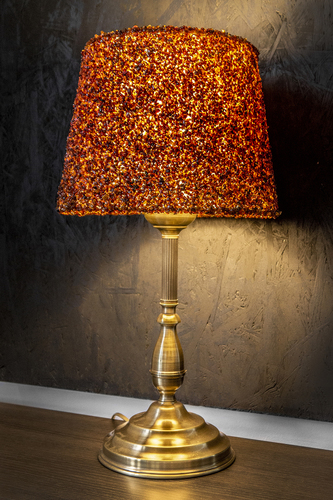
Traditional English – urn-shaped ceramic or brass bases with pleated fabric shades, a natural fit for period houses.
-
Tiffany style – stained-glass shades; more decorative glow than reading light.
Choosing the right one
| What to check |
Typical range |
Why it matters |
| Lamp height |
40–60 cm |
The bottom of the shade should sit at about chin height when you sit up against the headboard. |
| Shade width |
20–35 cm |
Keep it within the edges of the bedside table so it does not get knocked. |
| Bulb cap |
E27 or E14 screw |
Many UK homes stock B22 bayonet bulbs; continental lamps usually take screw caps, so buy the right fitting. |
| Colour temperature |
1800–2700 K |
Amber filament bulbs sit at the very warm end; clear ones around 2700 K. |
| Brightness for reading |
about 400 lm or more |
150–250 lm is plenty if the lamp is only for atmosphere. |
| Switch |
in-line cord switch or touch base |
A twist switch under the shade is authentic but awkward at 3 a.m. |
The shade decides where the light goes. Opaque metal or lined fabric pushes it down onto the bed; opal glass and pale linen spread a soft glow across the room; clear glass shows the bulb, so pair it with an amber or frosted filament bulb.
Filament bulbs and that old-fashioned glow
LED filament bulbs give the look of an Edison lamp while drawing only around 4–7 W, and they stay far cooler than the incandescent bulbs these lamps were designed for – useful under an older fabric or paper shade. Amber glass gives a beautiful candle-like tone but cuts the output noticeably, so a regular reader should choose a brighter version or clear glass under a closed shade. If the lamp has a dimmer, the bulb must be marked dimmable or it will flicker.
Buying an original: safety first
A lamp from the sixties often still has its original flex. Old rubber or early PVC insulation turns brittle, lampholders scorch, and metal bodies may have no earth. Have a second-hand lamp checked by a qualified electrician – a PAT test, and rewiring with new flex, lampholder and a fused three-pin plug if needed – before it goes beside the bed. Bedside lamps are made for dry rooms only, so keep them out of the bathroom.
Looking after it
Unplug the lamp and let the bulb cool before cleaning. Wipe lacquered brass with a dry, soft cloth; polish would strip the lacquer. Unlacquered brass can be polished bright or left to darken naturally. Dust fabric shades with a soft brush or lint roller, and wash glass shades in warm soapy water, drying them fully before refitting.
Frequently asked questions
How can you identify an antique lamp?
Look at the construction rather than the style. Signs of age include a maker's stamp on the base, wear that matches how the lamp was handled, and old flex or lampholders. A magnet helps too: it will not stick to solid brass but will stick to brass-plated steel, and cast spelter feels lighter than bronze.
What lamps were popular in the seventies?
Mushroom-shaped table lamps, smoked and amber glass, chrome globes, and ceramic bases in orange, brown and mustard. Many of those shapes are made again today as retro designs.
What did lamps look like in the twenties?
The decade belongs to Art Deco: stepped and geometric bases, opal or frosted glass, chrome and brass, and the banker's lamp with its green glass shade.
Will a vintage lamp take a UK bayonet bulb?
Only if it has a B22 lampholder. Lamps made for continental Europe usually take E27 or E14 screw bulbs, so check the fitting before buying spares.
Are filament bulbs bright enough to read by?
Yes, if you choose one of about 400 lumens or more. Amber glass looks lovely but gives off noticeably less light than clear.
Should both bedside lamps match?
A matching pair looks calm and symmetrical, but a mixed pair works well when the heights and colour temperature are the same.
For bedside lighting in other styles, start with bedside lamps, and for the bulbs that create the warm, old-fashioned glow, see vintage light bulbs.