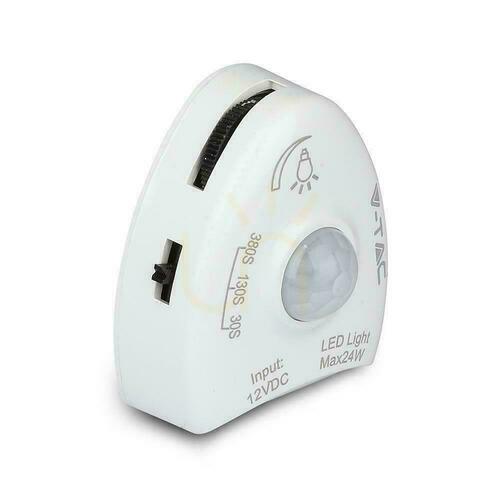
A motion sensor night light switches on by itself when you get up in the night or step onto a dark landing, then goes off again once you have passed and nothing has moved for half a minute or so. It turns the small lamp you would otherwise leave glowing all night, or fumble for in the dark, into a guide light that only works when someone is actually on the move. No groping for the switch, no harsh ceiling light waking the rest of the house.
Night light versus motion sensor night light
An ordinary night light is either on or off. Add a sensor and it becomes hands-free lighting for the route you take at 3 a.m.: bed to bathroom, the landing, the top of the stairs, a child's room you check on. The idea turns up in several forms:
-
plug-in night lights that sit straight in a wall socket and never need batteries;
-
battery units that stick on with an adhesive pad, a magnet or a couple of screws, wherever there is no socket;
-
rechargeable lights that top up over USB, often lifting off a magnetic base to double as a torch;
- less common variants such as LED strips under the bed frame and small bedside lamps with a sensor mode.
Almost all of them pair the motion sensor with a light sensor, which is why they stay dark during the day even when people walk past.
Choosing one: the figures that matter
| Feature |
Typical figure |
What it means at home |
| Detection range |
2–5 m |
About 3 m covers a landing or bedroom |
| Detection angle |
90–120° |
Wider angles pick you up as you pass, not only head-on |
| On-time |
20–60 s, often around 30 s |
Adjustable timers help on long stairs |
| Brightness |
5–50 lm, brighter units 100–200 lm |
A dozen or so lumens is enough to find your way |
| Colour temperature |
1500–3000 K |
Warm light is less jarring than cool 6500 K |
| Power |
Mains plug, 3–4 AAA/AA cells or USB battery |
Decides where it can go and how much upkeep it needs |
For a plug-in model, check that the plug suits a standard UK BS 1363 socket and that the body will not block the neighbouring outlet on a double socket. Battery and rechargeable units are the easier choice in a bathroom, where UK wiring rules keep sockets well away from water; pick one with a splash rating such as IP44 there.
Brightness and colour depend on where the light lives. On the route to the bathroom, in a bedroom or a nursery, a dim, warm glow is kinder: it shows the floor without waking you up fully, and it does not dazzle eyes that have adjusted to the dark. Inside a wardrobe, an airing cupboard or the cupboard under the stairs, a brighter, more neutral white makes it easier to tell navy from black. Remember that tiles and mirrors bounce light around, so the same unit looks noticeably brighter in a bathroom than on a carpeted landing.
Where to put it
A PIR sensor reacts to body heat moving across its detection zones, so it notices someone walking across its view faster than someone walking straight at it. In a hallway, fix the light to one side of your path rather than at the far end. On a staircase, roughly a third of the way up works well, lighting both the top and the bottom. Mounting low, just above the skirting board, keeps the glare out of sleepy eyes and puts the light where it is needed: on the floor, the treads and that rug edge you always catch.
That low, automatic light is also why carers often suggest these for elderly parents. Many falls happen on the night-time trip to the loo, and a light that comes on without anyone reaching for a switch takes one risk off the list. Before peeling off an adhesive backing, test the spot in full darkness; ranges look different at night.
Frequently asked questions
Is there a motion sensor light that only works at night?
Yes, that is what the built-in light (dusk) sensor does. It keeps the motion sensor disarmed until the room is dark, so the light ignores movement in daylight.
Do motion sensor lights work at night in complete darkness?
They do. A PIR sensor detects infrared heat rather than visible light, so darkness makes no difference to it. Glass does, though: it cannot see through a window or a glass door.
What are the disadvantages of motion sensor lights?
False triggers from pets, radiators or warm air from a vent, and missed triggers when the range or angle does not suit the room. Sit still for long enough and the light will time out on you.
Plug-in or rechargeable?
Plug-in if there is a socket exactly where you want the light, as it never needs attention. A rechargeable unit goes anywhere, but expect to charge it every few weeks to three months depending on use.
Which motion sensor night light suits stairs?
One with a wide detection angle and an adjustable on-time, mounted low on the wall partway up. A long flight may need two, one near each end.
How much electricity does a plug-in one use?
Very little. On standby it draws a fraction of a watt and usually under 1 W while lit, which adds up to a few kilowatt-hours a year at most.
Why does it come on during the day or stay off at night?
Usually the light sensor is misreading the room: sunlight on the unit or light spilling in from another room. Move it, and wipe the lens with a dry cloth now and then, as dust dulls the sensor. Check batteries every six months or so.
Prefer a lamp you switch yourself? Read more under bedside lamps. If a socket is right where you need it, plug-in night lights are the topic to compare next.