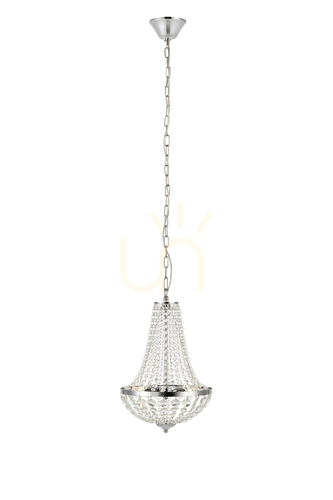
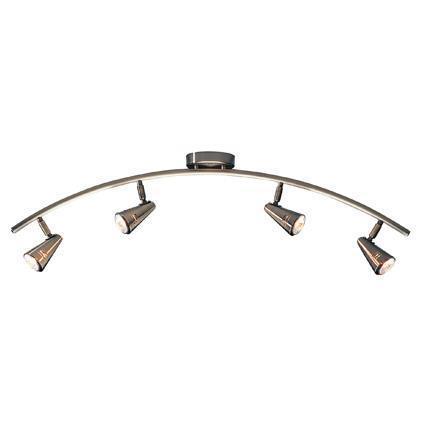
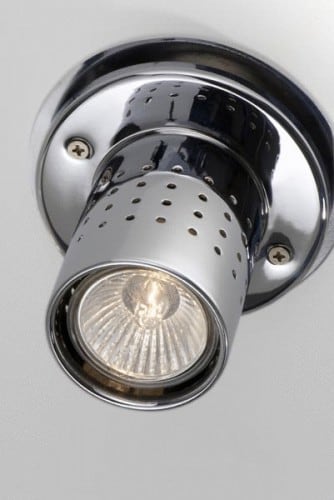
A halogen ceiling light is a fitting built around halogen bulb caps – typically GU10 or MR16 downlights and spotlights, or a flush or semi-flush fitting dressed with small G9 capsules. On a ceiling light, the halogen label tells you more about the lampholder and the supply voltage than about the light you will actually get, because almost all of these fittings now run happily on LED bulbs with the same cap. Keep the fitting, change the bulb, and it carries on for years.
That matters if you are buying a fitting with a particular look, or if you have moved into a house where every room has a grid of old spotlights and you are wondering whether they all have to come down. Usually they don’t.
Are halogen lights being discontinued?
The bulbs, largely yes. Ecodesign rules in Great Britain and the EU took most halogen lamps off the market in stages, mainly because they turn most of their energy into heat rather than light. Shops were allowed to sell remaining stock, and nobody has to remove halogen bulbs already in use. The fittings themselves were never banned. What has changed is what goes inside them: a GU10 LED instead of a GU10 halogen, an LED G9 capsule instead of a halogen one.
Which halogen fitting do you have?
Before buying a replacement bulb, or a new fitting to match others in the room, work out which family it belongs to:
| Fitting |
Usual cap |
Supply |
Check before switching to LED |
| Recessed downlight, fixed or tilting |
GU10 or MR16 (GU5.3) |
230 V or 12 V |
pull the bulb: two thick twist-lock pins mean GU10; two thin push-in pins mean MR16 and a transformer somewhere |
| Spotlight bar or plate |
GU10 |
230 V |
head size and whether the beam angle suits the room |
| Flush or semi-flush with glass or crystal |
G9 capsule |
230 V |
LED G9 bulbs are often longer and wider than halogen ones |
| Small low-voltage fitting |
G4 capsule |
12 V |
transformer compatibility and space inside the shade |
| Large accent downlight |
AR111 / ES111 |
12 V or 230 V |
depth of the ceiling void |
For a similar look to halogen, choose warm white at 2700–3000 K with a CRI of 90 or more. Judge brightness by lumens, not watts: a 50 W halogen GU10 is matched by an LED of roughly 5–7 W giving around 350–550 lm, and a 35 W one by about 4–5 W.
Swapping halogen for LED without the flicker
On mains voltage, GU10 and G9 bulbs are a straight swap. MR16 is where most problems start. Older transformers were sized for 20–50 W halogen lamps and often need a minimum load to work properly; a run of 4 W LEDs may sit below it, and the result is flicker, buzzing or bulbs that cut out. An LED driver matched to the total wattage solves it. Dimmers cause the other half of the complaints: halogen will dim on almost any dimmer switch, while LEDs need dimmable bulbs and an LED-rated dimmer, usually trailing-edge, with a low enough minimum load.
If you are fitting new downlights rather than changing bulbs, think about the ceiling too. A typical UK ceiling of around 2.4 m with 36–40° beams works with lights about 1–1.2 m apart and half that from the walls. Where the ceiling has to act as a fire barrier, such as below another flat or under the floor of a loft conversion, electricians fit fire-rated downlights. In England and Wales, Part P of the Building Regulations covers electrical work in homes, and new circuits or work near a bath or shower are generally notifiable, so use a registered electrician.
Bathrooms, heat and day-to-day care
Under BS 7671, zone 1 above a bath or shower needs at least IPX4, and many electricians choose IP65 there as a matter of course. Halogen capsules run hot: keep loft insulation clear of the fitting unless it is designed to be covered, and never handle a G9 or G4 capsule with bare fingers, as skin oil creates a hot spot on the glass. Clean glass and reflectors with a dry cloth once the light has cooled.
Frequently asked questions
Which light is better, LED or halogen?
For running costs and lifespan, LED wins easily: it uses roughly a fifth of the energy for the same output and lasts many times longer. Halogen still has the edge in natural colour rendering, which a good LED with CRI 90+ comes close to.
What are the disadvantages of using halogen lights?
High running cost, a lot of heat, a lifespan of only around 2000 hours and fragile capsules. A ceiling with ten 50 W halogen spots draws half a kilowatt every time it is switched on.
Why were halogen lights banned?
To cut energy use and carbon emissions. Halogen lamps waste most of their power as heat, and efficient LED replacements now exist for nearly every cap.
Are halogen bulbs safe?
Yes, used correctly. Keep them away from fabrics and insulation, let them cool before touching, and replace any capsule with a cracked or blackened envelope.
How do I replace a halogen ceiling light bulb?
Switch off and let the bulb cool. GU10s twist out anticlockwise; MR16s pull straight out, often after removing a retaining clip; G9 capsules ease out of their socket. Fit an LED with the same cap and check the transformer or dimmer if it misbehaves.
How do I dispose of halogen bulbs?
Halogen bulbs can generally go in general household waste, wrapped if broken. LED bulbs count as electrical waste and belong at a household recycling centre or a retailer collection point.
More on ceiling lighting in general: ceiling lights. If your spotlights run the length of a long, narrow space, read on about hallway ceiling lights.