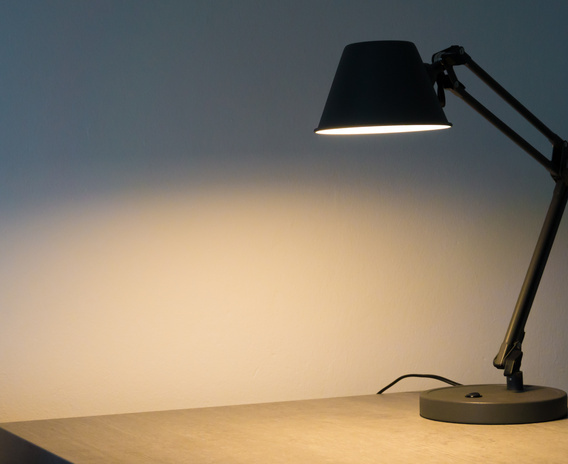
A rechargeable desk lamp runs from a built-in lithium battery, so it gives proper task light wherever the desk happens to be, with no socket or trailing flex nearby. The trade-off against a mains desk lamp is simple: you gain freedom of placement and a tidy desk, and you accept a finite runtime and, usually, a little less light.
When a cordless desk lamp makes sense
It earns its keep in places where a cable is awkward or impossible. Think of a desk floated in the middle of a room, a child's homework corner where a lead across the floor is a trip hazard, a rented flat where you cannot add sockets, student halls with one double socket for everything, or a garden office that was never wired for lighting. It also keeps you working through a power cut.
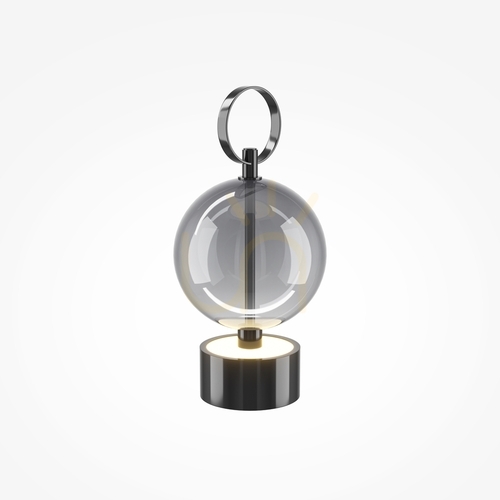
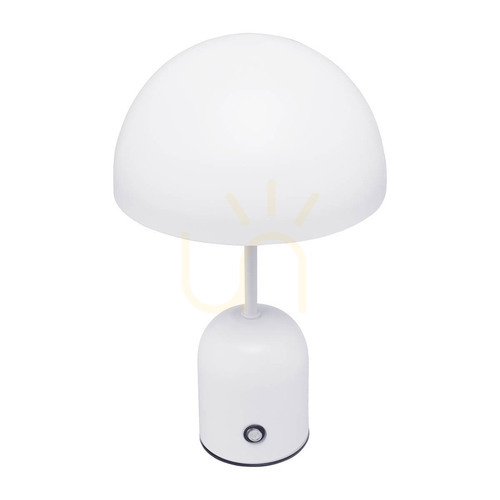
A desk lamp is a different animal from the decorative cordless lamps you see on dining tables. Those give 30–100 lumens of warm, cosy light. For reading and writing you want light aimed at the page through a tilting head or arm, roughly 4000 K, and several times the output, which is exactly what drains a battery fastest.
What to look for
Battery capacity in mAh only means something next to the power of the LEDs. A 2000 mAh cell at 3.7 V holds about 7.4 Wh. Run a 4 W lamp flat out and that lasts a little under two hours; at 1 W it covers several evenings of reading. So when a box promises ‘up to 40 hours’, check which brightness that refers to. It is almost always the lowest setting.
| Feature |
Typical range |
What suits a desk |
| Light output |
80–300 lm, stronger models around 400 lm |
250 lm or more for homework and paperwork |
| Battery |
1200–4000 mAh lithium-ion, 3.7 V |
2000 mAh as a sensible minimum for daily use |
| Runtime |
2–6 h at full power, 20–60 h dimmed |
compare at the brightness you will actually use |
| Charging |
USB-C or micro-USB, 5 V, 2–5 h |
USB-C shares a cable with your phone |
| Colour temperature |
3000–6500 K, often three steps |
4000 K for work, 3000 K for evenings |
| Colour rendering |
CRI above 80, better lamps 90 |
CRI 90 for drawing, sewing and craft |
Beyond the numbers, look for a touch dimmer, a memory that brings the lamp back at your last setting, and the ability to stay lit while plugged in. That last one matters more than it sounds: when the battery dies mid-essay, you plug in and carry on.
Some lamps run on AA or AAA batteries instead. They cost less to buy and suit occasional use, say a back-up light kept in a drawer for power cuts, but daily use gets through cells quickly. Rechargeable NiMH cells give 1.2 V rather than 1.5 V, so certain lamps glow a touch dimmer on them.
Setting it up on the desk
Place the lamp on the side opposite your writing hand, so on the left if you are right-handed, and your hand will not cast a shadow over the page. Aim the head at the work, not your eyes; the bottom edge of the shade should sit below eye level, with the head roughly 35–45 cm above the desk. Battery lamps tend to be light and easy to knock over, so for children a heavy base or a clamp on the desk edge is the safer choice. Keep some background light on in the room too, as a bright page in a dark room tires the eyes faster.
Looking after the battery
A lithium-ion cell typically manages 300–500 full charge cycles before it drops to around 80% of its capacity. Heat and long spells sitting completely flat are what age it fastest. Keep the lamp off a sunny windowsill, and if it is going in a cupboard for the summer holidays, leave it about half charged and top it up every few months. Charge it on a hard surface rather than on a bed or sofa. Take disposable batteries out of a lamp you are storing, because old alkalines can leak and corrode the contacts. Spent batteries go in a shop collection bin or to your local recycling centre, never in the household bin.
Frequently asked questions
Are rechargeable lamps worth buying?
For a desk without a nearby socket, yes. Charging costs next to nothing, there are no disposable batteries to replace, and the lamp moves with you. If you work long days in one spot next to a socket, a mains lamp gives more light for less fuss.
What makes a good rechargeable desk lamp?
Enough light for real work (250 lm or more), an adjustable head, neutral white around 4000 K, CRI above 80, USB-C charging and a runtime quoted at a useful brightness rather than only the dimmest setting. Flicker-free dimming is worth checking too.
How long does a rechargeable desk lamp last on one charge?
Usually 2–6 hours at full brightness and anything up to several dozen hours dimmed. For an evening of homework at mid brightness, expect to recharge every day or two; a larger battery stretches that further.
Can I use a USB rechargeable desk lamp while it charges?
Many allow it, though not all. Some switch off while charging to protect the cell, so check the specification if you sometimes want to run it from the cable.
Are battery desk lamps safe for children?
Look for CE or UKCA marking and a battery protection circuit, use the supplied cable with a standard 5 V USB charger, and choose a stable base. Retire any lamp whose casing swells or cracks.
For more light over long working days, read about mains-powered desk lamps. If what you are after is soft mood light for a dining table or a windowsill, the guide to cordless table lamps covers it.