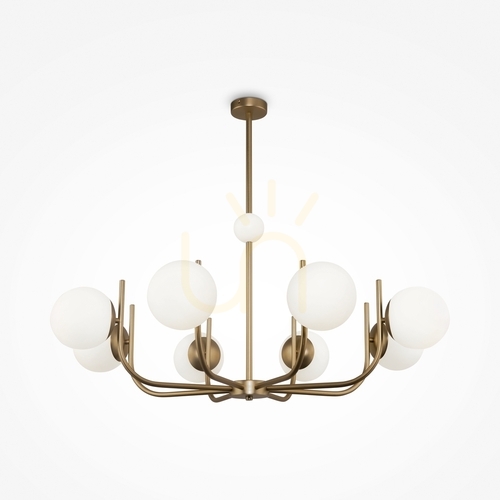
In a dining room the pendant decides whether the table reads as a place to sit down or as furniture in the middle of the floor. Hang it too high and the room goes flat; too low and you spend the meal looking round it at the person opposite. Nearly everything worth knowing follows from one measurement.
The height above the tabletop
Between 75 and 90 cm from the bottom of the shade to the tabletop, and most people land at 75 to 80. With a standard 75 cm table that puts the lower edge at roughly 1.50 to 1.55 m off the floor: high enough to see across, low enough that the light stays on the table instead of leaking into the whole room. Two things shift the number. Every extra 30 cm of ceiling height above 2.4 m is worth about 7 cm more drop, or the fitting looks stranded. And a wide shade open underneath can sit slightly higher, because it already spreads its light over a bigger area.
A dining pendant is the one light in the house nobody walks under, which is why it is allowed to hang this low. Check the drop the fitting actually offers: a rod suspension gives you one height plus a couple of removable sections, while cable or chain can be shortened to almost anything.
Diameter against the width of the table
A single shade wants to be roughly a half to two-thirds of the table's width. The sanity check that matters more: leave at least 15 cm of bare tabletop on each side beyond the edge of the shade, or people sitting along the sides end up reaching under it. On a 90 cm round table that means a shade of about 45 to 60 cm. On a 100 cm wide rectangular table, 50 to 65 cm.
Undersizing is the commoner mistake. A 25 cm shade over a six-seat table lights a plate and a half and leaves the rest in shadow — the exact look people are trying to escape when they take down a flush ceiling fitting.
One pendant, a row, or a cluster
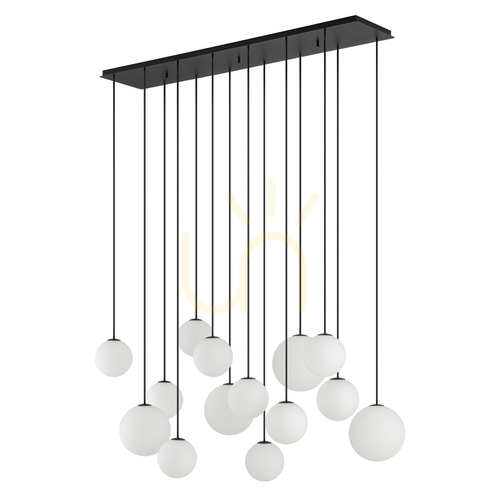
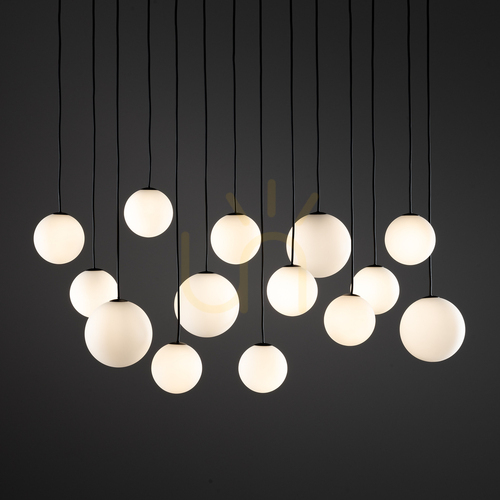
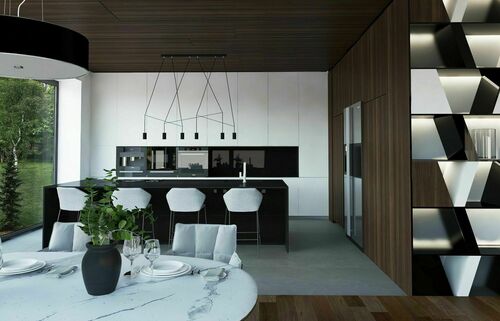
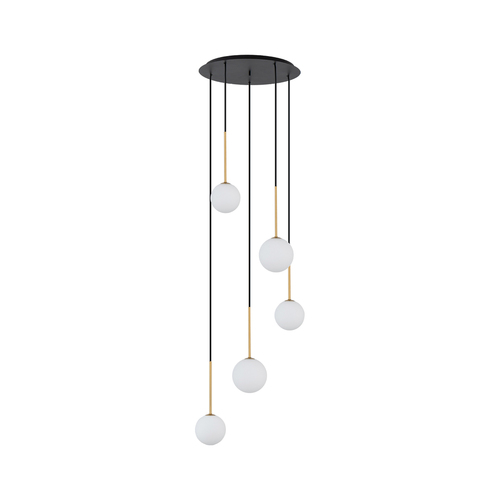
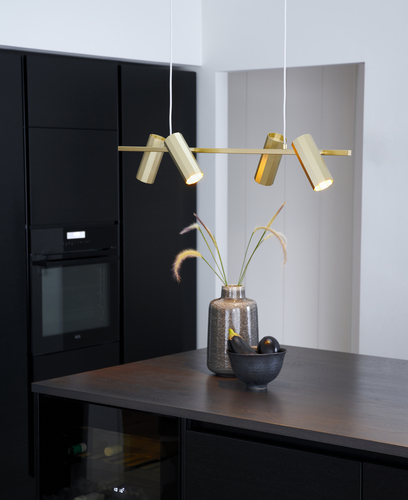
Up to about 140 cm of table, one fitting is enough. Beyond that a single shade cannot reach the ends, and you have two options. Reckon on one pendant per 60 to 75 cm of table length: a row of two or three smaller shades, spaced 60 to 90 cm centre to centre with about 15 cm clear at each end, lights the whole length evenly. A cluster — several drops at staggered heights from one canopy — is denser and more sculptural but concentrates the light in the middle, so it suits a square or round table better than a long one.
Light that lands on the food
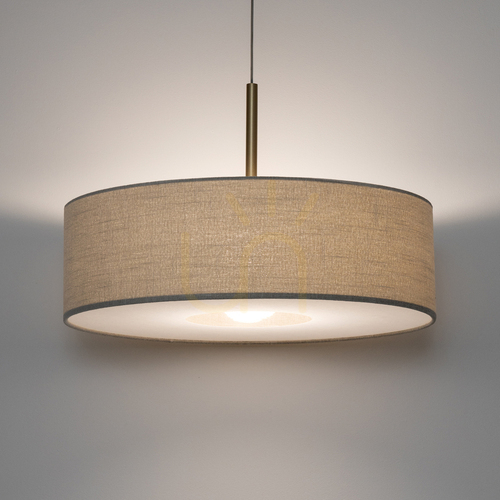
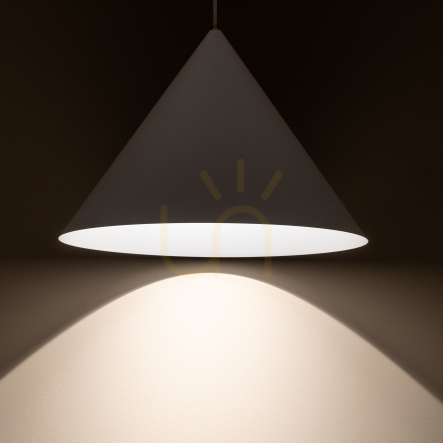
A dining pendant should push its light downward, and an open-bottomed shade with a matt white or opal interior does that well. The catch is glare: seated eye height is around 1.20 m and the bottom of the shade sits at about 1.50 m, so a bare bulb inside an open shade is barely out of the sightline of anyone leaning back. A diffuser across the bottom, or an opal rather than clear bulb, removes it.
Colour rendering is the other half. CRI 80 is the floor and Ra 90 or better is what you want — food, wine and skin all look duller under a low-CRI source, and the dining table is where that shows up most. Warm white at 2700 K is the convention for evening meals; 3000 K reads a little crisper if the room doubles as a workspace.
Round, rectangular and extending tables
A round table has a natural centre, so a single round or dome shade almost always works. A rectangular table has a long axis, which is what pushes people towards a row or a linear bar fitting. An extending table is the awkward one: the ceiling point only matches the table in one of its two configurations. Centre the light on the everyday size and accept that the extension leaf sits at the edge of the pool — or pick a fitting on a long cable that can be hooked across when the table grows.
Questions people ask
How high should a pendant hang over a dining table?
75 to 90 cm above the tabletop, most commonly 75 to 80 cm, which puts the bottom edge around 1.50 m above the floor with a standard-height table.
How wide should the shade be?
About a half to two-thirds of the table's width, and always narrow enough to leave 15 cm of clear tabletop on each side.
How many pendants over a long table?
One per 60 to 75 cm of table length — two above roughly 140 cm, three above 200 cm — spaced 60 to 90 cm apart with about 15 cm clear at each end.
Can the ceiling point be in the wrong place?
Frequently, and it is fixable without an electrician: a ceiling hook and a length of cable let you draw the pendant sideways to sit over the table, as long as the canopy stays at the original outlet.
Does a dining pendant need to be dimmable?
It is the single most useful option here. Full output while the table is being laid and cleared, and a low setting once people are eating, from one fitting.