Good garage lighting comes from more than one direction, and wall lights supply the side light that a ceiling batten can't: along the doors and sills of the car, over the workbench, on the tool wall and by the door into the house. A garage wall light also has a harder life than one in the living room, with dust, a wet car dripping on the floor, frost in an unheated space and the odd knock from a bike handlebar or a stepladder.
Why bother with wall fittings at all? A single ceiling light mostly lights the roof of the car. The wheels, the lower panels and the floor beside the doors sit in shadow, and an open up-and-over or sectional door covers the ceiling near the front of the garage, blocking any light mounted there. Lights on the long walls get round both problems.
Which wall lights work in a garage
-
Bulkhead lights: a sealed round or oval body with a gasket, often with a protective cage or eyelid. The classic choice where dust, damp and knocks are expected.
-
Wall-mounted LED battens: long and slim, throwing an even band of light down the side of a car or across a bench.
-
Adjustable spotlights: a head you can point at a vice, a shelf or a wheel arch.
-
Industrial cage lights: a wire guard over an E27 lamp. A good fit for a garage that doubles as a workshop, gym or motorbike den.
-
PIR wall lights: they switch on as you walk in with your hands full and off again on their own.
Choosing the right fitting
Four things decide it: protection against dust and water, light output, colour temperature and impact resistance. The values below are typical for a single garage of roughly 3 × 6 m with a ceiling around 2.4 m.
| What you do in the garage |
Light level |
Total output |
Colour temperature |
Protection |
| Park the car, store bikes |
around 75–100 lux |
2,000–3,000 lm |
3000–4000 K |
IP44 or higher |
| DIY, workbench, servicing |
300–500 lux at the bench |
6,000–10,000 lm |
4000–5000 K |
IP54–IP65, IK08+ |
| Detailing, paint and polish |
500 lux or more |
10,000 lm and up |
5000–6500 K, CRI 90+ |
IP65, IK10 |
A typical garage wall light gives somewhere between 800 and 2,000 lumens, so a workshop needs several points rather than one very bright one. IK08 means the housing withstands an impact of about 5 joules, IK10 about 20 joules. CRI (colour rendering) matters more than people expect: at CRI 80 a scratch is visible, at 90 and above you can see whether the touch-up paint actually matches.
Where to fit garage wall lights
On the side walls, mount them at roughly 1.8–2.2 m, above the roofline of the car and above an open door, so mirrors and doors don't clip them. Two lights per side, level with the front and rear wheels, cover a normal family car. Over a workbench, fit the light 60–90 cm above the worktop and slightly forward of where you stand, so your head doesn't shade your hands.
If the garage is integral and you go in and out through the house door, give that door its own light on its own switch. It can be warmer and plainer than the work lights. Two-way switching, one switch by the garage door and one by the house door, saves walking across a dark garage. Light-coloured walls bounce a surprising amount of light back, so a garage painted white or pale grey needs fewer fittings.
Fixed wiring is a job for a qualified electrician working to BS 7671. In England, adding a new circuit, for example to a detached garage, is notifiable under Part P of the Building Regulations, so ask for the certificate.
Cold, damp and other pitfalls
-
Cold starts: LEDs reach full brightness straight away in a frost, while fluorescent tubes struggle. Check the operating temperature on the label if the garage is unheated.
-
Condensation: a warm, wet car in a cold garage fills the air with moisture, which settles on cold surfaces. A sealed housing with a gasket keeps it out of the electrics.
-
Flicker: old tubes on 50 Hz mains can produce a stroboscopic effect, making a spinning blade look still. Near power tools, choose flicker-free LED.
-
Glass near the action: where timber, ladders and tyres get carried about, polycarbonate diffusers or a cage are the safer choice.
-
Dust: a dirty diffuser can lose a noticeable share of its light. Wipe it with a damp cloth with the power off, and only hose down a fitting rated IP65.
Garage lighting FAQ
What is the best type of lighting for a garage?
LED, in layers: one or two ceiling fittings for general light, wall lights for the sides of the car and the workbench, and a PIR light by the door. Neutral white around 4000 K suits most garages, cooler light suits detailing.
How do you attach lights to a garage wall?
On brick or block, use plugs and screws suited to the wall; on a timber frame, fix into the studs. The cable can run on the surface in conduit or trunking. Battery and plug-in wall lights need no electrician, but anything wired into the mains does.
How many lumens does a garage need?
For parking only, 2,000–3,000 lumens in total is usually plenty for a single garage. For a workshop, plan on 6,000–10,000 lumens shared between the ceiling and the walls, and roughly double that for a double garage.
Why do garages use hexagon lights?
Hexagon grids give a very even, shadow-free spread across the ceiling and look striking in a detailing bay. They are a ceiling system, though, and wall lights still help with the lower panels and the bench.
What are some good lights for outside a garage?
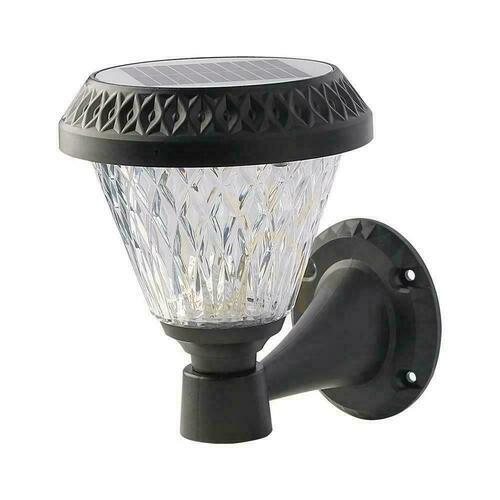
An outdoor-rated wall light or floodlight above or beside the door, ideally with a PIR and aimed downwards so it doesn't dazzle you as you reverse in. Where there's no cable, solar lights are an option.
Is LED or fluorescent better for a cold garage?
LED. It starts instantly at full output below freezing, a flicker-free driver keeps it steady near power tools, and it typically lasts tens of thousands of hours.
More on wall lights for the rest of the house: wall lights. If you'd like the garage to light itself as you walk in, have a look at wall lights with a motion sensor.