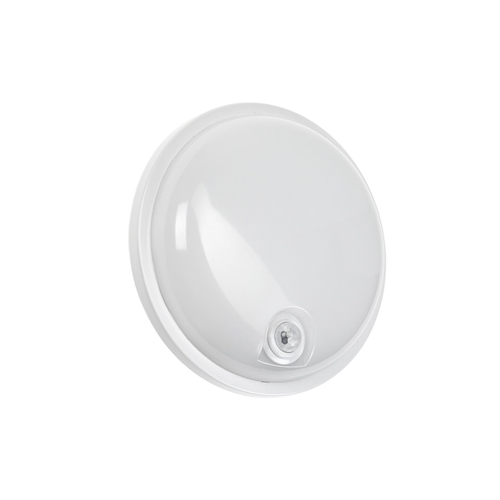
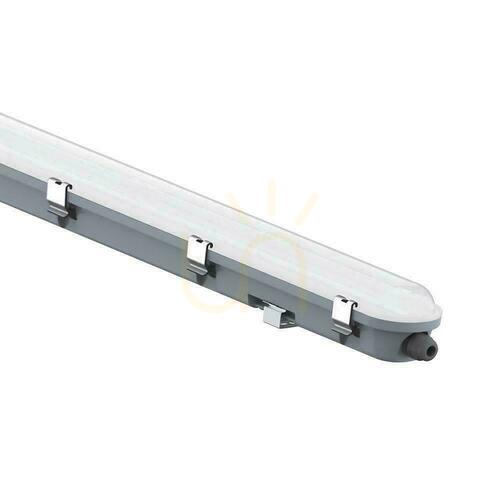
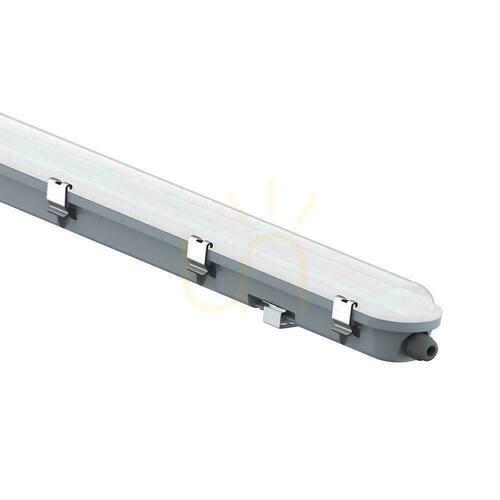
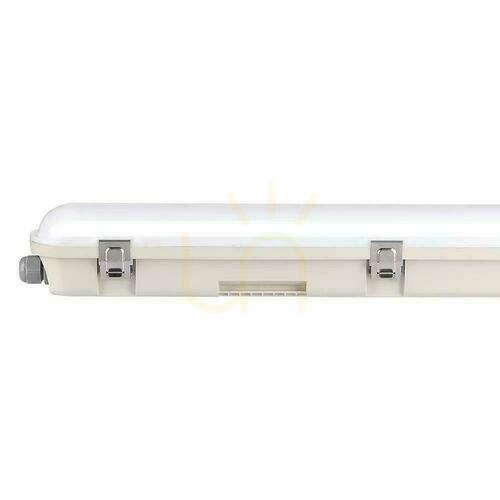
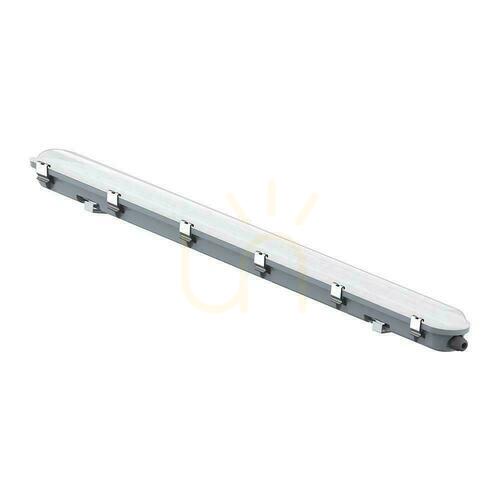
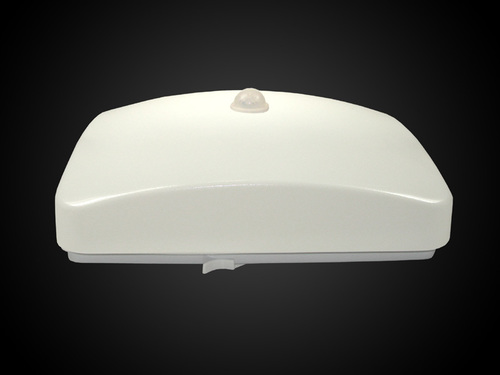
A bulkhead light with PIR is a sealed, hard-wearing wall or ceiling fitting with a built-in motion detector that switches the light on when someone walks into range and off again after a set time. On a utility light, the sensor changes the job completely: the fitting in the garage, bin store or communal stairwell stops burning all night and simply comes on when it is needed.
Most of these fittings are rated IP65, so they cope with damp garages, unheated outbuildings and covered outdoor spots as well as indoor corridors. Choosing one is less about looks and more about the sensor: which type, where it points and how it is set.
PIR or microwave: what sits inside the fitting
PIR stands for passive infrared. The sensor watches for body heat moving across its detection zones, so it responds best to someone walking past it rather than straight towards it. It has a visible lens, cannot see through glass and usually reaches around 8–12 m on a wall-mounted fitting. That makes it a good fit for porches, side passages and the outside of a garage.
Microwave (often sold as HF) sensors emit a low-power signal and read the reflection. They pick up any movement, including straight towards the fitting, typically cover 360° when ceiling-mounted and can sit hidden behind the diffuser, which keeps a bulkhead smooth and easy to seal. The catch: microwave sees through thin partitions, doors and plasterboard. In a block of flats, a sensor set too sensitive in the stairwell can be triggered by someone moving behind a door.
Choosing a bulkhead for the space
| Location |
Typical fitting |
Sensor and setting |
Protection |
| Communal stairwell or landing |
round or oval ceiling bulkhead |
microwave with corridor (on/dim) function, 30 s – 2 min |
IP44–IP65, IK08 or higher |
| Garage or workshop |
linear sealed batten or large bulkhead |
microwave, 2–5 min |
IP65 |
| Bin store or bike store |
compact bulkhead |
microwave or PIR, 1–3 min |
IP65, IK10 where vandalism is a risk |
| Porch, side passage, back door |
eyelid or round wall bulkhead |
PIR with photocell, 1–3 min |
IP54–IP65 |
| Car park or loading area |
bulkhead or batten, often with emergency version |
microwave, corridor function |
IP65, IK10 |
Time-out is usually adjustable from a few seconds to around 10–15 minutes, and the lux level decides whether the light reacts in daylight. In a windowless store, set it to respond at any light level. Neutral white around 4000 K is the usual choice for garages and communal areas; warmer 3000 K suits a front porch.
The IK rating matters more than people expect. IK08 survives knocks from bikes and bins, while IK10 is the standard choice for car parks and anywhere a fitting might be kicked or hit.
Corridor function, emergency versions and linking
Many sensor bulkheads offer a corridor or on/dim mode: after the time-out the light drops to about 10–20 % rather than switching off, either for a set period or permanently. Residents get a dim light on the landing instead of total darkness, and full brightness returns as soon as someone moves.
Emergency versions, maintained or non-maintained, often with a three-hour duration, exist in the same families. The sensor and the emergency function are separate jobs: a sensor fitting is not an emergency light unless it is specified as one.
A single sensor fitting can switch others on the same circuit as long as the sensor's maximum load is respected, which is handy along a long garage or corridor. Bulkheads with several 20 mm conduit entries make surface wiring in plant rooms and garages much tidier.
Installation and common mistakes
-
Keep the sensor's view clear of shelves, open doors and beams. Heaters, extractor fans and roller doors in the field cause false triggers.
-
Mounting height: around 2–2.5 m on a wall and 2.4–3 m on a ceiling suits most fittings. Too high and sensitivity drops.
-
Seal properly: the IP65 rating only holds if cable enters through the proper gland or grommet.
-
Clean the lens now and then; dust and cobwebs on a PIR lens shorten its range.
Fixed wiring should be done by a qualified electrician to BS 7671, especially outdoors and in communal areas.
Frequently asked questions
What is a bulkhead type light?
A robust, sealed fitting with a tough diffuser, mounted flat on a wall or ceiling. The name comes from ships' lights, and the format is now standard for stairwells, garages, outbuildings and exterior walls.
What does PIR mean on a wall light?
Passive infrared. The light has a detector that senses body heat moving across its field and switches on automatically, then off after the time-out you set.
Can you add a PIR sensor to any light?
Often, yes: a separate PIR detector can be wired between the supply and an existing fitting, as long as its load rating covers the fitting. A bulkhead with an integrated sensor is neater and keeps the seal intact.
Are outdoor PIR bulkheads waterproof?
Look for IP65 or at least IP54 for exposed walls. IP44 suits sheltered spots such as a deep porch.
Why does my sensor light stay on?
The time-out may be set to maximum, the sensitivity may be too high, or something keeps moving in the field: warm air from a heater, a fan, or with microwave sensors, people behind a thin wall.
Do LED bulkheads mind being switched on and off a lot?
Far less than old fluorescent fittings did. LEDs reach full output instantly and handle frequent switching, which is why they pair so well with sensors.
For more on lighting garages, workshops and warehouses, see industrial lighting. Replacing old tube fittings? Read about fluorescent lights as well.