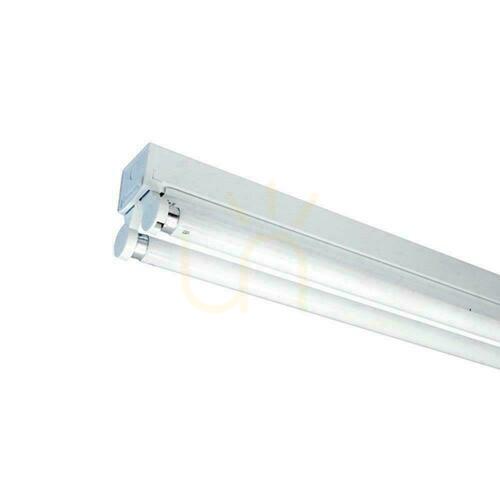
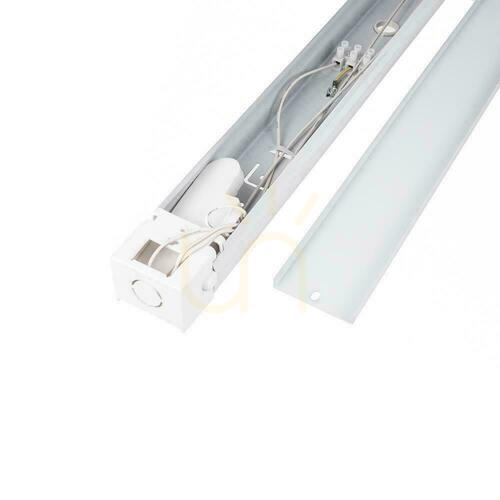
A fluorescent light makes light from a discharge through mercury vapour inside a glass tube: the discharge gives off ultraviolet, and a phosphor coating on the inside of the glass turns it into white light. In workshops, garages, warehouses and offices it usually takes the form of a long batten, a sealed non-corrosive fitting or a louvred ceiling panel – broad, even light across a whole room rather than a pool under one lamp.
Most people choosing a fluorescent fitting today are matching an existing installation, replacing a failed batten or keeping a run of lights consistent. What matters is the tube size, the control gear inside the fitting and how easily it will take an LED tube later on.
Fluorescent tube sizes
The T number is the tube diameter in eighths of an inch, so a T8 is one inch across and a T5 five-eighths. In the UK, tubes are still often asked for by length in feet, and the length tells you the wattage.
| Tube |
Length |
Wattage |
Approx. output |
Typical LED replacement |
| T8 (G13 pins) |
2 ft / 600 mm |
18 W |
around 1350 lm |
8–10 W |
| T8 (G13 pins) |
3 ft / 900 mm |
30 W |
around 2400 lm |
13–15 W |
| T8 (G13 pins) |
4 ft / 1200 mm |
36 W |
around 3350 lm |
16–18 W |
| T8 (G13 pins) |
5 ft / 1500 mm |
58 W |
around 5200 lm |
20–24 W |
| T8 (G13 pins) |
6 ft / 1800 mm |
70 W |
around 6200 lm |
28–30 W |
| T5 (G5 pins) |
about 2 in shorter than T8 |
14–80 W |
depends on HE or HO |
T5 LED matched to the gear |
The colour code on the tube reads in two parts: the first digit is the colour rendering band (8 means Ra 80 or above) and the next two are the colour temperature in hundreds of kelvin. An 840 tube is neutral white at 4000 K, the usual choice for a workshop; 830 is warmer, 865 close to daylight.
Switch-start or high-frequency gear?
A fluorescent tube cannot run straight off the mains. Older battens use a magnetic choke ballast with a small plug-in glow starter: they flash a few times before lighting, may hum, and the light pulses at 100 Hz. Next to a lathe or pillar drill that matters, because the stroboscopic effect can make a spinning chuck look still. High-frequency electronic ballasts strike without flashing, run silently, show no visible flicker and are kinder to the tube. Frequent short switching can almost halve tube life on switch-start fittings, while preheat electronic gear barely notices it.
Where fluorescent fittings fit in a technical space
-
Single and twin battens – plain ceiling fittings for garages, lofts, plant rooms and stores.
-
Non-corrosive fittings rated IP65 – the tube sits under a sealed polycarbonate diffuser; car parks, wash bays, cold stores and anywhere with dust or condensation.
-
Louvred and modular panels – recessed 600 × 600 mm panels for grid ceilings; the louvre cuts glare on screens.
-
Compact fluorescent downlights – 2G11, G24d or G24q lamps for corridors and stairwells.
As a guide, EN 12464-1 suggests roughly 100–200 lux for storage, 300–500 lux for a workshop and 500 lux at a desk. A single garage is usually well lit by two twin 4 ft battens, with a third over the workbench.
Unheated buildings deserve a thought: fluorescent tubes strike slowly and lose output in the cold, and T5s suffer far more than T8s. For a cold garage or outbuilding, a T8 in an enclosed IP65 fitting is the safer bet.
Frequently asked questions
Which is better, LED or fluorescent?
On running costs, LED: a 4 ft LED tube draws 16–18 W against 36 W for the fluorescent, and switch-start gear adds its own losses. Fluorescent still gives a pleasant all-round light and makes sense where you are keeping an installation consistent, but UK and EU rules on mercury and ecodesign have ended manufacture of most tubes, so replacements will only get scarcer.
What causes a fluorescent light to stop working?
Usually a worn tube (blackened ends, flickering, slow to strike) or a tired starter. Replace both together. Cold weather, a failed ballast or a loose tube in its holders are the next suspects. If the fitting still will not light, have an electrician check it.
How do you measure a fluorescent tube?
Measure from one end cap to the other, leaving out the pins, then check the diameter: about 26 mm for a T8, 16 mm for a T5. The wattage printed on the fitting confirms the length.
Can I put an LED tube in a fluorescent fitting?
Often. With switch-start gear you replace the starter with the dummy starter supplied with the tube. With electronic gear you need a tube approved for that ballast, or the fitting rewired for direct mains. Single-end-fed tubes short out if fitted the wrong way round, so label converted fittings.
Which fluorescent starter do I need?
Check the fitting. A single tube on its own choke takes a standard 4–65 W or 4–80 W starter. Twin-tube fittings where two short tubes share one choke, such as 2 × 18 W, use a series starter rated 4–22 W, one per tube. Electronic replacement starters are a direct swap and give a cleaner start without the flashing.
Do fluorescent fittings need to be earthed?
Yes, if it is a Class I fitting, as most metal battens are: the earth protects you if a fault makes the body live, and it also helps the tube strike reliably. Double-insulated Class II fittings have no earth terminal. Rewiring work should be done by a qualified electrician in line with BS 7671.
How do I dispose of old tubes?
They contain a few milligrams of mercury, so take them to a household recycling centre or a retailer take-back point, not the general bin.
Read more about lighting for warehouses, workshops and offices, LED included, under industrial lighting. If the light should come on by itself when someone walks in, see utility lights with a motion sensor.