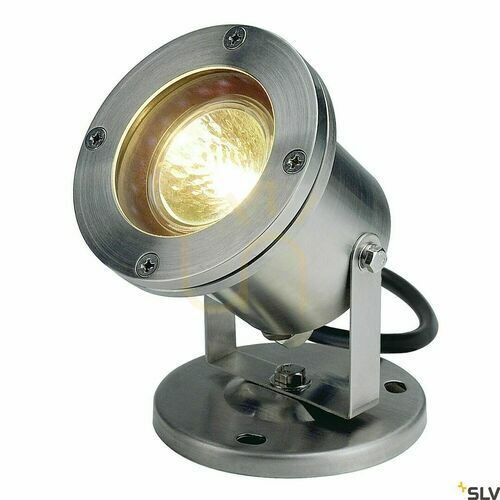
Pond lights are fittings built to sit underwater or right at the water's edge, sealed to IP68 for submersion and usually run at 12 V from a transformer kept well away from the pond. That is what separates them from ordinary garden lights: a border spike only has to shrug off rain, while a pond light lives on a marginal shelf, under a waterfall or beside a fountain jet for years.
The reward is a pond that keeps working after dark. A lit cascade, lily pads glowing from beneath or koi drifting through a clear beam turn the water into the part of the garden people actually look at in the evening. How much light, and where, depends mostly on what kind of pond you have.
Start with the type of pond
| Pond or feature |
Ingress protection |
Supply |
What matters |
| Koi pond, deep and well filtered |
IP68, depth rating to match |
12 V LED, often 3–6 W per spot |
side lighting from shelves, dark resting areas, cable long enough to reach the bank |
| Wildlife pond |
IP65 on the bank, if any |
12 V or solar |
keep the water mostly dark, warm white, beams shielded and low |
| Formal or raised pond |
IP68 |
12 V |
small spots in the corners angled across the water, since it is seen from above |
| Waterfall, fountain, bubbler |
IP68 |
12 V LED ring or mini spot |
pump outlet diameter, narrow beam under the lip |
| Splash zone |
IP67–IP68 |
12 V |
adjustable head, sturdy spike |
| Bank, clear of splashes, and paths |
IP65 (IP44 for paths further off) |
12 V or mains (installed by an electrician) |
glare, whether it can be walked on |
Koi ponds: light the fish, not the surface
Koi keepers usually have the best conditions for underwater light: deep water, strong filtration, little green tint. The mistake is a single bright spot on the bottom pointing up. It throws a glaring patch onto the surface, and fish swimming above it show only as dark shapes. Two or three spots on the shelves, angled across the pond towards the side you sit on but not into your eyes, show colour and pattern far better. Neutral white around 4000 K tends to render reds, oranges and whites more faithfully than very warm light. Leave the deepest part and any caves unlit so the fish have somewhere to rest, and switch off a few hours after dark.
Wildlife ponds: less is more
A pond dug for frogs, toads and newts works best mostly dark. Amphibians are active at night and bats often feed over water at dusk, and both do better without a lit surface. If you want to see the pond from the house, use one low, warm-white light on the far bank, shielded and aimed at planting or a stone rather than at the water, and put it on a timer. Solar marker lights along the path are another gentle option.
The kit itself
Underwater spotlights sit on a weighted base or spike and nearly all are LED now, drawing a few watts each. A fountain ring slips over the pump's riser and lights the jet from below; a spot just under the lip of a waterfall makes the falling sheet glow. Floating globes and lily lights are mostly solar and decorative. Stone-effect lights hide in rockeries, and walk-over ground lights or low bollards mark the edge of decking or a bridge, which is worth doing wherever children walk past water in the dark. Warm white at 2700–3000 K suits planting, timber and stone; colour-changing RGB is fun on a fountain, though many people settle back on white.
Planning the cable run from the house
Work backwards from the house. The mains supply to an outdoor socket or garden box needs 30 mA RCD protection and is usually run in steel wire armoured (SWA) cable or suitable ducting. In England a new circuit is notifiable under Part P of the Building Regulations, so have a qualified electrician install it to BS 7671.
Many people put the transformer in a garage, shed or weatherproof box near the house and run only the 12 V cable down the garden. Wherever it goes, it should be dry, raised and out of the splash zone – manufacturers typically ask for at least 2 m from the edge. Size it to the total wattage of all the lights plus some headroom. Keep connectors out of the water and leave a loop of spare cable so each light can be lifted out without wading in. If you are still digging, lay the ducting before the liner goes in.
Through the year
In spring, check seals and cables for cracks and re-aim spots once the marginals start growing. Through summer, algae and limescale film the lenses within weeks; a soft cloth clears them, abrasives leave them cloudy. In autumn, pond netting and fallen leaves can smother bank lights. A British winter may only freeze the pond for a few days, but lights in shallow margins and waterfall pools are the most exposed to ice, so lift them with the pump before a cold snap and store them dry. Never leave underwater lights running on the lawn for long: they rely on water to cool them.
Pond lighting FAQs
Do fish like lights in their pond?
A few hours in the evening does no harm, but lights left on all night disturb the fish's daily rhythm. Put the circuit on a timer or dusk sensor that switches off later in the evening, and leave darker corners for fish and wildlife.
What colour light is best for a koi pond?
Plain white. Neutral white shows the true colours of the fish; warm white flatters stone and planting. Coloured filters change how the koi look, which is fun for a party and tiring every night.
What are the best pond lights for a small garden pond?
Usually a low-voltage set of two or three LED spots that work both underwater and on the bank, so you can move them as plants grow.
Are solar pond lights underwater any good?
They avoid cable runs and suit floating decorations, but output depends on sunshine. In a British autumn the panel may only part-charge the battery, so treat solar as an accent, not the main light.
Mains or low-voltage pond lights?
Mains pond lighting normally means a mains supply feeding a 12 V transformer. Only the transformer connects to 230 V; everything in or near the water stays at safety extra-low voltage.
Is a UV clarifier a pond light?
No. A UV-C clarifier sits in the pump and filter circuit to clear green water. It gives no useful light, and pond lights do nothing for water quality.
If a tree leans over the water, uplighting it doubles the effect in the reflection – more on that under tree uplighters. Paths, borders and the patio around the pond deserve their own plan: outdoor lights.