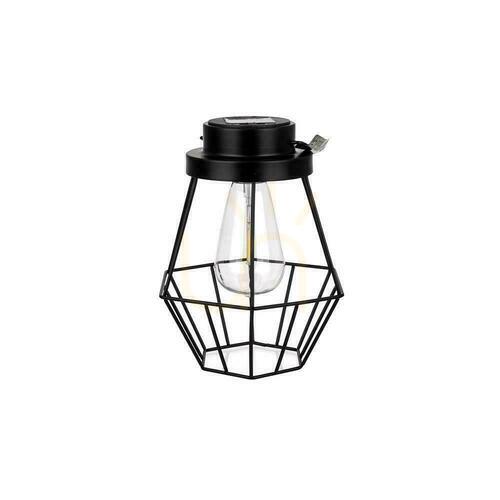
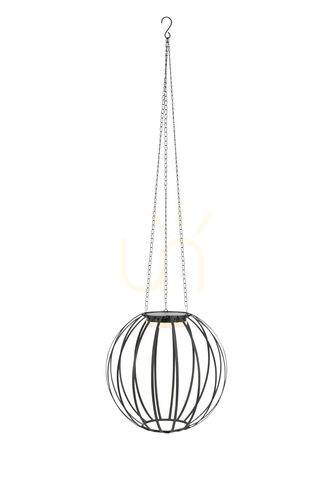
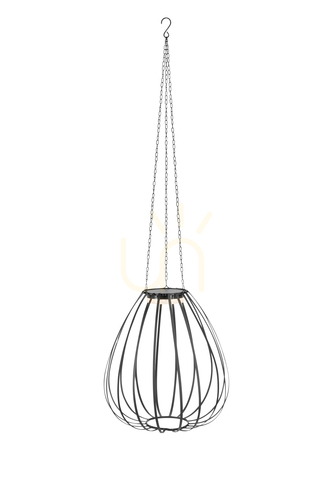
Hanging solar lights are lanterns, globes and shades that hang from a hook, branch or pergola beam and run entirely on their own small solar panel. There is no cable to bury and no electrician to book, so you can put soft light over a garden table or in an old apple tree in the time it takes to find a ladder.
What changes when solar meets a hanging fitting is where the panel ends up. A lamp that hangs usually hangs in shade – under a roof, a canopy of leaves or a parasol – and in a British garden, where cloud is the default, that matters more than the shape of the lantern.
How hanging solar lights work
A photovoltaic panel turns daylight into current and charges a rechargeable battery. As light fades, a dusk sensor (often the panel itself) switches the LEDs on; they go off at dawn or when the battery is flat. Most models have an ON/OFF/AUTO switch, and some add a timer, a flickering candle mode or a USB socket for topping up the battery on dull days.
There are two ways the panel is built in:
-
Integrated panel – set into the lid of a lantern or the top of a globe. Simple and tidy, but it only works if the lamp hangs in open sky.
-
Remote panel on a lead – the panel sits a few metres away on a shed roof, fence post or south-facing wall while the lamp hangs in shade. This is the answer for gazebos, covered patios and even hanging solar lights indoors, in a porch or summer house.
What to expect through the British year
Run time depends on yesterday's sunshine as much as on battery size. As a rough guide for a lamp whose panel gets proper sun:
| Season |
Typical charge |
Typical light per night |
| Late spring and summer |
long days, high sun – full charge is easy |
6–10 hours, often until the short night ends |
| Early spring and autumn |
lower sun, more cloud – tilt the panel south |
4–7 hours |
| Winter |
sun low and brief, panels often wet or shaded |
roughly 2–5 hours, sometimes none after grey days |
| Under a roof, integrated panel |
indirect light only |
minutes rather than hours – use a remote panel |
Decorative lanterns usually give 5–50 lumens, which is mood lighting. To light a table or a seating area, look for 100 lumens or more, or hang several lamps close together. Warm white around 2700–3000 K suits a garden best; cooler 4000–6000 K tends to look harsh outside.
Choosing well
The battery is the part that wears out first. NiMH cells (1.2 V, AA or AAA) are cheap but often fade after one or two seasons. Lithium-ion (3.7 V) lasts several years, and LiFePO4 survives the most charge cycles and tolerates heat well, though no lithium cell charges properly below freezing. A battery you can replace yourself turns a disposable lamp into one you keep. Monocrystalline panels squeeze more out of overcast skies than polycrystalline ones.
For weather resistance, IP44 handles rain from any angle and is fine under partial cover; a lantern hanging fully exposed is better at IP65. Metal and glass lanterns cope with wind and UV better than paper or fabric ones, which are best taken in before a storm.
Hanging them in the right place
South-facing branches, open pergolas, fence tops and balcony railings are the easy wins. Over a path, keep the bottom of the lamp at least 2.1–2.2 m up so nobody walks into it. Lightweight lanterns swing in gusts, so use S-hooks with a closure or a short chain. Keep them away from porch lights and street lamps: steady artificial light can fool the sensor into thinking it is still daytime.
Care
Charge a new lamp for a full sunny day before first use. If it stays dark, check the little switch underneath and any plastic tab on the battery. Wipe the panel every few weeks – pollen, dust and bird droppings cut charging more than you'd think. If the light gets shorter each night despite sunshine, the battery is ageing.
Frequently asked questions
Do solar lights charge on cloudy days?
Yes, but far more slowly. After an overcast day expect a shorter evening, not a full night. Monocrystalline panels and lamps with a USB backup handle long grey spells best.
What are the best hanging solar lights?
Look for a replaceable lithium battery, a monocrystalline panel, at least IP44 and an ON/OFF switch. If the lamp will hang under any kind of cover, a remote panel matters more than anything else on the spec sheet.
Can you use hanging solar lights indoors?
Only with a remote panel placed outside or on a sunny windowsill. A lantern with an integrated panel will not charge properly through glass and roof shade.
Are large solar hanging lanterns brighter?
Not necessarily – size is mostly about looks. Brightness comes from the lumen rating and the battery and panel behind it, so compare those rather than the dimensions.
How long do hanging solar lights last?
The LEDs themselves last for years; the battery is what gives up. Expect one or two seasons from basic NiMH cells and several years from lithium, longer if the lamp spends winter indoors.
Should I bring hanging solar lights in for winter?
It is the kindest thing for the battery. Switch them off, store them somewhere dry and cool, and they will start the spring with more capacity left.
If you would rather drape light along a fence or across a patio, read about solar string lights. For hanging fittings that give steady light all year, see outdoor pendant lights.