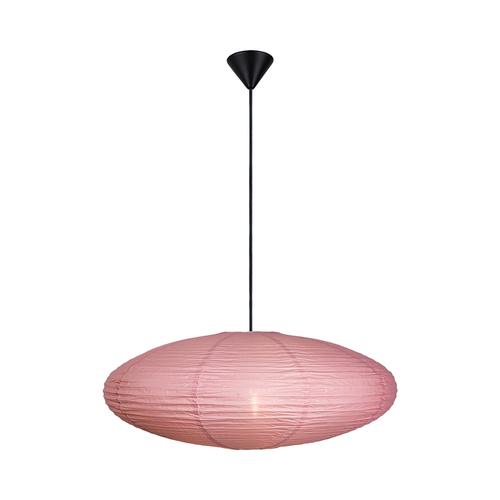
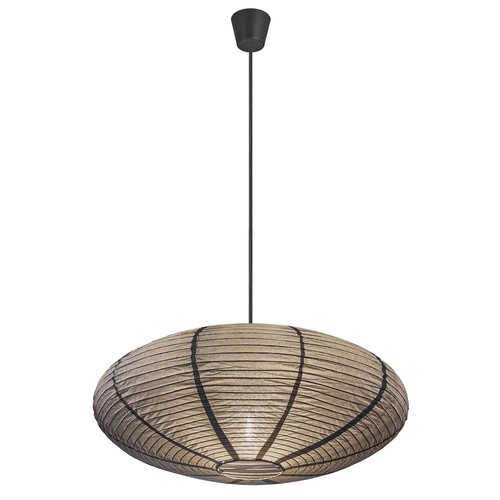
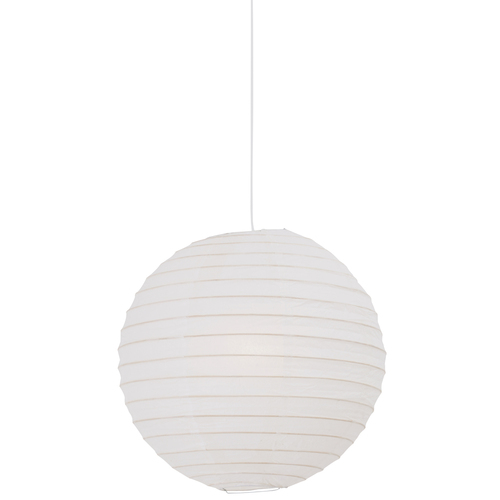
A paper lampshade turns a bare bulb into a soft, even glow, because thin paper scatters light in every direction instead of funnelling it out of the bottom. Choosing paper over fabric or glass changes three things: the shade weighs almost nothing, the whole surface lights up, and the bulb inside has to be a cool-running LED.
The family is broader than the classic white globe. Rice-paper lanterns on a spiral wire frame, pleated shades for table lamps, folded geometric shapes in card and moulded paper-pulp domes all count, and each one throws light differently.
Are paper lampshades safe?
Yes, with the right bulb. Paper burns, so the rule is simple: fit an LED, keep the bulb a few centimetres clear of the paper and never let the two touch. Old incandescent and halogen bulbs run hot enough to scorch paper over time, which is why many paper shades carry a maximum wattage of 40 W or 60 W. That figure refers to traditional bulbs. A 60 W-equivalent LED gives roughly 800 lm while drawing 7–9 W, and its glass stays warm rather than hot. Lanterns use a wire spreader inside to hold the paper taut and away from the bulb, so make sure it is clipped in properly before you hang the shade.
Fittings: easy fit, ring and harp
Most paper shades sold in the UK are easy fit: a non-electric shade that slips over an existing ceiling pendant and is held in place by the lampholder’s shade ring. British pendants usually take a B22 bayonet bulb, while lamps from the Continent use E27 or the smaller E14 screw cap. Check whether the shade’s centre ring suits your lampholder; a reducer ring bridges the gap when it is too wide. Table and floor lamp shades sit either on a ring fitting clamped by the lampholder or on a harp with a finial on top. If you are adding a new ceiling point rather than swapping a shade, the wiring has to meet BS 7671, so leave it to a qualified electrician.
Choosing the size and the bulb
With a typical UK ceiling height of around 2.4 m, the shade’s drop matters as much as its diameter.
| Where it goes |
Typical diameter |
What to watch |
| Hallway or landing |
25–35 cm |
Keep at least about 2 m of headroom below |
| Bedroom or nursery |
30–45 cm |
Warm 2700 K, frosted bulb |
| Over a dining table |
40–60 cm |
Bottom edge roughly 60–80 cm above the table |
| Living room |
50–80 cm |
Aim for 800–1500 lm from the bulb |
| Table or floor lamp |
20–45 cm |
Shade about a third of the lamp’s total height |
Pick a frosted or opal LED. A clear filament bulb shows through thin paper as a hard bright spot and spoils the lantern effect. Natural, kraft and beige papers warm the light a little; coloured papers tint the whole room.
Which paper does what
-
Rice or mulberry paper – the thinnest and most translucent, glowing like a lantern. Despite the name it is usually made from plant fibres, not rice.
-
Pleated paper – the folds cast fine stripes on the wall and hide the bulb better.
-
Card and paper pulp – nearly opaque, sending most light down and out of the openings, much like a conventional shade.
-
Folded origami shapes – self-supporting geometry that throws patterned light on the ceiling.
Where paper works, and where it doesn’t
Living rooms, bedrooms, dining areas and children’s rooms suit paper best, and it sits naturally in Japandi, Scandinavian and boho schemes. A cluster of three globes at different drops looks livelier than one big one. Skip bathrooms and the space above the hob: steam makes paper ripple and sag, and cooking grease settles into it for good. Outdoors is out too – garden lanterns that look like paper are usually synthetic fabric.
FAQ
How long do paper lampshades last?
Indoors and away from damp, many years. The usual signs of age are yellowing from sunlight and heat, and dust in the creases. A shade by a sunny window fades faster than one in the middle of the room.
What is the best paper to use for lampshades?
For a soft glow, thin fibrous paper such as rice or mulberry paper. For a lamp you make yourself, look for a lampshade material sold as flame-retardant; ordinary craft paper is not.
Can I make a lampshade from paper?
Yes: pleated paper on a ring kit or folded origami panels are the usual home projects. Use a lampshade ring kit to keep the paper at a safe distance and fit only an LED.
Are Japanese paper lamp shades the same as rice-paper shades?
Broadly, yes. The round lantern with a spiral rib is a Japanese form, usually made of washi-type fibre paper over bamboo or steel wire.
Is a large paper lampshade too much for a small room?
Less than you would think, because paper looks light. In a room of 10–12 m², 40–50 cm is usually enough; save 60 cm and up for bigger spaces.
Which bulb should go in a paper lampshade?
A frosted LED with the cap your lampholder takes – B22, E27 or E14 – in warm white, 2700–3000 K. Around 1000–1500 lm suits a big living-room globe; 250–470 lm is plenty for a bedside lamp. Dimmable LEDs work too, provided the dimmer switch is LED-compatible.
How do I clean a paper lampshade?
Dry only: a soft brush, a feather duster or a vacuum on low with the brush head, working from the top down. Water leaves tide marks. Patch small tears from the inside with tissue paper and a glue stick.
For shades in fabric, glass and other materials, see lampshades; for complete ceiling fittings with a paper shade, have a look at paper pendant lights.