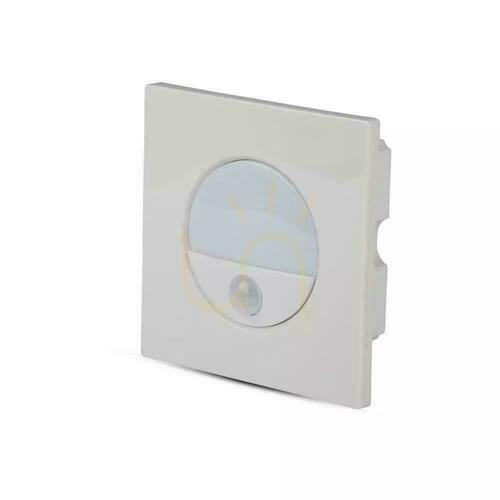
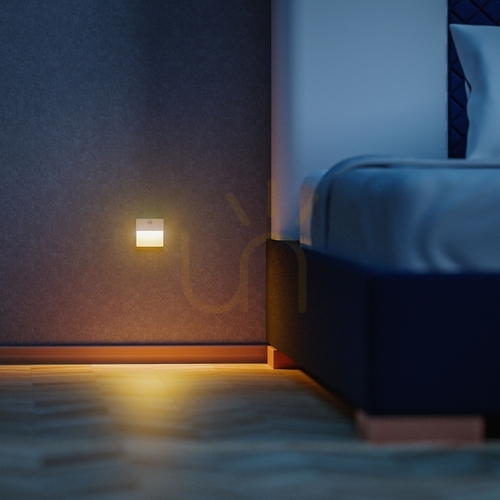
Motion sensor stair lights switch on the moment someone heads for the stairs and switch off again once the staircase is empty, usually after somewhere between a few seconds and a few minutes. Put them on a flight of stairs and the treads are lit before your foot lands on them, with no groping for a switch at the bottom when your hands are full of washing.
Stairs are an awkward place for a sensor, though. People approach from two ends, often half-asleep, and someone coming down from the landing sees the fitting from a completely different angle to someone coming up from the hall. Getting it right is mostly about where the sensors sit and how they talk to the lights.
Are motion sensor lights a good idea on stairs?
For most homes, yes. They help most on stairs used at night – to a bathroom, a loft room or a cellar – and in houses with young children or older relatives, where a missed step matters. They also replace the traditional two-way switching between hall and landing with something that simply reacts to you.
The trade-offs are real but manageable: a timer set too short leaves you in the dark halfway up, pets can trigger a sensor at 2 a.m., and battery models need recharging. A longer timer, lower sensitivity and a dusk setting that saves the battery in daylight take care of most of it.
What is the best type of light fitting for a stairway?
| Fitting |
Power and sensor |
Works best for |
| Recessed step lights in the wall |
230 V, sensor in each fitting or one fitting switching a group |
New builds and replastering; most fit a standard single-gang back box |
| LED strip or bars under each tread |
12 V or 24 V driver plus a stair controller with sensors top and bottom |
Step-by-step ‘cascade’ lighting; controllers usually handle about 5–20 steps |
| Wireless step lights |
Batteries or USB-rechargeable, built-in PIR |
Rented homes and finished walls; recharge every few weeks to months |
| Sensor ceiling or wall light on the landing |
230 V, often with an adjustable timer and dusk setting |
Lighting the whole stairwell rather than individual treads |
A single step light rarely needs to be bright – around 50–150 lm per fitting is typical, with a wide beam spread across the tread. What matters more is that it lights the nosing of each step and stays out of your eyes on the way down.
How the sensor sees you
Most stair lights use a PIR (passive infrared) sensor, which picks up body heat moving across its field of view. It needs a clear line of sight and works best when you walk across it rather than straight towards it. Step-light sensors usually cover a few metres, enough for the width of a staircase.
Some fittings use a microwave sensor instead, hidden behind the cover so nothing shows on the wall. It is more sensitive, but it can also ‘see’ through thin stud walls and doors and switch on for someone in the next room.
With a stair controller, mount the sensor roughly 30 cm above the step and aim it straight across the flight. Placing it at the first step starts the lights as you step on; half a metre before the stairs and the bottom tread is already lit when you get there. Avoid aiming it at a window, mirror or chrome handrail. On stairs with a half-landing or a turn, a second sensor partway up keeps the cascade going.
Fitting and wiring
Wall-mounted step lights generally sit 20–30 cm above the tread, on every step for low-output fittings or every second or third step for brighter ones. Mains fittings should be wired to BS 7671 by a qualified electrician; back boxes go in before plastering, or into dry-lining boxes on plasterboard walls. Low-voltage kits with a plug-in driver and wireless lights are fine as DIY jobs.
Colour temperature makes a difference at night. Warm white at 2700–3000 K is gentle on sleepy eyes yet still picks out the edge of each step; 4000 K suits a communal stairwell or cellar better.
Common niggles and how to sort them
-
Lights go off before you reach the top – lengthen the timer or add a sensor at the top of the stairs.
-
Switching on for the cat – reduce the sensitivity or re-angle the sensor so it looks across the tread, not along the floor.
-
A faint glow when ‘off’ – common with two-wire sensors and very small LED loads; a sensor with a neutral connection usually cures it.
-
Coming on in daylight – set the dusk (lux) threshold so it only reacts when it is actually dark.
Motion sensor stair lights: your questions
What are the best motion sensor lights for home stairs?
If the walls are open or being replastered, mains step lights with built-in or group-switched sensors give the neatest, maintenance-free result. For a finished home, a low-voltage cascade kit or wireless rechargeable lights avoid chasing cables into the plaster.
What are the best motion sensor stair lights for indoors?
Low-level step lights with a PIR sensor, an adjustable timer and a dusk setting, giving warm white light. They light the treads without dazzling you the way a bright ceiling light can, and IP20 is fine on dry indoor stairs.
Do motion sensor bulbs work on a staircase?
They can, in a landing pendant or ceiling light, as long as the wall switch stays on and the bulb has a clear view of the stairs. A sensor pointing down from a high ceiling may not spot someone until they are already on the first step.
Are wireless motion sensor stair lights bright enough?
For finding your way at night, usually yes. They tend to be dimmer than mains fittings and run on a short timer to save battery, so they suit occasional night-time use better than a busy family staircase.
Can I use motion sensor lights on outdoor steps?
Yes, with the right rating: IP44 at minimum under a porch, and IP65 for steps fully exposed to rain. A dusk sensor stops them switching on in daylight.
If running cables is not an option, read more about battery-powered stair lights. For step and stairwell lighting in general, with or without a sensor, see stair lighting.