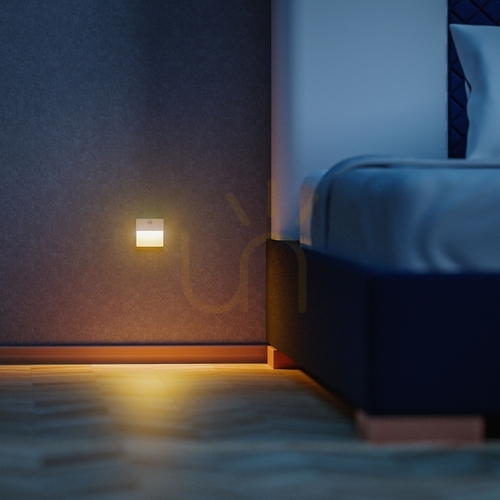
Battery stair lights are small LED lights that run on AA or AAA cells or a built-in rechargeable battery, so they go up without new wiring, chased plaster or an electrician. Taking the cable out of the picture means you can put light on the exact step that needs it: the dark turn halfway up, the top landing, the cellar stairs that never had a switch.
What you give up is unlimited power. A battery has a few weeks of light in it, not years, so these are guide lights rather than room lights. They come on when you walk up, go off soon after and stay modest in brightness, and that trade-off shapes every choice below.
What are good battery-powered lights for stairs?
The ones that light the treads without lighting your face. Look for a low output, warm white light pointing downwards, a PIR motion sensor and a light sensor that keeps the unit off in daylight. An ON/OFF/AUTO switch is handy for the evenings when you want the stairs lit while you carry laundry up and down.
Then decide how you want to feed them. Replaceable AA or AAA batteries suit one or two lights on a little-used flight. A built-in lithium battery charged by USB or USB-C suits a full staircase, because you recharge rather than buy cells for every unit. The best rechargeable designs sit on a magnetic plate: lift the light off, charge it for a few hours, put it back. Rechargeable AAs also work in many battery models, though at 1.2 V rather than 1.5 V some will flag a low battery sooner.
Matching the light to the staircase
| Where |
Typical set-up |
Worth knowing |
| Main staircase, 13–14 steps |
a light every second or third step, 20–30 lm, 2700–3000 K |
rechargeable units keep running costs down |
| Turn or winder steps |
one light per step |
the narrow end of a winder is where feet slip |
| Landing or half-landing |
one or two lights with a 2–3 m sensor range |
place them to catch you as you reach the top step |
| Open-riser staircase |
lights on the wall or stringer, or a short battery LED strip under the nosing |
keep the beam off the gaps between treads |
| Cellar or loft stairs |
battery AA/AAA lights, up to 4000 K |
few trips a day, so cells last a long time |
| Outdoor steps |
IP44 or higher |
cold cuts battery capacity, solar is often easier |
How long will the battery last?
Usually somewhere between a few weeks and a few months per charge or set of cells. A rough sum shows why. A 500 mAh lithium cell holds a little under 2 Wh, which runs a 0.4 W light for about 4–5 hours in total. If that light comes on 25 times a day for 20 seconds, it burns for only a few minutes daily and one charge lasts weeks. A two-minute on-time, a busy family or a cat on night patrol shortens that fast, so keep the timer at the low end of its usual 15–60 second range.
Fitting them without drilling
Wall lights normally sit 10–30 cm above the tread and shine down onto the nosing, so the edge of every step is clear. Most PIR sensors are rated for a mounting height of about 1 m, with a detection angle of 90–120°, so a light set very low may only see feet and react late. Facing the sensor towards the bottom and top of the flight helps.
Adhesive pads hold on clean, dry, smooth surfaces. Wipe the spot with isopropyl alcohol (or surgical spirit) first and press the pad firmly. Textured paint, Artex, woodchip paper, fresh emulsion and bare timber are where pads let go, so screw the magnetic plate to the wall there and let the light snap onto it. Two small screw holes are easy to fill when you move out, which matters to renters.
Common niggles
- Lights triggering at random: PIR sensors react to heat, so a radiator or a sunny window in view can fool them.
- Mixed whites: stick to one colour temperature on one staircase.
- Dim light long before the battery is flat: alkaline cells fade gradually, so swap the whole set at once.
- Dusty sensor lens: give it a wipe with a dry cloth every so often.
- Spent batteries: take them to a recycling point; most supermarkets have a collection box.
Battery stair lights: common questions
How do I light stairs without electricity?
Stick or screw battery-powered or rechargeable step lights beside the treads, ideally with a motion sensor so they only use power when someone is on the stairs. For outside steps, solar lights charge themselves during the day.
What is the best automatic light for stairs?
One that combines a PIR motion sensor with a dusk sensor and an adjustable on-time. Linked sets, where movement at the bottom switches on the whole flight, are the most comfortable on long staircases. More on sensor types and set-ups in our guide to stair lights with a motion sensor.
Are battery stair lights bright enough?
For finding your footing at night, yes. They are meant to show the edge of each step, not to replace the landing light, so 10–60 lumens per light is the usual range.
Do rechargeable stair lights work in a power cut?
Yes. They don't depend on the mains, so they keep lighting the stairs when the rest of the house goes dark.
What are good battery-powered lights for outdoor stairs?
Models rated IP44 or above, ideally higher for exposed steps. Winter cold reduces battery life and lithium cells should not be charged below freezing, which is why many people use solar step lights outside instead.
Can I fit battery stair lights in a rented home?
Yes. Magnetic and adhesive mounts need no wiring and come off when you leave. Warm a pad gently with a hairdryer before peeling it, so it doesn't lift the paint.
If the stairs are being redecorated and new cables are an option, hard-wired or recessed step lights are worth considering. More on lighting a staircase in general: stair lighting.