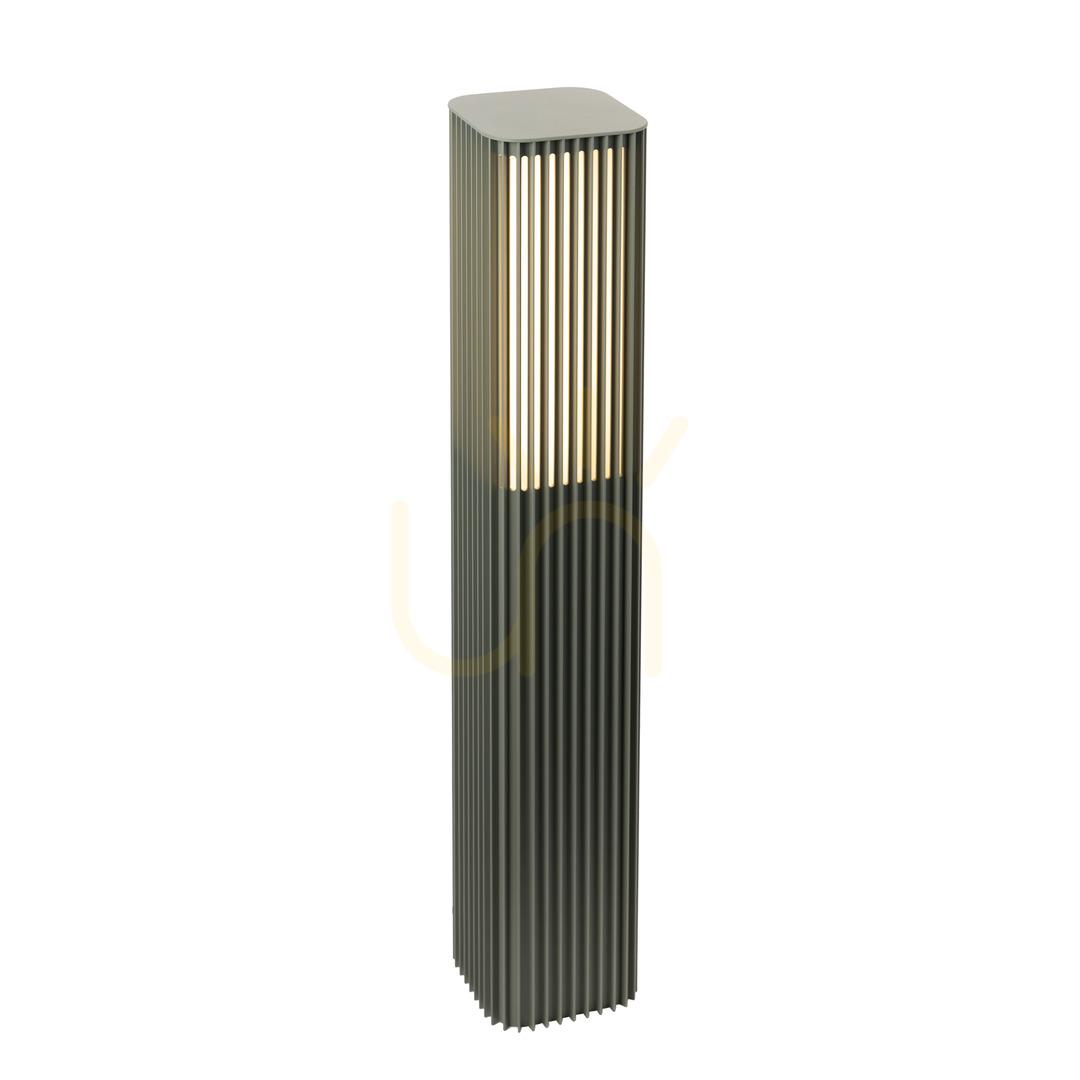
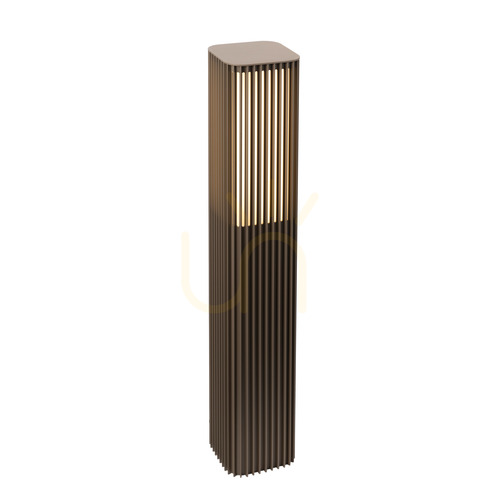
Astrid 2214CG is an 85 cm bollard light made from an extruded aluminium profile, powder-coated in cement grey (RAL 7033). Its cross-section is 14 × 14 cm with rounded corners, and vertical ribs run the full length of the post. In the upper section the ribs reveal a milky PMMA diffuser with the built-in LED module behind it.
What light it gives
The luminaire draws 10.4 W and delivers 239 lm at 2700 K, a warm, slightly yellowish light. The milky diffuser spreads it sideways, all around the post, and the manufacturer states a ULOR of 50%: half of the output goes above the horizontal. This is light that marks a path, a driveway or the edge of a terrace and brightens the immediate surroundings, rather than a strong beam aimed at the ground.
The bollard can be dimmed with a TRIAC phase dimmer — the manufacturer allows both trailing-edge (TE) and leading-edge (LE) control, so it works with both common types of dimmer.
Mounting and connection
The base is fixed with three bolts through ø9 mm holes spaced at 120° on a ø65 mm circle. Concrete anchors, ground anchors, a concrete-foundation adapter and a mounting adapter are sold separately, so the fixing method has to be chosen and ordered together with the light. The bollard weighs 6.24 kg.
The terminals take conductors up to 3 × 2.5 mm² and allow the supply to be looped through to the next fitting, and the EPDM gland accepts a round-sheathed cable up to 12.5 mm in diameter. Several bollards along a path can therefore run on one supply line. Because of the inrush current, the manufacturer gives the maximum number of fittings per circuit breaker: 46 on B10A, 75 on B16A, 74 on C10A and 120 on C16A. The luminaire is protection class I, so it must be connected to a protective earth conductor, and the manufacturer requires installation by a qualified person.
Where it fits
IP65 means a dust-tight housing that withstands water jets, and IK10 is the highest impact-resistance class, which matters wherever the post is exposed to accidental knocks, for example beside a driveway. Astrid is intended for gardens, terraces, driveways and streets. Its plain, ribbed form without ornament suits modern and Scandinavian architecture.