
UV-C lamp: how it works, how to use it safely
A UV-C lamp inactivates bacteria, viruses and fungi with radiation at about 254 nm, but only where that radiation reaches directly. The same radiation injures the eyes and skin, so an open lamp runs only in an empty room. We explain how to read the exposure time in the manufacturer’s instructions, when a room is too large for a given lamp, and which safeguards rule out accidental exposure.

Contents
- UV-C lamp in brief
- How a UV-C lamp works
- UV-C dose: irradiance times time
- Open lamp or enclosed air purifier?
- Which of our lamps is which type
- UV-C versus air filtration and ventilation
- UV-C lamp exposure time and how to read it
- Virucidal lamps and 99.9% – how to read efficacy claims
- Ozone-producing and ozone-free lamps
- Lamp life and output decline
- UV-C lamp safety
- A disinfection cycle step by step
- UV-C steriliser – what the lamp will not do
- Practices, gyms, waiting rooms – where UV-C makes sense
- A germicidal lamp at home – when is it worth considering?
- Frequently asked questions
- Which lamp to choose
UV-C lamp in brief
A UV-C lamp acts only on what it irradiates directly, and only at the dose the manufacturer has set. An open lamp is switched on only in an empty, secured room. With people present, only an enclosed air purifier designed for it by its manufacturer may run. The exposure time comes from the instructions, and the lamp does not replace cleaning or airing. Models of both types are in the Germicidal Lamps category.
How a UV-C lamp works
Ultraviolet is divided into three bands: UV-A (315–400 nm), UV-B (280–315 nm) and UV-C (100–280 nm). The germicidal effect lies mainly in the 200–280 nm range. The atmosphere absorbs practically all of the sun’s UV-C, which is why it has to be produced artificially for disinfection.
Nucleic acids (DNA and RNA) absorb radiation strongly around 260 nm. UV-C damages them, among other things by forming so-called pyrimidine photoproducts – abnormal bonds between neighbouring bases. At a sufficient dose the microorganism loses the ability to multiply. That is why technical documentation speaks of inactivation rather than “killing”. The method has been used for decades in water treatment and air disinfection. Technical reports of the International Commission on Illumination (CIE) describe it.
In practice you will come across three UV-C sources:
- Low-pressure mercury tubes (about 254 nm, precisely 253.7 nm) are the standard in germicidal lamps. They look like ordinary fluorescent tubes but have no phosphor, and the tube is made of a material that transmits UV-C. The bluish glow during operation is the visible part of the mercury spectrum. UV-C itself is invisible.
- UV-C LEDs (usually about 265–280 nm) contain no mercury and reach full output as soon as they are switched on, but they are still markedly less efficient than tubes. They are found mainly in small devices, such as boxes for disinfecting small objects.
- Far-UVC (222 nm) means filtered excimer lamps. They are already on the market, though not in our range. Research suggests this radiation penetrates the skin and the surface of the eye less deeply. Safety with people in the room still has to be assessed for the specific device: its spectrum, unwanted emissions, exposure and installation. A label saying “safe for people” is not enough.
UV-C dose: irradiance times time
What a cycle achieves depends on the dose:
dose (mJ/cm²) = irradiance (mW/cm²) × time (s)
Irradiance is also given in W/m², where 1 W/m² = 0.1 mW/cm². The manufacturer of the LumeeLamp Sterilizer Dual 36 F states a UV-C irradiance of 1.4 W/m² at a distance of 1 m, which is 0.14 mW/cm². At constant irradiance, one minute therefore gives about 8.4 mJ/cm² at that single point. That is not the dose throughout the room, and it is not proof of efficacy. Whether such a dose is enough depends on the microorganism and on the reduction you expect. Bacterial spores and mould spores usually need doses many times higher than most bacteria and viruses. That is why the manufacturer sets the cycle. Do not derive it from the lamp’s wattage, the room’s floor area or this example. The electrical power of a tube (e.g. 36 W) is not its UV-C output.
The formula leads to six rules that decide whether the lamp works at all:
- UV-C acts on what the lamp can “see”. Under a worktop, behind a chair, inside a drawer and in the folds of fabric the dose is close to zero, however long you irradiate.
- Irradiance falls with distance. For a point source, or at a large distance, it falls with the square of the distance: at twice the distance it is about four times lower. Close to a long tube or a lamp with several tubes the decline follows a different curve, so the manufacturer’s data count, not a general rule.
- A surface facing the lamp receives more than one lit at a sharp angle.
- Typical walls reflect only a small share of UV-C, so the radiation will not reach the corners by bouncing off them. Some surfaces, metal ones in particular, reflect it well enough for the reflection to burn the eyes.
- Dust, grease and biofilm absorb UV-C and shield microorganisms. Clean first, then use the lamp.
- Ordinary glass and most plastics block UV-C. Whatever lies behind a display-case pane or under film will not be disinfected.
Open lamp or enclosed air purifier?
An open lamp irradiates surfaces and air, but you may switch it on only in an empty, secured room. An enclosed UV-C air purifier treats only the air that passes through its housing. It may run with people present if its manufacturer designed that model for it.
An open lamp is also called a UV-C emitter or irradiator. Its tube is exposed, and it irradiates everything in its line of sight: worktops, equipment, the floor and the air. It comes as a ceiling or wall fitting, a lamp on a stand or a mobile unit on wheels.
In an enclosed air purifier the tube sits inside a chamber, and a fan draws air through it. No radiation should escape. For the unit to run while someone is in the room, four conditions must hold. The manufacturer designed the model for it, the unit is in closed mode, the housing is undamaged, and it is used according to the instructions. Its appearance or the word “flow-through” in its name proves nothing. An enclosed air purifier does not act on surfaces.
Airflow does not tell you how many microorganisms the unit inactivates. For the LumeeLamp Dual 36 F in closed mode, the manufacturer states 39 m³/h (silent mode) and 68 m³/h (turbo). In a 50 m³ room on turbo, air equal to about 1.4 times the room’s volume passes through the chamber in an hour. That does not mean all the air has been treated once, or that a specific reduction has been reached. Only the manufacturer’s test at the given airflow shows that, and in a real room it also matters how the air mixes. For a bedroom or a treatment room, check the noise: the same manufacturer states 33 dB in silent mode and 46 dB on turbo.
| Open lamp | Enclosed air purifier | |
|---|---|---|
| What it disinfects | surfaces in its line of sight and the air | only the air passing through the unit |
| People and animals in the room | never | yes, if the manufacturer permits it |
| Operation | a cycle with a time from the instructions | continuous |
| Typical use | after hours and between patients | waiting rooms, practices and rooms during the day |
There are also two in-between solutions. Dual-mode units work in open mode (the room must be empty) or closed mode, and the mode has to be switched before anyone enters. Duct modules are installed in a ventilation or air-conditioning system, where they irradiate the air supplied to the building. A ventilation designer and installer select and fit them, and a qualified electrician connects them.
Which of our lamps is which type
We assigned the following models in the Germicidal Lamps category to a type based on the manufacturer’s data:
- Care Antilia A-69 (75 cm and 135 cm) are open lamps for mounting on the ceiling, suspended or on a wall, with an adjustable beam angle. The manufacturer intends them for disinfecting closed rooms outside working hours or in breaks between visits, and recommends a timer. It lists a microwave motion sensor and a door-opening sensor as options. The fitting is connected by a qualified electrician.
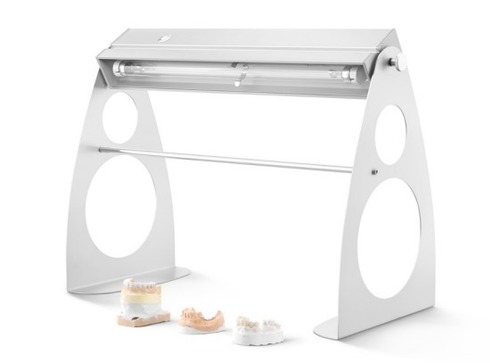
- Care LAB A-69 on a stand is an open lamp for treating surfaces on a worktop and workstation. Both versions have three factory-set time settings. The “+ timer” version comes with the timer included. It has a 30-second start delay, an audible signal at the end of the cycle and an hour counter with a replacement reminder after 9,000 hours. In the basic version the timer is an option.
- Care mobile MB-150 (4 tubes) is a mobile open lamp on a wheeled base, with a 5 or 10 m cable, for disinfecting rooms between visits. A timer is standard, a motion sensor optional.
- LumeeLamp Sterilizer Dual 36 F is a dual-mode unit, even though its product name calls it flow-through. In open mode it works as an open lamp. In closed mode it works as an enclosed air purifier with a fan and a dust filter with activated carbon, which the manufacturer permits to run with people in the room. The manufacturer states a 254 nm PL-L 36W/4P tube on a 2G11 base, an average tube life of 8,000 h and suitability for rooms of 15–20 m² (35–50 m³). The product sheet does not say which mode that range refers to – check the instructions.
- STERILIZER AirPRO 500–7500 is a duct module for ventilation and air-conditioning systems, specified individually by the manufacturer after measurements on site.
Not every model is available in every country – the category shows the current range.




UV-C versus air filtration and ventilation
A UV-C lamp, an air purifier with a filter and air exchange do three different things and do not replace one another.
A filter, such as HEPA, captures particles: dust, pollen, smoke particles and, with them, the microorganisms they carry. HEPA filter classes are defined by EN 1822; under test conditions an H13 filter retains at least 99.95% of particles of the size that is hardest to capture. That is a filter class, not a guarantee for the whole room, because the unit’s sealing, airflow and running time matter too. A HEPA filter does not remove gases or odours; activated carbon does that.
UV-C inactivates microorganisms but removes nothing from the air. Pollen, dust and smoke stay where they were. Opening windows or mechanical ventilation exchanges the air: it removes the carbon dioxide breathed out by occupants and dilutes everything else. A filter purifier and an enclosed UV-C air purifier only recirculate the air in the room.
For allergies and smog, choose a purifier with a filter (the Air purifiers category), not UV-C. To reduce microorganisms in the air of an occupied room, consider an enclosed UV-C air purifier designed for it or a filter purifier. Compare the confirmed output with the room’s volume. Surfaces, for example between patients or clients, are treated with an open lamp as a supplementary method. In every case you still need to ventilate.
UV-C lamp exposure time and how to read it
The exposure time depends on the irradiance of the specific lamp, so never apply a table meant for another model to your device. The manufacturer sets it for:
- the room’s volume (m³) or floor area (m²) – when irradiating a whole room,
- the distance from the surface – when treating a worktop or objects,
- the number and power of the tubes in the lamp,
- the target assumed, meaning the test microorganism and the reduction the calculation is based on.
How to use it:
- Work out the volume: length × width × height. A 4 × 5 m room with a 2.7 m ceiling is 54 m³.
- Choose the setting that covers at least that volume. Do not round down, and do not extrapolate the time yourself beyond the range in the instructions. A larger room needs a solution chosen by the manufacturer or a designer: several positions, several lamps or a more powerful unit. The manufacturer rates the LumeeLamp for 35–50 m³, so a 54 m³ room is outside that range.
- Count the time from the moment the lamp actually irradiates, not from pressing a button with a start delay.
- For worktops and objects, keep to the distance in the instructions. The side lying on a tray gets no dose. If the instructions provide for it, turn the objects over and repeat the cycle.
Care lamps have a factory-programmed time based on the room volume or the distance from the surface, with three settings chosen by a switch. A longer cycle raises the dose where the lamp shines, but it does not help in shadows, it wears the tube faster and it damages UV-sensitive materials. If the manufacturer has given no time table or documentation, do not invent a cycle; get the instructions first.
Virucidal lamps and 99.9% – how to read efficacy claims
“Virucidal lamp” or “99.9% effective” on the box refers to one specific microorganism under specific test conditions. 99.9% means a reduction by three orders of magnitude, a thousand times fewer microorganisms able to multiply. Before you believe the figure on the box, check:
- which microorganism was tested, and whether on a surface or in the air,
- at what distance, for how long and at what airflow,
- who tested it (which laboratory) and by what method,
- whether the test conditions match your room.
A declaration of conformity and the CE mark concern safety and regulatory compliance, not disinfection efficacy. Efficacy is shown by a test report. An efficacy claim always belongs to the manufacturer and applies only under the conditions described; we do not extend it. If someone promises a cure, protection against a particular disease or “sterile air throughout the house”, treat it as a warning sign.
Ozone-producing and ozone-free lamps
Besides the 254 nm line, a mercury tube also emits a line at about 185 nm, which splits oxygen in the air. The result is ozone (O₃). Whether ozone is produced depends, among other things, on the tube material: whether it transmits radiation at about 185 nm. Versions the manufacturer marks as ozone-free limit its emission.
Ozone has a characteristic “after the storm” smell. It irritates the airways and eyes, harms people, animals and plants, and with frequent contact speeds up the ageing of rubber and some plastics. After an ozone-producing lamp has run, you may enter only once the conditions in the instructions are met: the waiting time and the method of ventilating, ideally without going inside, for example through mechanical ventilation. The smell fading is not proof that it is safe to enter. The exposure time does not include this wait. At home, and wherever cycles are frequent, choose an ozone-free version. You will find information about ozone in the tube’s marking and in the instructions. If the product page does not state it, ask before you buy.
Lamp life and output decline
A tube’s average life tells you after how many hours it statistically stops working. Its useful germicidal life is shorter: the time during which it still gives enough UV-C. The replacement reminder in a timer is a third figure. For the LumeeLamp Dual 36 F the manufacturer states an average life of 8,000 h, and the timers of Care lamps remind you to replace the tube after 9,000 hours.
- UV-C output falls with operating time. A tube can still glow blue and yet give less UV-C. Replace it according to the hour counter and the manufacturer’s recommendations, not when it stops lighting.
- Frequent switching shortens the life of every fluorescent tube, not only germicidal ones.
- Dust and grease on the tube absorb UV-C. Clean it as the instructions say, always with the power disconnected and the tube cooled down. In enclosed units, also clean or replace the filter and check the housing.
- Replace the tube only with the type the manufacturer specifies (for the LumeeLamp: PL-L 36W/4P, 2G11). UV-C tubes have the same bases as ordinary ones (e.g. G13, 2G11). An ordinary tube in a germicidal lamp will disinfect nothing, and a UV-C tube fitted in an ordinary luminaire is a serious hazard to everyone in the room.
- Tubes contain mercury. Take used ones to a collection point for waste electrical equipment. If a tube breaks, leave the room, take children and pets out, air the room, do not vacuum the fragments, and follow the lamp manufacturer’s instructions.
- In a practice, keep a log of operating hours; the counter in the timer makes this much easier.
UV-C lamp safety
Never expose people, animals or plants to direct UV-C radiation. There is no exception for “a moment” or “just a quick look”. Reflected radiation can also cause harm, so not seeing the tube does not protect you. Do not treat a pane of glass or a partition as shielding.
In the eyes, UV-C causes photokeratitis: inflammation of the cornea caused by UV radiation, which may come with conjunctivitis. It is the same thing as snow blindness or welder’s flash. Symptoms appear with a delay, usually after a few hours (often 6–12 h, though it varies): pain, a gritty feeling under the eyelids, watering and sensitivity to light. If exposure has happened, stop it safely and contact a doctor straight away, without waiting for symptoms. Never look at a working lamp, not even to check whether it is on.
On the skin, UV-C causes erythema similar to sunburn. The manufacturers of our lamps warn that prolonged exposure can lead to irreversible tissue damage. The World Health Organization (WHO) explicitly warns against using UV lamps to disinfect hands or skin.
It happens fast. Directive 2006/25/EC on artificial optical radiation at work sets an effective exposure limit for ultraviolet of 30 J/m² over eight hours, spectrally weighted. At 254 nm the weighting factor is about 0.5, which gives about 60 J/m², or 6 mJ/cm². At the LumeeLamp’s 1.4 W/m², that limit is reached after about 43 seconds at a distance of 1 m from an open lamp. It is an occupational exposure limit, not a safe viewing time and not permission for brief exposure.
The photobiological safety standard for lamps, EN 62471 (IEC 62471), defines an exempt group (RG0, under the assessment conditions of the standard) and the low-risk (RG1), moderate-risk (RG2) and high-risk (RG3) groups. A product’s group comes from the manufacturer’s assessment, not from a single figure on a data sheet. UV lamp products are covered by a separate part of the standard, EN IEC 62471-6. For enclosed air purifiers, EN 60335-2-65, the standard for electric air-cleaning appliances, also matters. Check which of them the declaration of conformity lists and which risk group the documentation states. An irradiance like the one in the example signals a serious hazard, so exposure has to be ruled out by organisational and technical measures, not by “being careful”.
Children cannot see the danger, and the blue glow attracts their attention. Keep the lamp, the remote and the timer out of their reach. Never use an open lamp as a night light or to “disinfect” toys while a child is in the room. Before a cycle, take out every animal, including caged birds, rodents and terrarium animals, and every pot plant, because UV-C scorches leaves.
The installation must rule out accidental exposure, and the choice of safeguards depends on the device and the room. The most common are:
- a timer with a start delay (30 seconds in Care lamps) and an audible signal at the end,
- a remote control or a switch outside the room, in public premises ideally key-operated,
- a door contact sensor, which cuts the UV-C when the door opens,
- a motion sensor (PIR or microwave), which switches the irradiation off when it detects a person; it may react late or fail, so it does not replace access control or a door interlock,
- a warning sign and an indicator light on the door showing that a cycle is in progress.
The controls must also prevent the lamp from being switched on again while someone is inside. Permanently mounted fittings and the wiring of sensors and switches are connected by a qualified electrician. This is not a job for an amateur.
UV-C also yellows and embrittles many plastics, fades fabrics, paper and pictures and ages wood finishes. Take valuable or sensitive items out or cover them.
A disinfection cycle step by step
- Clean. Wash and dry the surfaces to be irradiated, because UV-C does not penetrate dirt.
- Clear the room. Take people and animals out, remove plants, put away or cover anything sensitive to UV.
- Position the lamp as the instructions say, at the recommended distance and direction. Open cupboards and drawers that are to be irradiated. In a large or cluttered room, plan several lamp positions to reduce shadows.
- Set the time according to the manufacturer’s instructions for the room volume or distance.
- Leave and start the lamp with a delay, by remote control or with a switch outside the door. Close the door and put up a warning sign.
- Before entering, make sure the UV-C is off, from signals and indicators outside the room, without looking in. An audible signal alone does not confirm it. After an ozone-producing lamp, wait as long as the instructions say.
- Log the operating time and check the tube’s hour counter.
UV-C steriliser – what the lamp will not do
The name “UV-C steriliser” promises more than the lamp does: UV-C disinfects, but it does not replace sterilisation or instrument reprocessing where procedures require them. Irradiation does not reach hinges, channels and shaded parts of instruments, so the process specified by their manufacturer applies.
The lamp does not remove dirt, dust, grease or allergens, so cleaning stays. It does not work in shadows, under a layer of dirt or through glass. It does not penetrate fabrics, sponges and porous materials; it reaches only their surface, and unevenly. One open lamp will not clean the air in a whole house either. It works in its own room and only while it is running, and when the household comes back and opens the doors, the air mixes again. Unlike some chemical disinfectants, UV-C leaves no residual effect. The lamp does not cure or prevent illness in people in the room, and it does not replace a doctor’s advice.
Practices, gyms, waiting rooms – where UV-C makes sense
Dental, medical, physiotherapy and beauty practices, tattoo studios and hair salons usually have two lamps. The first, an open lamp on the ceiling or a mobile one, runs after hours or between clients. The second, on a stand, treats the worktop. In the waiting room, you can consider an enclosed air purifier designed to run while people wait. UV-C is a supplementary method here: it does not replace the practice’s hygiene procedures, chemical disinfection or the sterilisation of instruments.
In gyms, changing rooms and washrooms, a mobile lamp after closing time works well. Training equipment casts a lot of shadows, so irradiating from several positions matters more here than a long cycle. Mats and handles still have to be washed.
In waiting rooms, offices, meeting rooms and hotels, enclosed air purifiers run during the day. In buildings with mechanical ventilation, duct modules specified as part of the system design are an option.
A germicidal lamp at home – when is it worth considering?
A germicidal lamp at home is an extra, not a condition for a healthy home: airing, handwashing and cleaning remain the basis. Consider one if you can empty and close a room for the whole cycle, or if you want an enclosed air purifier to run as an addition to airing.
In winter windows stay closed more often, so questions about UV-C lamps for the home multiply in this season. When someone at home is ill, an enclosed air purifier that its manufacturer permits to run with occupants can work in closed mode in their room as an addition to airing. It is not known whether this reduces infections among the rest of the household. When everyone has left the house, an empty room can be treated with an open lamp on a timer, once animals and plants are out.
An open lamp is suitable for a home only if you can reliably keep children, visitors and pets out of the room for the whole cycle. If you cannot guarantee that, choose an enclosed unit or do without UV-C.
Frequently asked questions
Can I stay in the room while a germicidal lamp is on?
Only with an enclosed air purifier that its manufacturer designed to run with people present, or with a dual-mode unit switched to closed mode, according to the instructions and with an undamaged housing. With an open lamp, never, not even for a moment.
How long should I irradiate a room with a UV-C lamp?
As long as the manufacturer states for the room’s volume or the distance from the surface. The time depends on the irradiance of the specific lamp, so there is no single universal figure. If the room is outside the lamp’s range, the manufacturer should choose the solution.
Does a UV-C lamp kill viruses? What is a virucidal lamp?
At a sufficient dose, UV-C also inactivates viruses, which is why such lamps are sometimes called virucidal. What reduction a given lamp achieves, at what distance and in what time, only the manufacturer’s test can tell, and only under its conditions. The lamp does not cure or protect the people in the room.
Do I need to ventilate after a cycle?
After an ozone-producing lamp, yes: follow the conditions in the instructions before anyone enters the room. An ozone-free lamp produces practically no ozone, so airing is not a condition for going back in. Ordinary airing still remains the basis, because the lamp does not exchange the air.
Can a germicidal lamp be used in a child’s room or around pets?
An open lamp only when the room is empty and secured against entry, and the lamp and its controls are kept out of the child’s reach afterwards. An enclosed air purifier that its manufacturer approves for it can run with the household and pets present, according to the instructions.
How do I know whether a UV-C tube still works?
The blue glow does not prove it, because UV-C is invisible and its output falls over time. Go by the hour counter and the manufacturer’s recommendations. Where a measurement is needed, a calibrated UV-C radiometer is used.
Colour-changing indicator cards only show that UV-C reached a spot; they do not measure the dose or the disinfection result.
What is the difference between a UV-C steriliser and a germicidal lamp?
Usually none, because “UV-C steriliser” is a trade name for the same devices. Technically, a UV-C lamp disinfects, meaning it reduces the number of microorganisms. Sterilisation is a process after which an item is free of viable microorganisms, including spores. In practices, that is the autoclave’s job.
Is a germicidal lamp suitable for a swimming pool or a pond?
The room models described in this article are not. Water is treated by a separate group of devices: enclosed UV-C reactors fitted in the filtration circuit. An open lamp above the water will not disinfect a pool, and it puts people and animals at risk.
Which lamp to choose
For a practice, salon or gym that you can empty after hours, use an open lamp with a timer and a start delay, and add a door contact sensor if it is permanently installed. For a room where people stay all day, choose an enclosed air purifier approved for that and check that its volume range covers your room. If you cannot guarantee an empty room at home, do not buy an open lamp. Before you buy, look in the instructions for the time table, the ozone information and the replacement tube type. Open lamps, a dual-mode unit and a duct module are in the Germicidal Lamps category.
Michał Smykowski


Maybe you will be interested in products from these categories?
Germicidal Lamps
Tags & Blog Categories