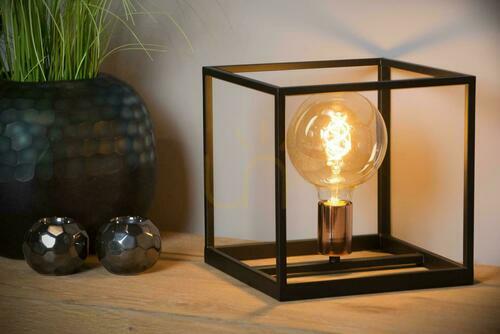
An industrial table lamp by the bed borrows its looks from factory floors and workshops: bare or blackened steel, cast iron, brass, exposed bolts and hinges, and very often a bulb you can see. Next to a bed, that style changes the brief – the bulb is often no longer hidden behind a shade, so its shape, colour and brightness decide whether the lamp feels cosy at night or glares at you over your book.
Workshop lamps were built to light a bench, not to help anyone fall asleep. The trick with industrial bedside lighting is keeping the rugged look while taming the light.
What makes a bedside lamp industrial
Honest materials and mechanics on show. Most industrial bedside lamps follow one of a handful of shapes:
-
Dome or workshop shade – a metal bowl that throws light down onto the pillow and bedside table. The most practical for reading.
-
Cage lamp – a wire guard around a bare bulb. Lovely glow, but it lights in every direction, so it suits ambient light better than reading.
-
Adjustable arm – a hinged or tilting head you can angle over the page; handy when the bedside table sits lower than the mattress.
-
Pipe or bare-bulb lamp – a steel tube or a chunky concrete or timber base with a decorative bulb on top.
Finishes run from powder-coated black and gunmetal to distressed raw steel, brass and copper. Wood and concrete usually turn up in the base, where they warm up the metal and add weight.
Getting the size right – and the pair
A useful rule of thumb: with the lamp on the bedside table, the bottom of the shade should sit roughly at eye level when you are propped up against the headboard, typically 40–50 cm above the mattress. The shade should also be narrower than the tabletop, or it will overhang and get knocked.
| What to check |
Typical for a bedside |
Industrial-specific catch |
| Lamp height |
usually 30–50 cm; large lamps 50–70 cm |
a heavy dome on a tall stem can feel top-heavy on a narrow table |
| Bulb holder |
E27 (ES) most often, also E14 (SES), G9 or GU10 |
UK bulbs are often B22 bayonet, which will not fit an E27 holder |
| Colour temperature |
warm white, 2200–2700 K |
filament bulbs often sit at 1800–2200 K – atmospheric but dim |
| Brightness for reading |
around 400–500 lm |
a clear bulb this bright glares; choose frosted or smoked glass |
| Switch |
on the base, inline on the flex, or touch |
an inline switch is the easiest to find in the dark |
| IP rating |
IP20 |
dry rooms only, so not for an en-suite |
A matching pair either side of a double bed gives a calm, hotel-like symmetry. Industrial interiors also wear a deliberate mismatch well: a task lamp with an arm on the reader's side, a low cage lamp as a soft night light on the other.
Bulbs, flex and plugs
Because the bulb is on display, it is half the design. Teardrop, globe and long tube filament bulbs give that amber workshop glow but rarely enough light to read by, so a dimmable LED is the sensible middle ground: dim for winding down, full brightness for a chapter. A bulb only dims when it is marked dimmable and paired with a compatible dimmer; a smart bulb does the same from your phone without extra hardware.
The maximum wattage on the label – often 40 W or 60 W – refers to old incandescent bulbs. An LED giving the same light draws a few watts and keeps a metal shade barely warm.
Lamps designed for continental Europe come with a continental plug. A fused UK adaptor that takes the earth works, but for a lamp you will use every night it is neater to have the plug swapped for a fused UK plug; if you are not confident wiring it, ask an electrician, especially on all-metal lamps, which rely on their earth connection.
Care and common mistakes
- Wipe powder-coated steel with a damp cloth; skip abrasive creams and scourers.
- Unlacquered brass and copper darken into a patina. Polish them if you want shine, but never polish a lacquered finish.
- Concrete is porous – dust it dry rather than wiping it wet.
- Only clean an exposed bulb when the lamp is unplugged and cool.
- A light lamp with a big shade tips over when the flex is tugged; look for a weighted base or rubber feet.
Frequently asked questions
What is the difference between vintage and industrial lamps?
Industrial takes its cues from factory and workshop lighting – metal, mechanics, function first. Vintage leans on domestic lamps from past decades, often with fabric shades or coloured glass. The two blend easily, usually through a filament bulb.
What does a modern industrial table lamp look like?
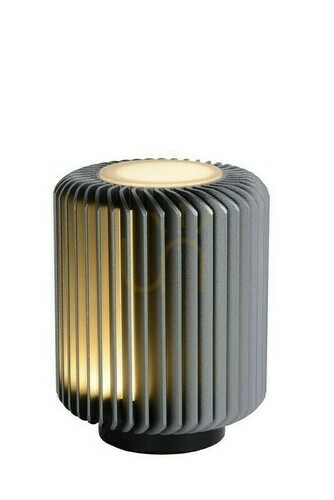
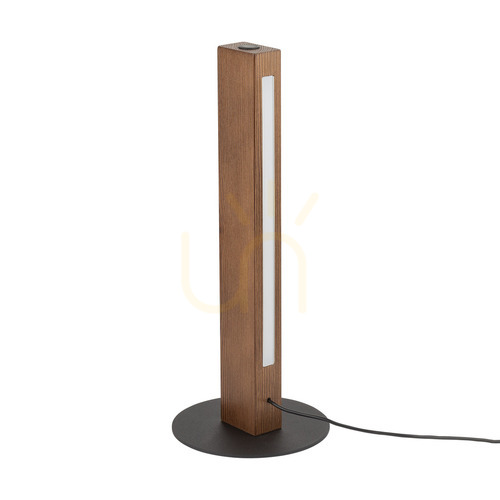
Cleaner lines, matt black or brushed finishes, and often an integrated LED in place of a bare bulb. It keeps the hinges and the metal but drops the distressed look.
Is a large industrial lamp too much for a bedside table?
Not if the table is wide enough and the shade sits at eye level from the bed. On a small table, go for an arm lamp that reaches over rather than a wide dome.
Should bedside lamps be a matching pair?
For a symmetrical bedroom, yes. In an industrial scheme, two different lamps in the same finish often look more natural than an identical set.
Can I use an industrial table lamp in the living room?
Of course. A dome or arm lamp works on a side table or a desk just as well; on a sideboard a taller lamp with a warmer bulb reads better.
Which bulb suits an industrial bedside lamp?
A warm white LED of about 2700 K, dimmable if possible. For the classic look, choose a filament LED in smoked or amber glass to soften the glare.
Drawn to the softer side of retro? Have a look at vintage bedside lamps, or read more about choosing bedside lamps in general.