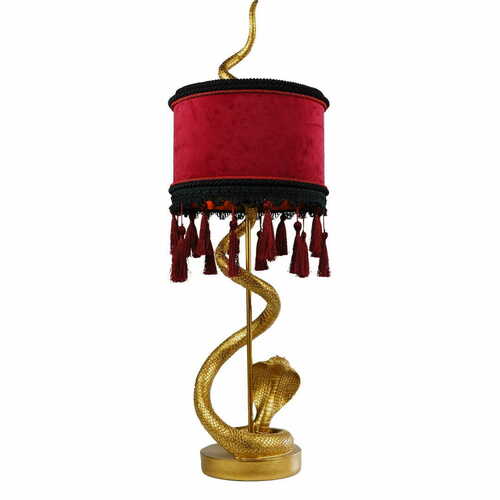
A red table lamp beside the bed is the quickest way to bring colour into a bedroom without repainting or buying new furniture. Most of the time the red is in the base or the shade and the lamp still gives ordinary warm white light for reading; a smaller group of bedside lights actually glow red, as a dim night light for feeds, nappy changes or a trip to the bathroom. Both are useful, but they do different jobs, so it pays to decide which one you need before you start comparing shapes.
Red base, red shade or red light?
What you see when the lamp is switched on depends on the shade. Lacquered metal and glazed ceramic are opaque: the red stays on the outside and a clean pool of white light falls on the bedside table and your book. A red fabric drum, tinted glass or translucent acrylic lets the light pass through the colour, so the room picks up a warm, rosy glow – lovely for winding down, but noticeably less useful light. A red ceramic base under a cream or white linen shade gives you the colour and full reading light at the same time, which is why it is such a common bedside combination.
Lamps that glow red work differently. They use red LEDs, a red bulb or the red setting of a colour-changing lamp, and when switched off they can look like any other white lamp.
Sizing a bedside lamp
| What to check |
Typical guide |
Why it matters |
| Overall height |
usually 35–60 cm on a standard bedside table |
the bottom of the shade should sit around chin height when you sit up in bed |
| Shade width |
no wider than the table top |
an overhanging shade gets knocked in the night |
| Brightness for reading |
roughly 250–450 lumens |
enough to read without lighting the whole room |
| Colour temperature |
2700–3000 K warm white |
keeps a red shade rich; cooler light flattens it |
| Night setting |
a few lumens, red or amber |
enough to see by without waking yourself up |
| Bulb fitting |
B22 bayonet, E27 or E14 small Edison |
check before you buy spare bulbs |
Red is the colour that suffers most from a poor bulb. An LED with a high colour rendering index (CRI 90 or above) shows reds as they are meant to look, on the lamp and on your skin, while a cool white bulb above about 4000 K can turn a cherry base dull and brownish.
Which red, and what to pair it with
Deep shades such as oxblood, burgundy and wine behave almost like a neutral and sit happily next to navy, bottle green, brass and dark wood. Brick, rust and terracotta warm up a room with linen bedding, rattan and pale oak. Bright pillar-box red is the bold option: it looks sharp against white, grey and black, and suits a teenager's room or a retro scheme. Patterned shades – a red marbled paper or a red-and-cream stripe – are an easy middle ground if a solid red feels like too much.
Pairs are the classic choice for a double bed and make a room feel ordered. A red lamp on one side and a different lamp on the other looks more relaxed and collected over time. Either way, make sure each sleeper can reach their own switch lying down: an in-line switch on the cable, a touch base or a dimmer.
Red light at night
Blue light, roughly 380–500 nm, has the strongest effect on melatonin. Red light, around 620–750 nm, affects the body clock far less and does not ruin your eyes' adjustment to the dark, which is why it is the gentlest choice for getting up in the night. It is not a sleep cure, though. There is little firm evidence that red light improves sleep on its own, and any lamp shining brightly into your eyes will keep you awake. If you use a colour-changing lamp, choose the pure red setting on its lowest level: orange and amber are often mixed from red and green, and green light has a stronger effect on melatonin.
In a nursery, keep the lamp within the parent's reach but away from the cot, and route the cable so a small child cannot pull it. That is a big reason cordless rechargeable lamps are popular for night feeds.
Safety and care
- Never exceed the maximum wattage marked on the lamp, especially under a fabric shade. LED bulbs run much cooler.
- Lamps marked Class II are double insulated and do not need an earth connection.
- Red fabrics fade in strong sunlight, so a lamp on a sunny windowsill will lose its colour over time.
- Wipe lacquer and ceramic with a dry or barely damp cloth, dust fabric shades with a soft brush or lint roller, and clean glass only once it has cooled.
Frequently asked questions
What colour should my bedside lamp be?
Whatever ties in with the room – red works well as the one strong accent in a calm scheme. The colour of the light matters more for sleep: warm white for reading, and only a dim red or amber glow if something stays on overnight.
What kind of lamp has a red shade?
Most often a ceramic or brass table lamp with a red fabric drum or empire shade, but red glass, lacquered metal domes and pleated shades are common too. A fabric shade tints the light; a metal one does not.
Can you read by a red bedside lamp?
Yes, if only the base or outside of the shade is red and the bulb is warm white. A lamp that glows red is fine for a quick task but tiring for reading.
Is red light good for sleep?
Darkness is best. If a light has to stay on, dim red disturbs sleep less than white or blue light, but it will not fix poor sleep by itself.
What is the best night lamp for a bedroom?
One that is dimmable, has a switch you can reach from bed and gives diffused light rather than a bare LED at eye level. For night feeds, add a red setting and no trailing cable.
What bedside lamps never date?
Simple shapes in a single solid colour – a round ceramic base, a plain drum shade, a metal dome. They let the red do the talking and are easy to move to another room later.
For more on choosing a light for the bedside, see bedside lamps. If you would like to carry the colour into the living room or hallway as well, have a look at red lamps.