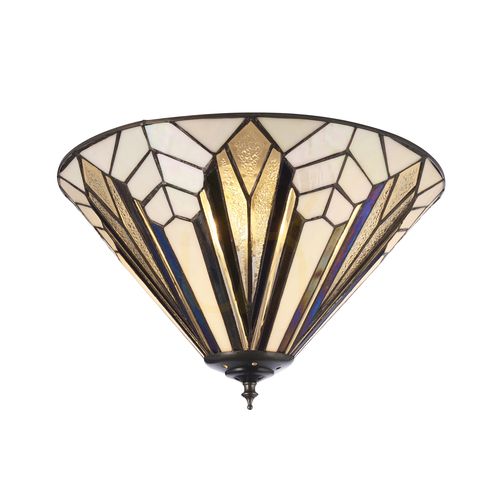
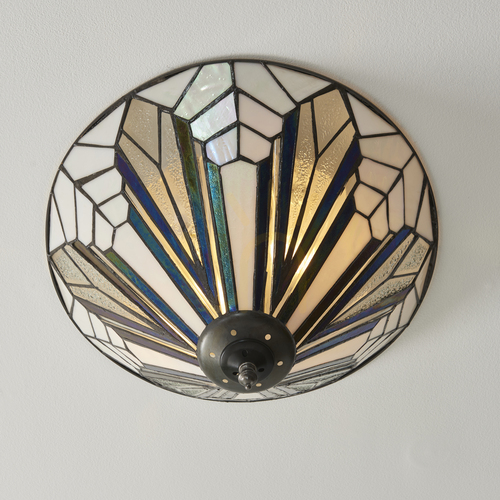
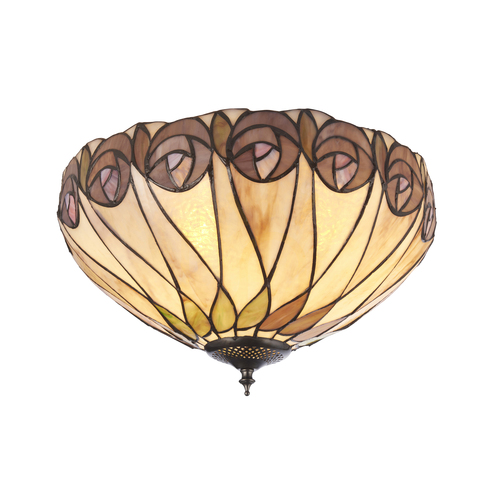
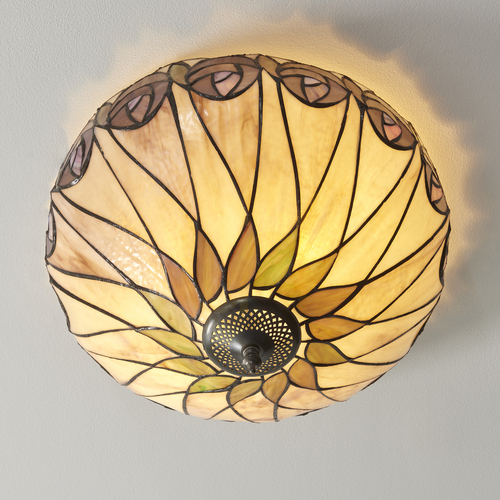
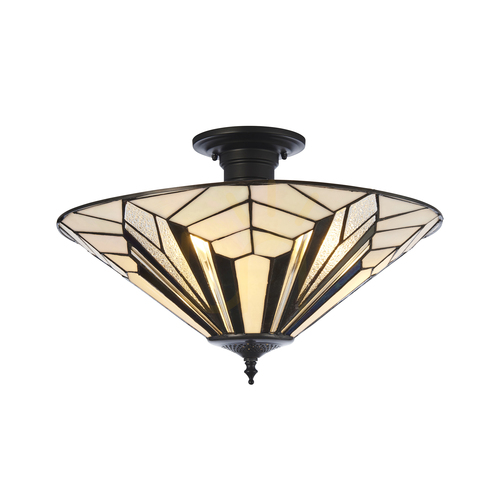
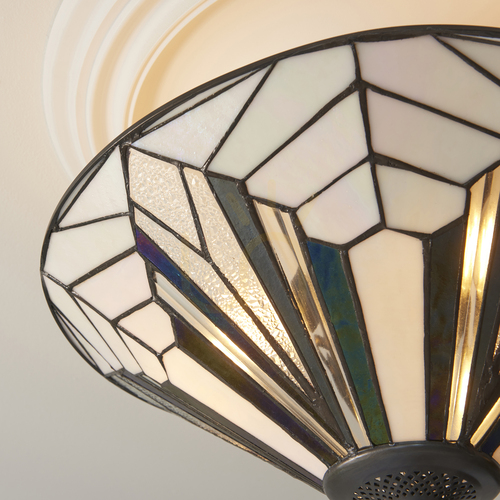
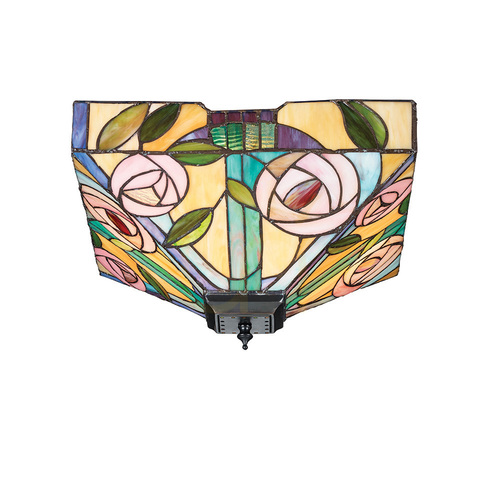
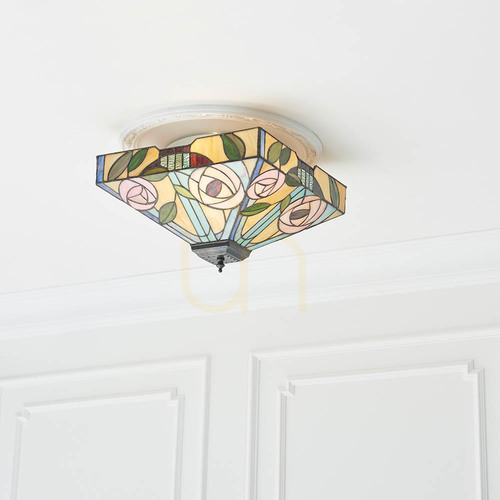
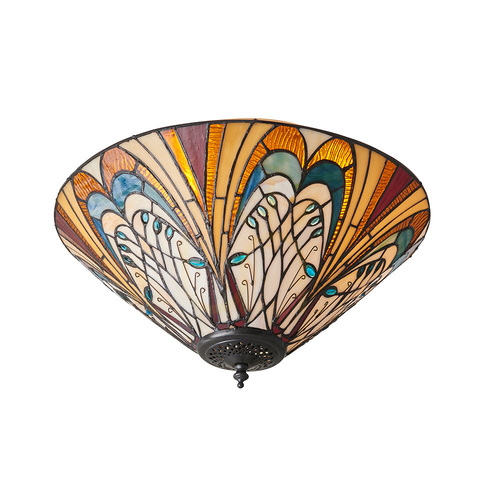
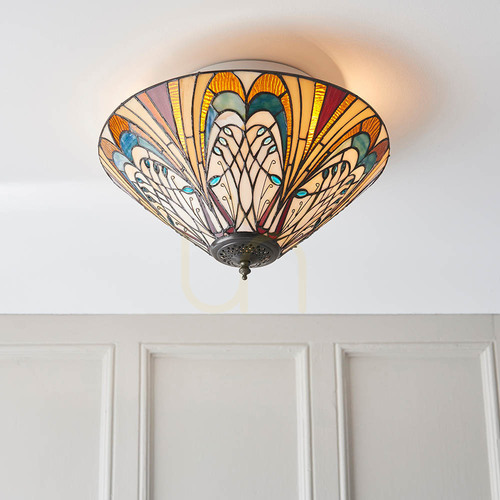
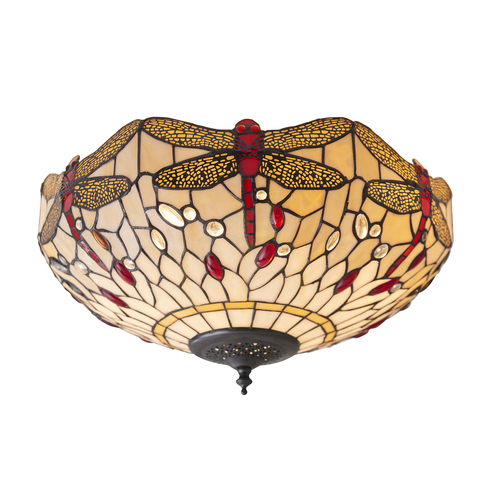
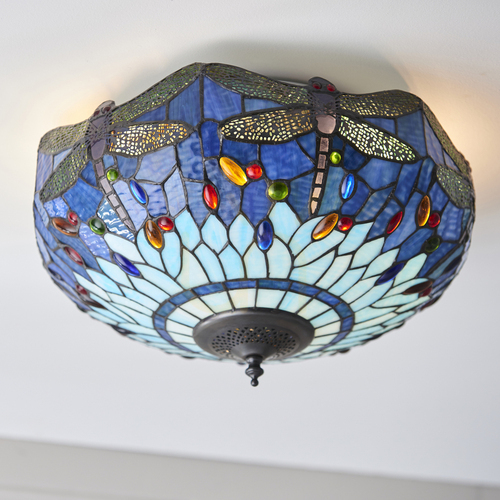
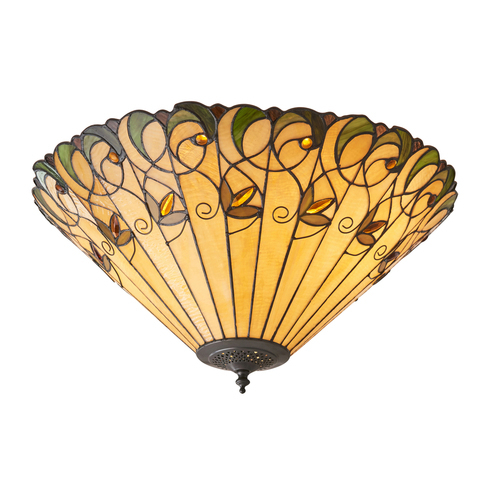
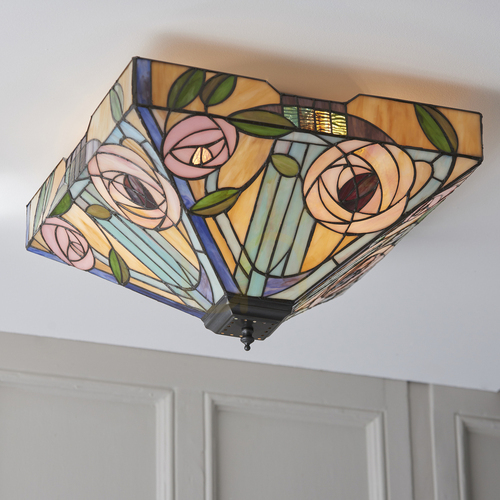
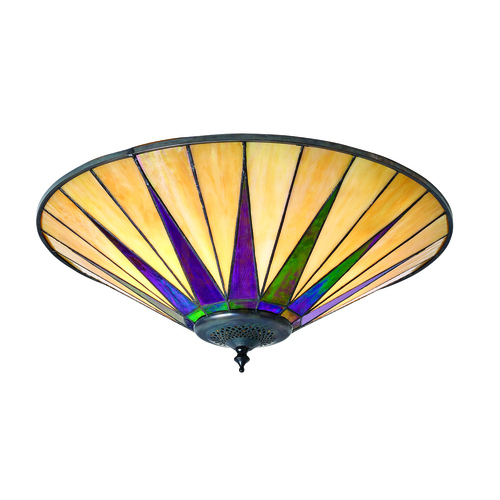
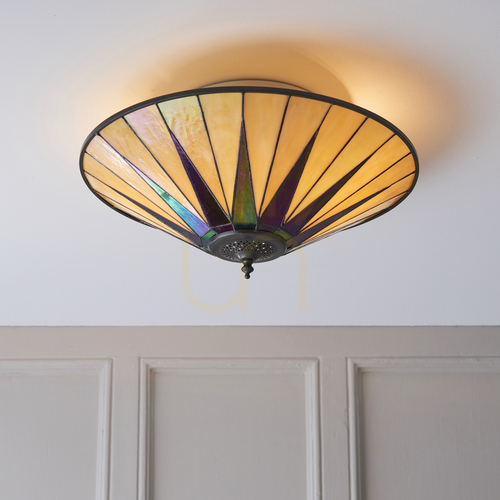
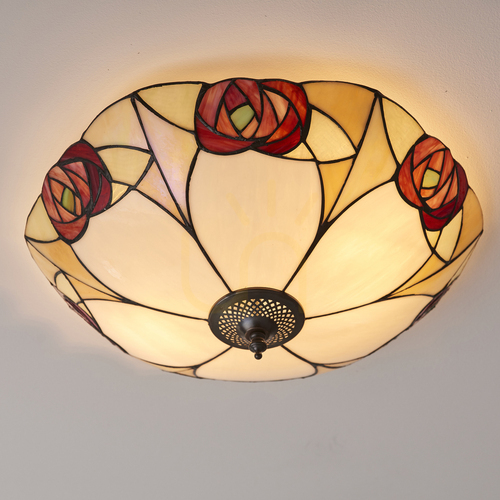
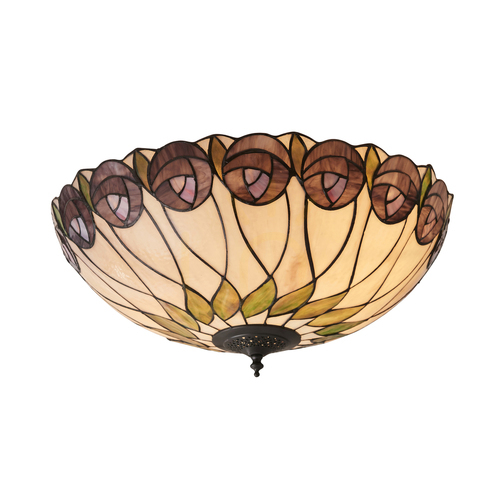
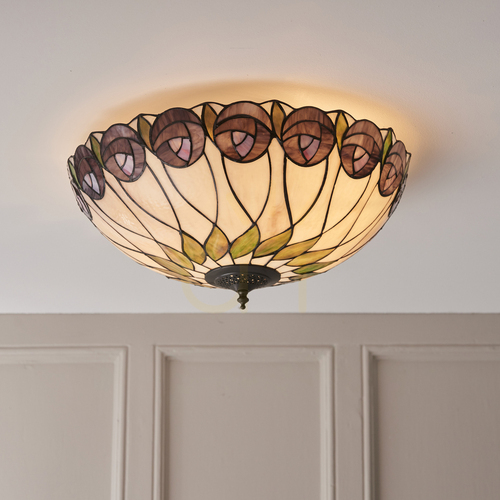
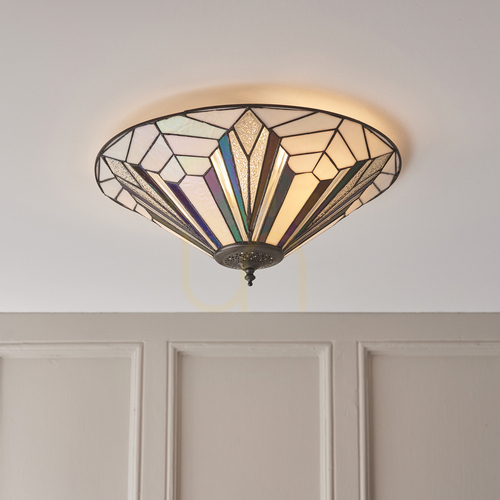
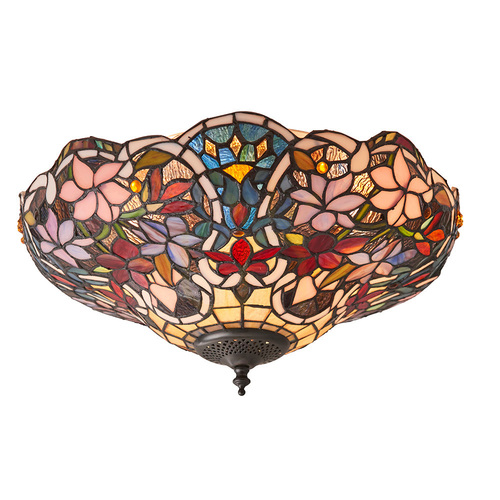
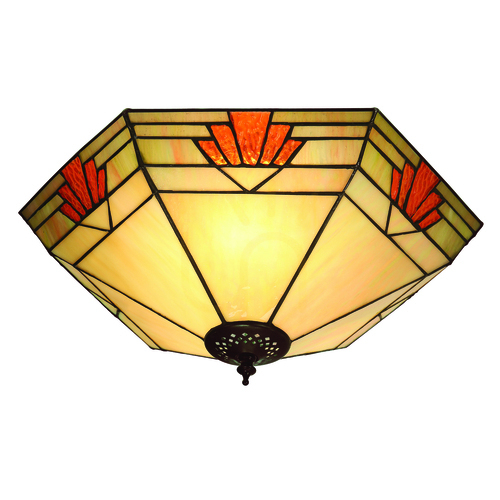
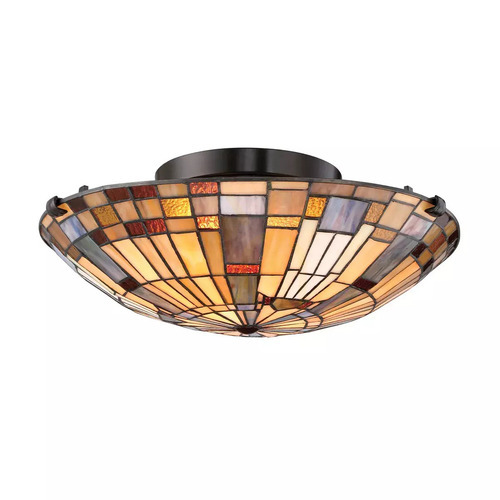
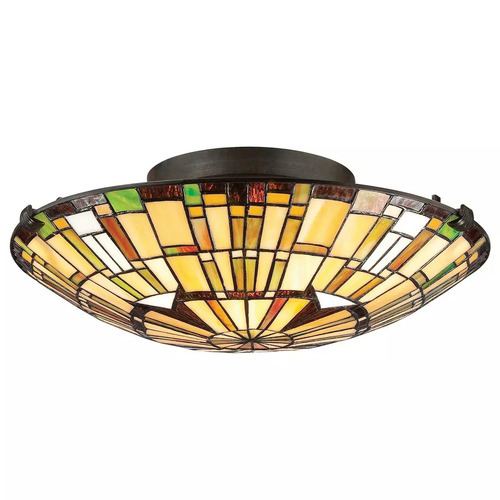
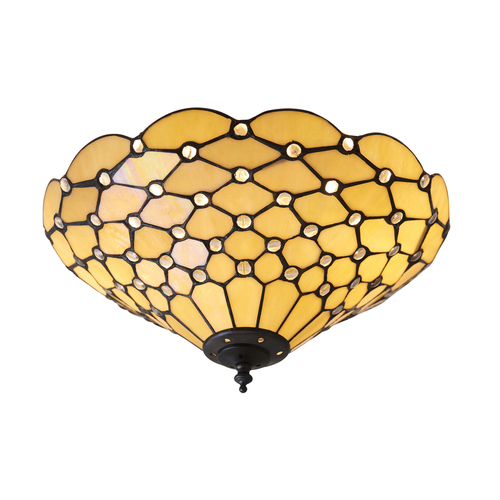
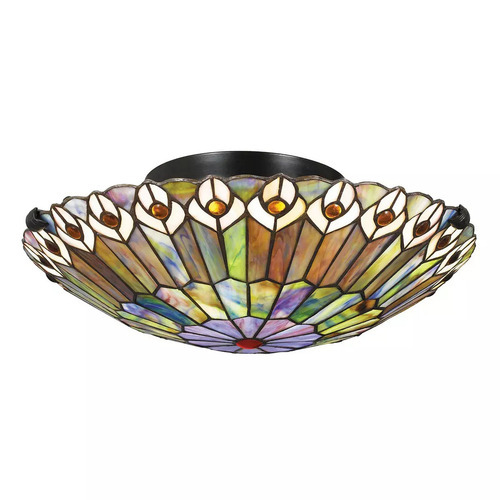
Tiffany ceiling lights are flush and semi-flush fittings whose shade is a bowl of real leaded stained glass — dozens or hundreds of individually cut pieces, each wrapped at the edge in adhesive copper foil and soldered to its neighbours. That copper-foil technique is what separates a Tiffany piece from a printed or moulded imitation: the joints are raised solder lines that catch the light, the glass has depth and variation inside each piece, and the whole shade has weight you can feel the moment you lift the box.
Where the style comes from
Louis Comfort Tiffany's New York studio developed the copper-foil method in the 1880s because lead came was too coarse for the curved, three-dimensional shades he wanted to make. Foil let a glazier follow a tight curve and set small irregular pieces, which is why a Tiffany shade can be a dragonfly wing or a wisteria canopy rather than a flat panel. Stylistically the work belongs to the same moment as European Art Nouveau — botanical motifs, insects, whiplash curves, an obsession with natural glass colour — and the two are best understood as the American and European branches of one idea. If the curves and the plant forms are what draw you rather than the glass itself, the European side is covered on art nouveau lamps.
The glass decides how the fitting behaves
An ordinary shade diffuses white light. A Tiffany shade filters it, and every colour in the glass subtracts something. That makes the glass palette a functional choice, not only an aesthetic one.
How each glass colour behaves lit and unlit
GlassLitSwitched off, in daylightSuits
Amber and honeyWarms the whole room; the most forgiving colour to live underReads as a soft bronze bowlLiving rooms, halls, anywhere used in the evening
Cream and opalescent whiteHighest light output of any Tiffany glass; keeps the pattern visible without tinting the roomMilky, almost pearlKitchens and landings where you need the light more than the colour
GreenCuts output noticeably and casts a cool tint on pale wallsThe richest colour of all when unlitRooms with timber, and as an accent rather than the only light
BlueAbsorbs the most; a blue-dominant shade needs help from another fittingDeep and dramatic against a white ceilingBedrooms and studies, on a dimmer
Red and roseThrows a warm blush onto the ceiling around the fittingNearly black in a dark room, glowing in sunDining rooms, where the blush is welcome
Colour temperature is the buying decision people get wrong
Cool light kills stained glass. Under a 4000 K lamp, amber turns muddy yellow-grey, red loses its depth and the solder lines go flat blue. Under 2700 K the same shade does what it was designed to do, because the glass was selected in the era of gas and incandescent light and its colours were chosen against a warm source. If a Tiffany shade has ever looked disappointing to you in someone's house, the lamp inside it was almost certainly the reason.
Use 2700 K as the default and 2200 K if the room is evening-only. Colour rendering matters as much as temperature: below CRI 90 the subtler glass tones collapse into each other. Every one of the 24 models behind this page takes an E27 lamp, so you are free to choose the lamp yourself, and none of them ships with one — which on this style is an advantage rather than an omission.
Two lampholders, and why that matters
23 of the 24 models carry two light points and one carries three. That is not a brightness decision, it is an evenness decision. A single central lamp inside a shallow leaded bowl produces a bright ring directly around the lamp and leaves the rim dim, so the pattern only half reads. Two lamps set apart inside the bowl light the glass across its whole width. When you compare fittings, count the lampholders before you compare lumens.
Weight, and the fixing that follows from it
Every model on this filter is recorded in both steel and glass — a soldered glass bowl on a steel frame and back plate. Real leaded glass is heavy: a 40 cm bowl runs to several kilograms before the frame is counted, and a semi-flush design puts that weight on a short stem where a pendant would put it on a chain. On a plasterboard ceiling this is the difference between a fitting that stays up and one that does not. Fix into a joist, or into a timber noggin set between joists, and treat plastic plasterboard plugs as unsuitable regardless of what the packet claims. On a concrete slab an expansion anchor into the slab itself, not into the plaster skim, is the equivalent.
The flush and semi-flush form is the reason to choose this page rather than a hanging fitting. 17 of the models are recorded specifically as flush-mount ceiling fittings, and the form exists for rooms with 230 to 250 cm ceilings, landings, halls and bedrooms where nothing may hang into the space. Interiors supplies most of the range, with Elstead Lighting contributing the rest. Of the recorded colours, 19 models are multicoloured — the classic mixed-glass mosaic — with a small number of brown, blue and beige dominant designs.
Living with a leaded shade
-
Cleaning: a dry soft brush, then a barely damp cloth. Never spray a glass cleaner at it — the liquid wicks under the foil line and eventually dulls the solder.
-
Heat: LED lamps are the right choice inside a closed leaded bowl, where a hot filament lamp cooks the solder and the ventilation is poor.
-
Dimming: worth having. Stained glass at 30 per cent output is the state most people actually want it in.
-
Repairs: a cracked piece is replaceable by any stained-glass workshop, which is genuinely not true of a moulded imitation shade.
Common questions
How do I tell real leaded glass from a printed imitation?
Run a finger over the outside. Real copper-foil work has raised solder lines you can feel and slight irregularities where pieces meet; a moulded shade is smooth under the paint, and the pattern lines are perfectly even. The weight in the hand tells you the same thing.
Will one of these light a whole room?
A cream or amber shade with two E27 lamps will light a hall or a bedroom. A green or blue dominant shade will not — the glass absorbs too much — and needs either a second fitting or wall lights alongside.
Can it go in a bathroom or a kitchen?
14 of the models carry a recorded IP20 rating, which means dry rooms. Away from a shower zone and away from directly above a hob, a flush Tiffany fitting is fine; inside those zones it is not the right choice.
Is there a hanging version of the same style?
Yes, and it is a different buy, because a suspended frame changes both the fixing and the sizing question. That is covered on Tiffany chandeliers.
Does Tiffany work in a modern room?
It works better than most people expect, provided it is the only ornamental object overhead. Against plain plaster and a pale floor a leaded bowl reads as a piece of glass art. Against patterned wallpaper and a second decorative fitting it reads as clutter. The same rule governs art nouveau chandeliers, which share the botanical vocabulary.