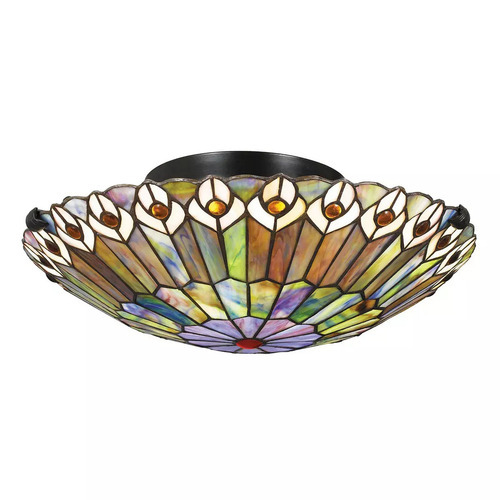
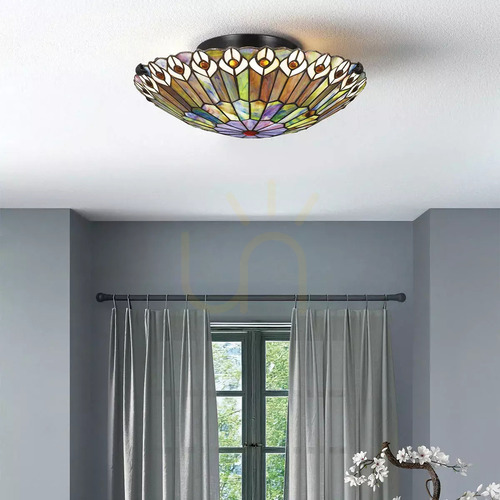
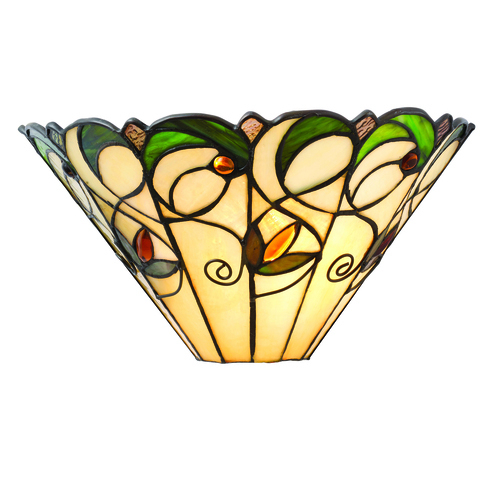
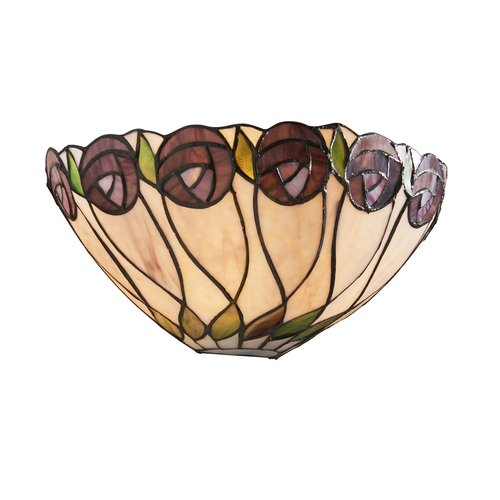
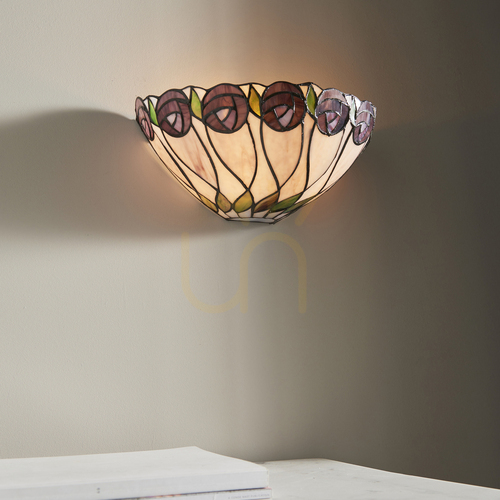
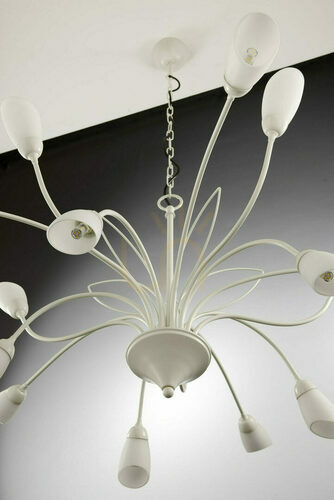
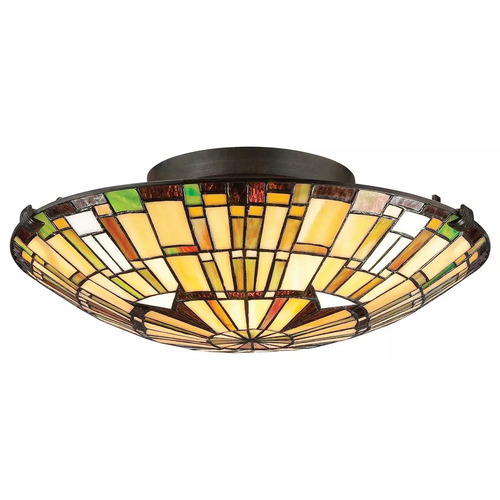
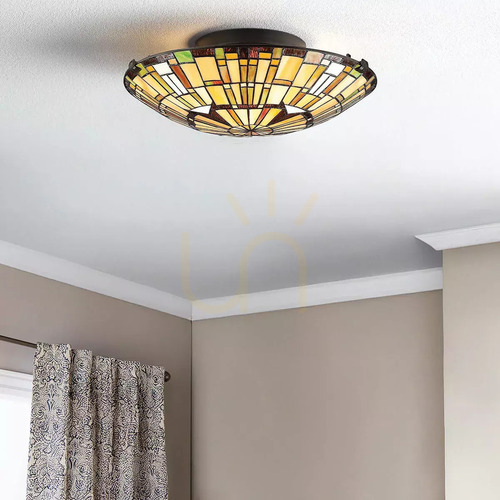
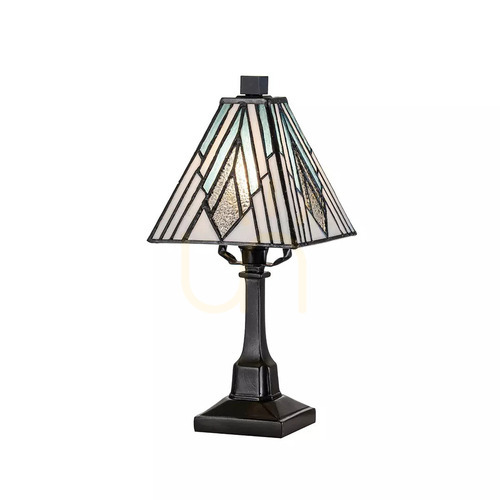
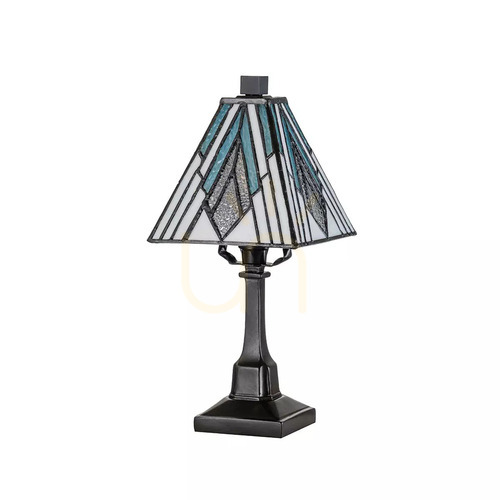
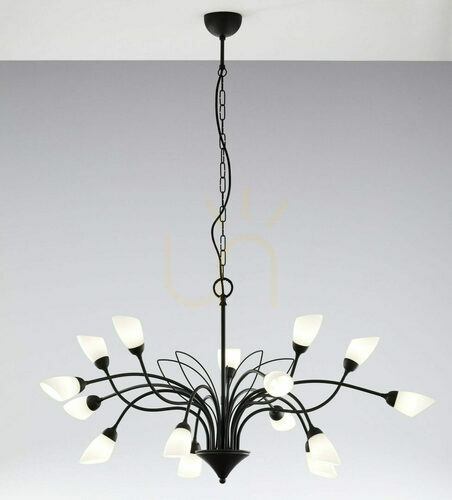
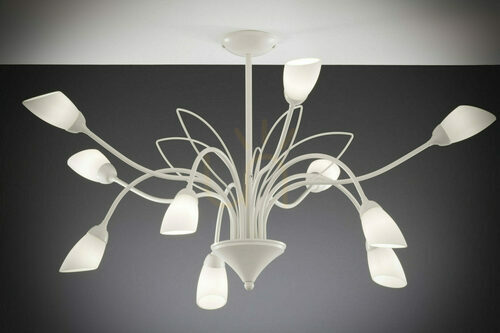
Lamps art nouveau — the style that ran from about 1890 to 1910 — took the one thing every previous lighting tradition had avoided and made it the subject: the curve that does not repeat. Stems rise like plant stalks and bend back on themselves, arms end in tulip or lily heads, glass is tinted and iridescent rather than clear, and bronze is patinated green or brown instead of polished. Nothing on a genuine piece is symmetrical for its own sake. If you can fold the drawing down the middle and both halves match, it is probably a different style.
How to recognise it in four features
-
The whiplash line. A long S-curve that accelerates and then snaps back, taken from a plant stem under tension. It appears in the arms of a chandelier, in the stem of a table lamp, in the lead lines of a glass shade. It is the single most reliable identifier of the period.
-
Botany and insects, drawn from life. Not a stylised rosette but a specific plant — a poppy, a wisteria, an iris, a magnolia — and the dragonflies, beetles and moths that go with them. The period took its motifs from botanical illustration and Japanese woodblock prints, which were arriving in Paris in quantity at exactly that moment.
-
Glass that is coloured all the way through. Cameo glass with layers cut back to reveal a landscape, opalescent glass that shifts from amber to green, iridescent surfaces achieved by exposing hot glass to metallic vapour. The glass is not a diffuser with a pattern painted on it; the colour is the material.
-
Patinated metal. Bronze and brass allowed to darken, sometimes gilded in the recesses only. Bright chrome and mirror-polished brass belong to the decades either side, not to this one.
Art nouveau and art deco are not neighbours
These two get confused constantly and they are opposite instincts, separated by a world war and by an entirely different idea of what a machine is for.
Two styles, thirty years apart
|
Art nouveau, roughly 1890 to 1910 |
Art deco, roughly 1920 to 1939 |
| Line |
Organic, asymmetric, the whiplash curve |
Geometric, stepped, symmetrical |
| Motifs |
Plants, insects, the human figure with flowing hair |
Sunbursts, chevrons, fluting, the ziggurat |
| Glass |
Coloured, opalescent, iridescent, leaded |
Frosted, moulded, opal white, clear and cut |
| Metal |
Patinated bronze, darkened brass |
Chrome, nickel, polished brass |
| Attitude to machines |
Suspicious. The value is in the hand of the maker |
Enthusiastic. The machine age is the subject |
If you are choosing between them for a room, the practical difference is that art nouveau softens a hard interior and art deco sharpens a soft one. Art deco lamps covers the second of the two.
The regional names, which are all the same style
Jugendstil
Germany and Austria. Slightly more restrained, with the botanical motif often reduced to a stylised line. The Vienna branch pushed further towards the grid and effectively invented the transition to art deco.
Liberty and stile floreale
Italy, named after the London shop that sold the fabrics. Lighter and more decorative, with wrought iron used where France used bronze.
Modernisme
Catalonia. The most structural version, where the curve runs through the whole building rather than the fittings alone, and where wrought iron and ceramic mosaic do the work that glass does elsewhere.
Tiffany
The American branch, and the one with the strongest surviving identity. Leaded glass shades assembled from hundreds of individually cut pieces, in dragonfly, wisteria and laburnum patterns, over bronze bases. It has its own rules about how the glass is made and lit — see Tiffany chandeliers for the ceiling forms.
Room by room
-
Hall and stairwell. The best home for the style, because a curved bronze arm reads properly against a plain wall and there is height for the form to unfold. A single fitting is enough.
-
Dining room. A tulip or lily shade hung 75 to 85 cm above the tabletop. Coloured glass over a table changes the colour of the food, so keep the tint light — amber and pale green are safe, deep blue and red are not.
-
Living room. A table lamp with a leaded or cameo glass shade on a side table, used as a low warm light rather than as the room's main source. This is where the style is most comfortable in a modern house.
-
Bedroom. A pair of wall brackets with small tulip shades, mounted 1.1 to 1.25 m from the floor. The upward-facing tulip is the period's own shape and it throws light onto the ceiling rather than into your eyes.
-
Bathroom. Difficult. Leaded glass and patinated bronze do not enjoy constant humidity, and the protection rating a bathroom requires rules out most period-style fittings. Choose a different room for this style.
Lighting coloured glass properly
This is the part that most often goes wrong, because a shade designed for a 1900 filament behaves very differently under a modern source.
- Coloured and leaded glass wants a warm source — 2200 to 2700 K. A neutral or cool lamp behind amber glass turns it a flat mustard and kills the depth entirely.
- The lamp should be diffuse, not a point source. Leaded glass shows every bright spot behind it as a visible hot patch, and a small high-output LED chip inside a large shade produces exactly that. A frosted globe lamp spreads the light across the whole inside of the shade.
- Output can be low. These shades transmit far less light than clear glass, so the lamp brightness you would choose for a plain shade will be uncomfortable here. 400 to 600 lumens is usually right for a table lamp.
- European fittings in this style take E27 or E14 on 230 V, which keeps the source replaceable — worth having, since getting the colour temperature right behind coloured glass usually takes one attempt to correct.
- A dimmer helps more here than on any other style, because the colour of the glass shifts as the lamp warms and dims. That shift is most of the appeal.
Questions people ask
Does art nouveau work in a modern flat?
One piece does, and more than one usually does not. The style is dense and it was designed for rooms that were equally dense. Against plain plaster and simple furniture, a single patinated bronze fitting with coloured glass reads as a deliberate object; three of them read as a museum room.
Is it the same as Tiffany?
Tiffany is the American branch of art nouveau, so it belongs inside the style rather than beside it. The distinguishing feature is the construction: hundreds of individually cut pieces of glass wrapped in copper foil and soldered, rather than a blown or cast shade. European art nouveau more often uses cameo, opalescent or moulded glass in one piece.
Was there such a thing as a period electric fitting?
Yes, and that is part of why the style looks the way it does. Domestic electric light arrived in the 1880s and 1890s, at exactly the moment this style was forming, so art nouveau is the first decorative tradition drawn for the electric lamp rather than adapted from a candle or a gas mantle. That is why the shades point downward and outward in ways a gasolier never could.
What should I buy first?
A single fitting in the room people arrive in — a hall or a stairwell — where it has space around it and gets seen from more than one level. Art nouveau chandeliers covers the multi-arm frames for exactly that position, including how to size one against a stairwell.
How do I stop it looking like a theme?
Keep everything else plain. The period's own interiors were saturated, but a modern room reads the style as a signal rather than as a whole language, and one signal is enough. Plain walls, plain furniture, one curved bronze object.