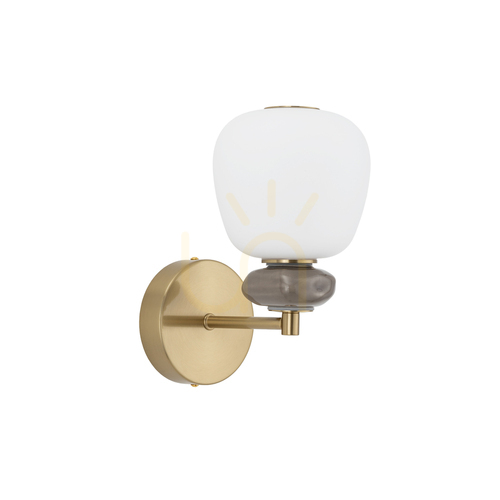
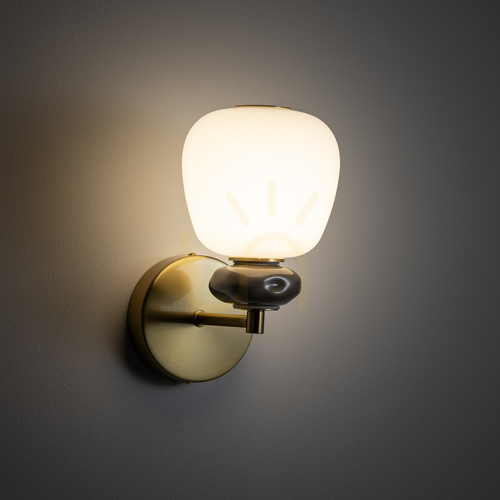
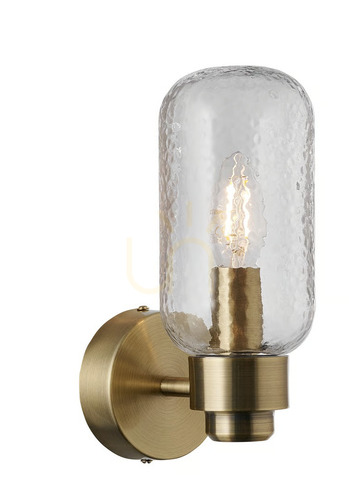
Art Deco lamps belong to a period with hard edges: roughly 1920 to 1939, named after the Paris Exposition Internationale des Arts Décoratifs et Industriels Modernes of 1925, and built out of brass, chrome, nickel, opal and smoked glass, marble, onyx and black lacquer. It is the first decorative style that took its shapes from machinery and from the new skyscrapers rather than from plants, and that is the reason it still reads as modern a century later. It is also the style most often faked by putting a gold ring around a smoked glass ball, so the useful thing this page can give you is a way to tell the difference.
Five tests for the real geometry
Look at any fitting sold as Art Deco and run it past these. Three of the five is usually enough.
-
Steps, not curves. The signature move of the period is the ziggurat: a stack of discs, rings or tiers that each step in as they rise, borrowed straight from the setbacks of a 1920s tower. A single smooth dome is not it.
-
Fluting and reeding. Parallel vertical grooves cut into glass, or parallel ribs standing proud of it. Both come out of classical column shafts and both appear everywhere in the period, on shades, on stems, on the metal collars between them.
-
Symmetry about a vertical axis. Deco compositions are balanced and frontal. Asymmetry belongs to the style that preceded it.
-
A hard material meeting a warm one. Marble or onyx against brass. Black lacquer against chrome. Alabaster against bronze. The contrast of a cold mineral with a polished metal is the period's favourite gesture, and it is the detail a cheap copy skips, because stone costs money.
-
The fan, the sunburst and the chevron. Radiating lines, stepped triangles and zigzags, most often on the shade edge or the backplate.
What is not Art Deco: bare filament bulbs on black flex, a plain brass sphere, a cage of thin rods. Those are industrial and mid-century motifs, and they arrived after this period ended. The other frequent confusion is with art nouveau lamps, which run about 1890 to 1910 and are organic, asymmetric and plant-derived — Art Deco is the reaction against exactly that.
The glass is the decision
Almost every choice you make on this page comes down to what the glass does to the light source behind it, and the three period materials behave completely differently.
Glass types in Art Deco fittings and what each does to glare
GlassWhat it does to the lightBulb it needs
Fluted or reeded clear glassEach groove behaves as a small cylindrical lens. It smears the image of the filament sideways into a row of narrow bright lines, so the shade sparkles and the source is broken up — but the source is still visible, and its brightness is not reduced.A low-brightness source: a frosted lamp, or a long filament LED where the light comes off a long line rather than a point.
Opal glass, white through the thicknessScatters the light completely. The whole shade becomes an even glowing surface, the filament disappears from every angle, and the fitting can be looked at directly.Almost anything that fits and stays within the stated wattage. This is the forgiving option.
Alabaster, or plaster and resin imitating itTransmits warmly and unevenly, with the veining showing as darker figures in a lit field. Historically used for bowl uplighters hung on chains.A diffused source, and one with good colour rendering, or the veining goes flat and grey.
Smoked or amber glassCuts output and warms the colour, without hiding anything. A clear bulb behind smoked glass is as glaring as a clear bulb without it, only browner.Frosted, always, and expect to need more lumens than the same fitting in clear glass.
The short version: fluting shapes light, opal hides the source. If a fitting hangs at eye level or sits on a table beside a chair, and the glass is clear or fluted, the bulb you buy is doing half the design work.
Metals, and how they age
-
Brass. The period's default. Unlacquered brass is a living finish — it darkens over months and takes fingerprints, which some people buy it for. Lacquered brass holds its colour and cannot be polished back once the lacquer wears through in one place. Both dislike bathrooms.
-
Chrome. Cold, bright and hard. Correct for the machine-age end of the style, and the finish that survives a damp room best.
-
Nickel. Warmer and softer than chrome, slightly grey, and much closer to what genuine Parisian fittings of the 1920s were plated with. It is worth knowing that chrome and nickel are not interchangeable in a room where one is already installed.
-
Black lacquer and bronze. The counterweight to all that metal. A black stem under a brass collar is the period reading of the same shape, and it hides a lot in a small room.
Light source and colour
Every one of these fittings was designed under tungsten light, and colour temperature is what decides whether it looks right or looks like a reproduction.
- 2700 K is the safe warm white. 2200 K is closer to the actual period, and it suits brass, amber glass and marble particularly well in an evening room.
- Above 3000 K, brass turns greenish, alabaster goes grey and smoked glass looks dirty. This is the single most common way a good Art Deco fitting is spoiled.
- CRI 90 or better wherever there is stone, wood or metal to look at, which on this page is everywhere.
- Fittings sold in the EU run at 230 V on E27, E14, G9 or GU10 sockets, or on integrated LED modules. Where the bulb is visible, the shape of the bulb matters as much as its output — a globe or a tubular filament lamp reads as period, a compact spiral does not.
- Dimming suits the style. Use a trailing-edge dimmer with retrofit LED lamps, check that the lamps state that they are dimmable, and respect the dimmer's minimum load.
Where each type belongs
The style covers every fitting in the house, and the practical constraints differ by type rather than by decade. Overhead, start from ceiling lights art deco, which sets out the choice between a hanging fitting and a flush one against your ceiling height. For a hallway, a stair or a dining room, chandeliers art deco covers the tiered and multi-arm fittings the period is known for. At eye level, wall lights art deco handles the fan-shaped shell uplighters and the pairs that flank a mirror. On a surface, see table lamps art deco, where the marble and onyx bases live.
Questions people ask
Is Art Deco the same as Art Nouveau?
No, and they are thirty years apart. Art Nouveau, roughly 1890 to 1910, is asymmetric, organic and drawn from stems, flowers and whiplash curves. Art Deco is symmetric, geometric and machine-derived. Putting one in a room furnished for the other is the most visible mismatch in period lighting.
Will unlacquered brass tarnish?
Yes, deliberately. It darkens unevenly, faster where hands touch it, and a light polish brings it back. If you want the colour it arrives in to stay, buy lacquered — but accept that lacquer eventually fails at the wear points and cannot be repaired invisibly.
Does Art Deco work in a modern flat?
Better than most period styles, because the shapes are geometric rather than ornate. A stepped brass pendant over a plain table sits comfortably where a carved fitting would not. The limit is quantity: one or two strong fittings in a room, not six.
What size fitting does my room need?
For a fitting in the middle of a room, add the room's length and width in metres and read the result as centimetres of diameter — a 4 by 5 m room takes something around 90 cm. Over a dining table, ignore the room and use the table: shade width about one third to one half of the table width.
Can I mix brass and chrome?
Within one fitting, the period did it constantly — a chrome stem with brass collars is authentic. Across a room it is harder, and the reliable version is to keep one metal on the fittings and let the other appear in the hardware and the frames.