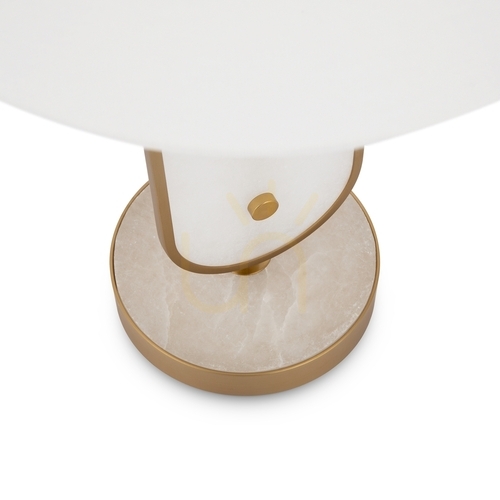
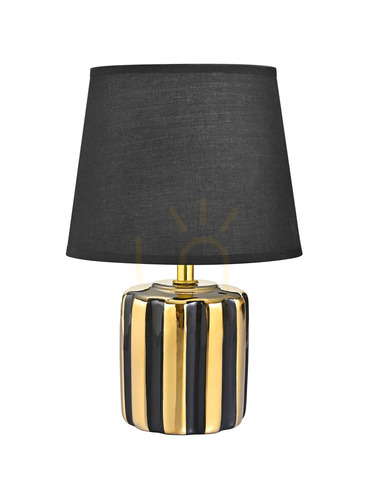
Art Deco table lamps are the part of the style where the materials do the talking. The interwar decades put a cold mineral under a warm metal and lit a piece of glass on top of it: a stepped block of marble or onyx carrying a chromed stem and a frosted globe; a black lacquered column with brass collars and an opal cone; an alabaster dish on a bronze foot. That combination of stone, metal and glass is the period's signature, and it is also the reason a good example feels different in the hand from anything else on a sideboard — a real one is heavy.
The base tells you what you are buying
Period base materials and how they behave
| Material |
What it looks like lit |
What to know before it arrives |
| Marble |
Matt, veined, absorbs light rather than reflecting it — the visual anchor under a bright shade |
Heavy and porous. It stains from oil and wine, so a coaster is not optional on a dining sideboard, and the felt on the underside protects a veneered top from scratching. |
| Onyx |
Banded, translucent at the edges, glows slightly where light catches it |
Softer than marble and more brittle at thin sections. Genuine banding is irregular; a printed imitation repeats. |
| Chromed or nickelled metal |
Bright, hard, reflects the room |
Chrome is colder and bluer, nickel warmer and slightly grey. Nickel is closer to the original French plating, and it does not show fingerprints as badly. |
| Black lacquer, bronze, patinated brass |
Recedes, letting the shade be the whole object |
The right choice in a small room, where a stone base plus a large shade becomes visually heavy. |
| Alabaster and plaster |
Warm, uneven transmission with the veining reading as darker figures |
Chips at the rim and cannot be repaired invisibly. Wants a high colour rendering source or the veining goes grey. |
The period also produced the figural lamp — a bronze or spelter dancer, an athlete, a bird, holding or standing beside a glass shade. They were the fashionable objects of the late 1920s and they are the hardest part of the style to place in a modern room: one is a centrepiece, two in the same room is a collection.
Proportion on the surface it stands on
The measurement that decides everything is where the bottom of the shade sits relative to the eye of somebody sitting nearby. Too high and you look straight at the source; too low and the light pools on the table and lights nothing else.
-
Side table beside an armchair, 50 to 60 cm high: a lamp 45 to 60 cm tall. Sit down and check that the bottom of the shade is at or just below your eye — around 105 to 120 cm from the floor.
-
Sideboard or console, 75 to 90 cm high: a lamp 40 to 55 cm tall, giving a total height of roughly 1.2 to 1.4 m. Above that it starts arguing with whatever hangs on the wall behind it.
-
Bedside table: 40 to 55 cm tall, with the shade shielding the source from somebody sitting up in bed, and a switch you can reach from the pillow. A stepped stone base is stable, which matters more here than anywhere else in the house.
-
Width: keep the shade narrower than the surface, with a hand's width of table visible each side. Under a mirror, the shade should not overlap the frame.
-
A pair on a long sideboard sits at the quarter points, not hard against the ends.
The shade and the bulb behind it
This is where most Art Deco table lamps are won or lost, because the period's favourite glass does not hide a light source.
-
Opal glass — white right through — scatters everything. The shade becomes an even glowing surface, the filament vanishes from every angle, and you can look straight at the lamp from a chair. The forgiving choice, and the one for a bedside.
-
Fluted and reeded glass works as a row of small cylindrical lenses: it smears the filament sideways into a set of narrow bright lines, so the glass sparkles. It does not reduce the brightness of the source. Behind fluting, buy a frosted lamp or a long low-brightness filament, never a compact high-output one.
-
Frosted and satin-etched glass sits between the two: the source is softened and still faintly visible as a bright centre.
-
Smoked and amber glass cut the output and warm the colour without dimming the source itself, so plan on needing more lumens than the same fitting in clear glass.
-
Fabric drum and tapered shades were used throughout the period on the taller lamps. They glow at the surface, spread light widely and forgive any bulb — but watch the maximum wattage, because heat inside a closed drum has nowhere to go.
For colour, 2700 K suits brass, marble and opal; 2200 K reads as the original tungsten and is worth trying in a room lit mostly by lamps in the evening. Above 3000 K, brass turns greenish and alabaster goes grey. CRI 90 or better throughout, because the whole point of a stone base is the stone.
The practical checks nobody photographs
-
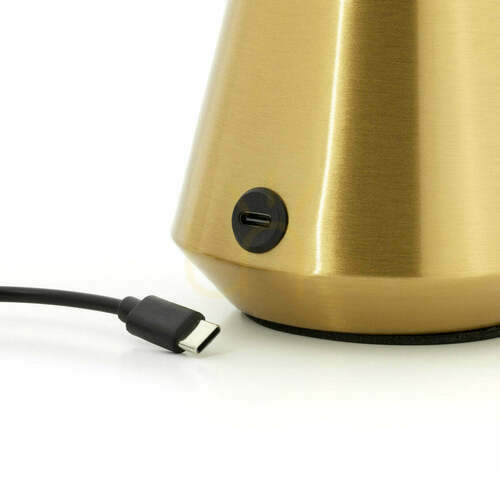
Cable length. Period-styled lamps often ship with a shorter flex than expected. Measure to your socket before you commit, because an extension lead across a floor undoes the object.
-
The switch. An inline cord switch is period-correct and awkward on a bedside table. A base switch or a touch dimmer is worth more than the styling there. Photographs rarely show which one a lamp has.
-
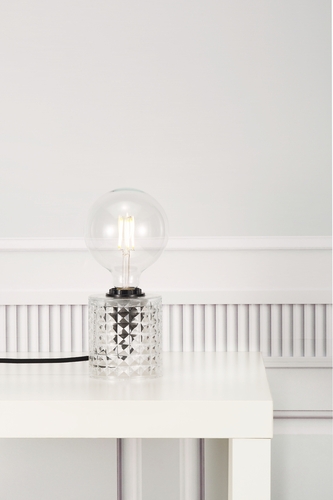
Sockets. E27 and E14 at 230 V cover most of the range, with G9 in smaller bases. Where a bulb shape shows through clear glass, a globe or a tubular filament lamp reads as period and a compact spiral does not.
-
The base under the base. Check for felt. Stone directly on a lacquered or veneered top will mark it.
-
Glass is a consumable. A moulded shade that cracks is usually not replaceable on a period-styled lamp. If the lamp lives somewhere exposed, prefer metal or fabric.
Questions people ask
How tall should the lamp be?
Measure from the floor, not from the table. Around 1.2 to 1.4 m from the floor to the top of the shade for a sideboard lamp; beside an armchair, use your own seated eye level as the ceiling for the bottom of the shade.
Is a marble base real marble?
Weight and temperature answer it faster than a photograph. Real stone is cold to the touch and far heavier than it looks, and its veining never repeats. A resin base is light, room-temperature, and its pattern recurs if you look at the whole surface.
Can these be used as reading lamps?
Only the ones with a directional shade. A frosted globe or an opal sphere gives an even glow and very little on a page; a tapered shade with an open bottom, placed over your shoulder, will do the job. If the lamp is for work rather than atmosphere, the geometry you want is on design desk lamps.
Do these go with modern furniture?
Yes, and more easily than most period lighting, because the shapes are geometric. A stepped stone base beside a plain sofa reads as a deliberate object. The limit is quantity — one or two strong pieces in a room, not six.
What else finishes the room?
At eye level, wall lights art deco pairs with these bases and costs no surface. Overhead, ceiling lights art deco sets out the choice by ceiling height, and the materials, motifs and bulb rules for the whole style are on art deco lamps.