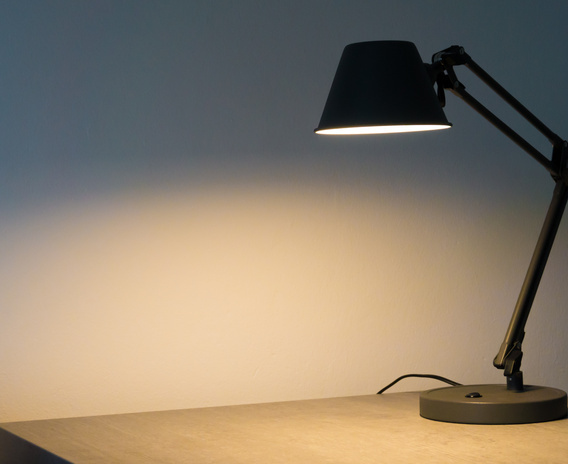
Design desk lamps are the one corner of this catalogue where the famous names were solving an engineering problem rather than a decorative one, and where you can measure whether they succeeded. A desk lamp has a single job: put enough light on a surface, from an angle that does not bounce back into your eyes or into a screen, and stay where you put it. Most sculptural lamps fail that test. The ones on this page were built for it.
The mechanisms, and what each is like after five years
Constant-tension springs
George Carwardine, an automotive suspension engineer, patented a spring linkage in the early 1930s that holds a lamp head in balance at any angle without a clamp. Move it with a fingertip and it stays. The design is still made, and copies of it are everywhere — the tell is what happens when you set the head low and let go. A correct spring rate holds; an approximated one creeps downward over the following minute, and it will only get worse as the springs relax.
Counterweights
Richard Sapper's 1972 lamp replaced springs with weights on the short ends of two arms, and ran the low-voltage supply through the arms themselves so there is no wire to snag. It is almost frictionless to move, it has a very small footprint on the desk, and the head is deliberately tiny — this is a lamp that lights a page, not a room. The whole object depends on the arms conducting current, so a copy that puts a visible cable along the arm has not copied the design at all.
Friction joints and gas springs
Michele De Lucchi's 1987 aluminium arm uses tensioned cables inside the arm and knurled friction knobs at the joints. This is the family that ages best in a busy office, because a friction joint can be tightened when it loosens; a spring cannot be adjusted at all. If a lamp will be moved several times a day, this is the mechanism to look for.
Fixed-arm and reflector lamps
The Bauhaus bedside and desk lamps of the late 1920s — Marianne Brandt's among them — had no adjustment beyond a tilt, and made up for it with a deep reflector and a switch you could find in the dark. They are quiet, robust and inflexible. On a desk used for one thing, that is enough.
The numbers that decide whether it works
What a work surface needs
TaskLight on the surfaceWhat that means in practice
Reading, writing, general desk workAround 300 luxThe level the European standard for indoor workplaces sets for ordinary office work
Detailed work, small print, drawing500 lux and upThe desk lamp, not the ceiling, has to supply this
Screen work in a dim roomLower on the desk, but never a dark surroundA bright screen against a dark wall is the classic recipe for eye strain — light the wall behind the monitor
An ordinary ceiling fitting delivers a fraction of 500 lux at desk height, which is why the lamp exists. Lux falls off sharply with distance, so a head 40 cm above the page does far more than the same lamp at 70 cm; moving the head closer is usually more effective than buying a brighter lamp.
Placement, which is free and matters as much as the lamp
-
Opposite your writing hand. Light from the left for a right-handed person, and the other way round, so your hand does not cast a shadow across what you are writing.
-
Out of the screen's reflection. Sit where you normally sit and look at the monitor. If you can see the lamp head, or a bright shape, reflected in the glass, move it. Behind and to the side of the screen is usually safe.
-
Head below eye level. If you can see the lamp's light source from your seated position, the shielding is not doing its job — tilt the head down or choose a deeper shade.
-
Not on a bare white desk. A high-gloss white surface reflects the lamp straight back at you. A matt surface or a desk pad kills that instantly.
Fixings and footprint
Desk space is expensive. Three mounting options exist, and the base is the worst of them: a weighted foot is stable and takes 20 to 25 cm of surface you could be using. A table clamp gives the same rigidity for the width of the clamp jaw — check the maximum desk thickness it accepts, usually somewhere around 5 to 6 cm. A grommet or through-desk insert is the tidiest and commits you to one position for the life of the desk. Where a lamp is offered with a choice, the clamp is normally the version worth buying.
Light source
-
Socket or module. Older designs use E27 or E14 at 230 V, and reissues frequently keep the socket so the lamp survives its bulb. Newer task lamps carry an integrated LED array, often with dimming and colour-temperature adjustment built in. Both are legitimate; the socket version is more repairable, the module version usually gives better control.
-
Colour temperature. 4000 K keeps you alert for daytime work and looks clinical in a living room. 2700 to 3000 K suits an evening desk and a room that also has to feel domestic. Adjustable-temperature lamps exist precisely because a home desk is both.
-
Colour rendering. CRI 90 or better if you draw, paint, sew, solder or match colours. Below that, greys and skin tones go strange under the lamp and correct everywhere else.
-
Flicker. A cheap driver on a lamp at 40 cm from your face is the one place flicker becomes noticeable — visible on a phone's slow-motion camera, and a common cause of headaches at a desk. Buy the driver, not the shade.
Questions people ask
Is a famous design lamp actually good on a desk?
Only the ones drawn for a desk. A sculptural table lamp with a diffusing shade produces a pleasant glow and nowhere near enough light on a page; a counterweighted or sprung arm with a deep head produces the light and looks like machinery. That is the trade, and it is worth making deliberately rather than discovering it after delivery.
How bright a bulb should I put in?
For a socketed lamp, the equivalent of a traditional 60 W bulb — around 700 to 800 lumens — placed 40 to 50 cm above the surface covers ordinary desk work. Detailed work wants more light, and it is better to move the head closer than to overrun the fitting's stated maximum.
Clamp or base?
Clamp, if the desk edge allows it. It frees the surface, it does not slide, and it lets the arm reach further across the desk without the base tipping.
Can a desk lamp double as a bedside light?
An adjustable arm makes an excellent reading light beside a bed, provided the switch is reachable from the pillow and the head can be turned away from the other side of the bed. It will look like a work lamp, because it is one.
What if I want something for the room rather than the task?
Compare design table lamps, which are judged on proportion against the surface rather than on light output, and design wall lights for a reading light that uses no surface at all. The full authorship picture, including what a licensed reissue means, is on design lamps.