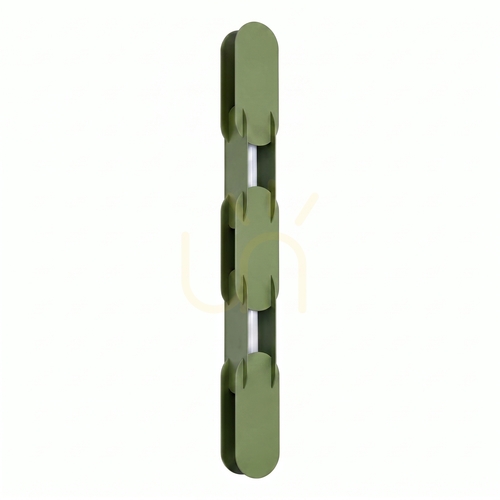
Design wall lights are the part of the catalogue where authorship is easiest to verify and hardest to fake. A wall light has almost nowhere to hide: one arm, one shade, one fixing plate, and the whole design is the geometry between them. That is why the wall bracket is where several of the twentieth century's lighting designers did their sharpest work — Serge Mouille's black steel arms of 1953, with a shade shaped like a spinning top on a swivel; Arne Jacobsen's AJ wall light, drawn in the late 1950s for a hotel in Copenhagen, with a cut-off cylinder that throws light down the wall and nothing at the eye; Charlotte Perriand's pivoting-shutter bracket, a flat reflector on a hinge that you swing between reading light and wall wash; the pleated shades of the Danish workshop tradition, folded by hand rather than moulded.
Height is the decision, not the shape
Nearly every complaint about a wall light — glare, a scalloped hot spot, a bracket that catches a shoulder in a corridor — is a mounting height problem rather than a product problem. Fix the height first and the choice of fitting gets much easier.
Working heights, measured to the centre of the fitting from the finished floor
WhereHeightSpacing and notes
General light, living room or hallway1.5 to 1.7 mEvery 2.5 to 3 m along a wall. Higher than 1.7 m and an open-topped shade shows you its inside.
Flanking a mirrorCentre around 1.6 to 1.7 m75 to 100 cm apart, one each side. Light from the sides fills in the shadows under the eyes and chin; a single light above the mirror does the opposite.
Beside a bed1.1 to 1.25 m, or 50 to 60 cm above the mattress topAn adjustable arm needs 30 cm or more of reach to get the light over the page rather than over the pillow.
Stairs1.6 to 1.8 m above the tread nosingMeasure from the step directly below the fitting, not from the landing, or the spacing will read as a staircase of its own.
Above a picture15 to 20 cm above the frameThe arm has to project far enough to clear the frame, otherwise the top of the canvas burns out and the bottom stays dark.
One more constraint that catches people in narrow spaces: in a corridor, a bracket that projects more than about 10 cm from the wall below shoulder height is something people walk into. Flat plates, half-cylinders and up-and-down washers exist for exactly that reason.
Wired, or plugged in
Wall lights split into two families that have nothing to do with style, and this is the first thing to check against your own wall.
Hard-wired
A backplate over a recessed box, wired into a switched circuit. This is the tidy answer and the one most reissued designs assume. It commits you to the position, so mark the height on the wall with masking tape and live with it for an evening before anybody drills.
Cord and plug
A visible flex to a socket, sometimes with an inline switch on the cable. Renters need this, and several classic brackets were drawn with the cable exposed as part of the design rather than as a compromise — a fabric-braided flex clipped down the wall is a period-correct detail, not a failure.
What the shade is doing
-
Up and down. Open at both ends. Two soft triangles of light on the wall, very little in the room. Reads as architecture; useless for reading.
-
Downlight only. A closed top and an open bottom. A tight scallop on the wall and good light on a bedside table. Watch the wall finish — a hard downlight on textured plaster shows every trowel mark.
-
Diffusing globe or opal disc. Comfortable from every angle and visually quiet, which is why it survives in corridors and bathrooms. It lights the room, not a task.
-
Adjustable arm or pivoting shutter. The only version that does two jobs. The trade is a visible mechanism, and the joint is the part that wears, so check whether it tightens.
Bathrooms and damp rooms
A wall light near water is governed by the protection rating, not by taste. Inside the zone immediately around a bath or shower, and in the zone extending 60 cm beyond it, a fitting needs at least IPX4 — protection against splashing from any direction. A light beside a basin mirror is normally specified at IP44 for the same reason. Beyond those zones an ordinary fitting is allowed, but a brass finish in an unventilated bathroom will still bloom within a couple of years; chrome and nickel hold up far better in that room. Anything in a bathroom is also work for an electrician, everywhere in the EU.
Light source notes
- Sockets on the fittings sold here are usually E27, E14 or G9, on 230 V, or an integrated LED module. A wall light at eye level is the worst place for a bare high-brightness source, so choose a frosted or opal lamp for anything with a visible bulb.
- 2700 K suits brass, wood and warm plaster. Push a wall light to 4000 K and the wall behind it turns grey-green, because you are lighting the paint from 10 cm away and every colour shift shows.
- If a pair flanks a mirror, keep them on the same dimmer and the same colour temperature. Two lamps from different batches will not match, and on a face that is very visible.
- Where a fitting sits close to the wall, check the maximum wattage on the label. Heat has nowhere to go, and a fabric or paper shade against plaster is the one place that limit is not theoretical.
Questions people ask
How many wall lights does a room need?
Fewer than most plans show. Wall lights are accent and circulation light: a pair either side of a bed, a pair flanking a fireplace or mirror, or a run down a corridor at even spacing. Trying to light a whole living room from the walls alone produces a ring of bright patches and a dark middle.
Should a pair match exactly, or mirror each other?
If the design has a direction — an asymmetric arm, a shutter, a shade that tilts — a mirrored pair looks composed and two identical units look like a mistake. Symmetrical shapes can simply be repeated. Check before you buy whether the model is offered handed at all.
Can I put a design wall light on a dimmer?
Only if the lamp or the integrated module says it is dimmable. With retrofit LED lamps a trailing-edge dimmer is the usual answer, and every dimmer has a minimum load, so a single low-wattage lamp on an old dimmer will buzz or flicker at the bottom of its range.
What if I want the same design language overhead?
Several families run across the whole room — a wall bracket, a pendant and a table version of one drawing. Start from design ceiling lights for the overhead choice, and see design table lamps for the surface. If the room is period rather than modern, wall lights art deco and retro wall lights cover the same wall from the other direction.