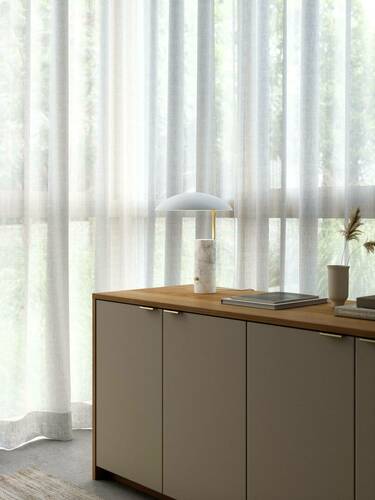
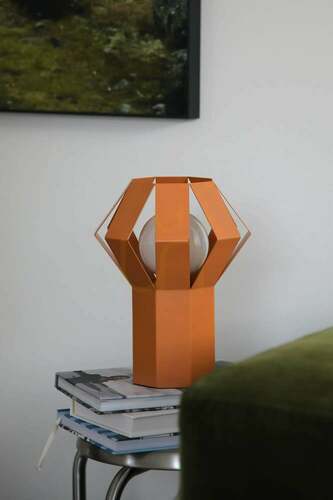
Design table lamps are the easiest place to own a piece with a name on it, and the easiest place to get the proportions wrong. A table lamp is bought in a photograph, where it is alone against a white ground, and then it arrives on a real sideboard next to a bowl and two picture frames and it is 15 cm too tall. Almost everything below is about the second situation.
Sizing it to the surface
There is one measurement that matters more than the rest: where the bottom edge of the shade sits relative to the eye of somebody sitting next to it. Too high and you see the bulb every time you look up; too low and the light pools on the table and lights nothing else.
Working proportions for a lamp on a surface
| Where it stands |
Surface height |
Lamp height that works |
The check |
| Side table beside an armchair |
50 to 60 cm |
45 to 60 cm |
Sit down. The bottom of the shade should be at or just below your eye — roughly 105 to 120 cm from the floor. |
| Sideboard or console |
75 to 90 cm |
40 to 55 cm |
Total height around 1.2 to 1.4 m from the floor. Anything taller starts competing with what hangs above it. |
| Bedside table |
50 to 65 cm |
40 to 55 cm |
Sit up in bed. The shade should shield the bulb from that position, and the switch has to be reachable without leaving the pillow. |
| Desk or work table |
72 to 76 cm |
35 to 50 cm |
A different buy entirely — the number that matters is light on the paper, not proportion. |
For width, keep the shade narrower than the surface it stands on, with a hand's width of table visible on each side. On a console under a mirror, the shade should not overlap the mirror's frame. A pair on a long sideboard looks composed when the lamps sit at about the quarter points rather than hard against the ends.
The named designs, and what they are actually like to live with
Glass on glass
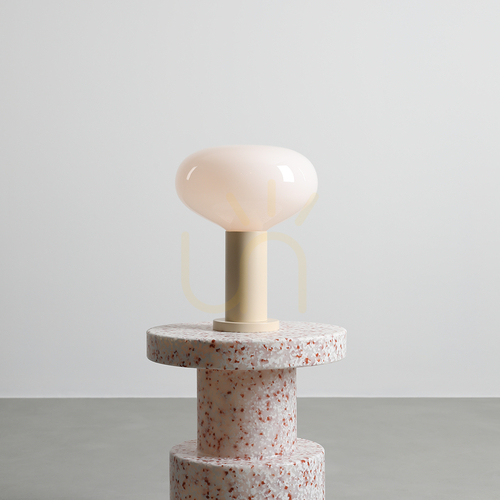
Wilhelm Wagenfeld's 1924 lamp put an opal glass dome on a glass stem and ran the cord visibly through it. The whole object glows rather than throwing a beam, which makes it a superb object on a sideboard and a poor light to read by. It is also the shape that most replicas get dimensionally close and materially wrong — pressed glass instead of blown, and a dome that reads grey rather than warm when lit.
Metal shades on a stem
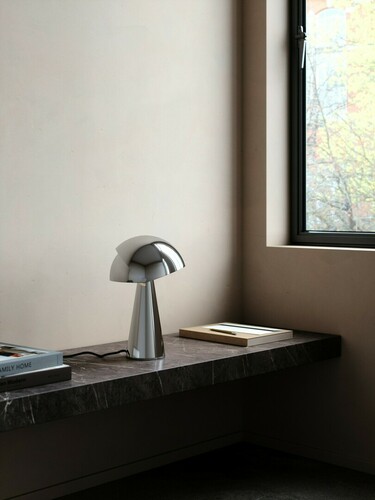
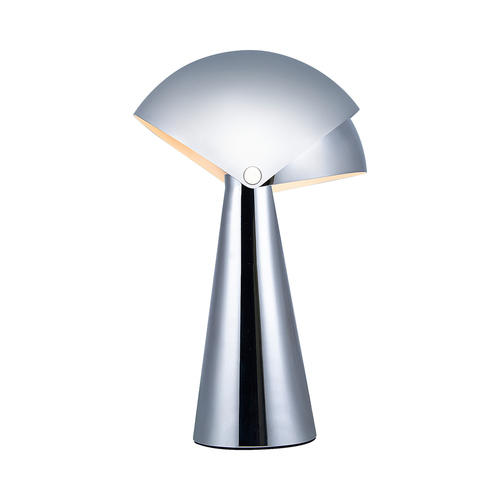
Arne Jacobsen's table light of the late 1950s, drawn for a Copenhagen hotel, tilts a cut-off cylinder over a weighted foot. It is directional, it shields the source completely from the sitting position, and it will genuinely light a book. This family — angled metal shade, heavy base, no adjustment beyond the tilt — is the compromise between sculpture and usefulness.
Moulded plastic
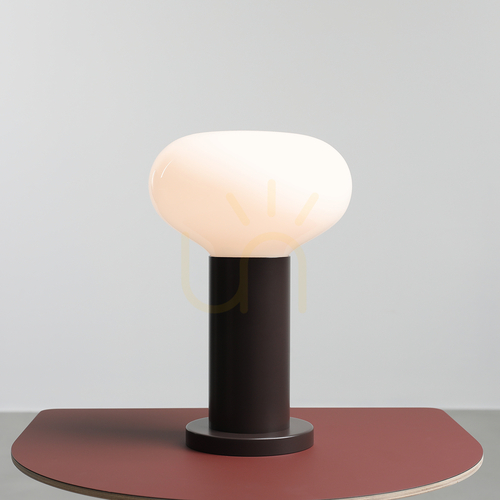
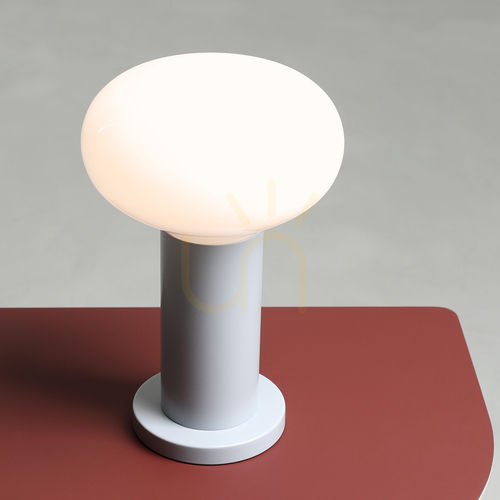
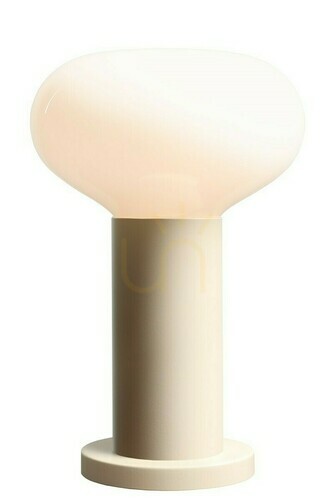
The mushroom shapes of the late 1960s exist because injection moulding briefly made a seamless glowing volume cheap. They light a room softly in every direction and they are, by construction, entirely un-directional. Check the material honestly: the originals were tinted through, not sprayed, and a sprayed copy shows its coating at the rim.
Telescopic and adjustable
Gae Aulenti's telescopic lamp of 1965 changes height by around 20 cm, which is the rarest useful feature in the whole category — one object that works low on a side table and tall on a sideboard. Where a design has a mechanism, that mechanism is what wears, so ask what the service part is before assuming a lifetime.
Shade, source and switch
-
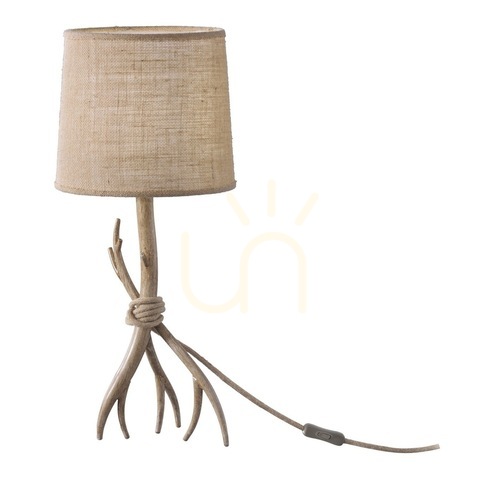
Fabric and paper shades spread light widely and glow at the surface. They are the friendliest to a bare bulb and the least directional. Watch the maximum wattage on the label; heat inside a closed drum has nowhere to go.
-
Opal glass hides the source completely and looks the same switched off. It is heavy, and a chipped rim cannot be repaired.
-
Metal shades put nearly all the light in one direction. Look inside before you buy: a white-painted interior gives soft light, a polished interior gives sparkle and a hot spot.
-
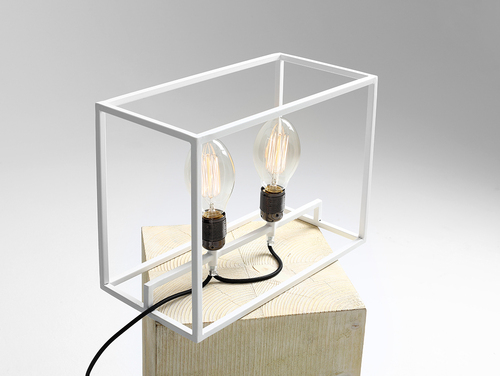
The source. E27 and E14 at 230 V cover most of what is sold here, with G9 in smaller bases. Where the bulb is visible through glass, buy frosted or a long low-brightness filament — a compact high-output lamp behind clear glass is unpleasant from across the room.
-
Colour. 2700 K for brass, wood and warm plaster; 2200 K if the room is lit mostly by lamps in the evening and you want the old tungsten feeling. Keep every lamp in one room on the same temperature, because mismatched whites are obvious the moment two lamps are on together.
-
The switch. Inline cord switches are period-correct on many reissues and awkward on a bedside table, where a base switch or a touch dimmer is worth more than the styling. Check which one the model has; photographs rarely show it.
Cables, weight and the things nobody photographs
A table lamp is one of the few fittings you install yourself, so the small practicalities decide whether you keep it. Check the cable length against the distance to the socket — many reissues ship with a shorter flex than expected, and an extension across a floor undoes the object. Check the base weight if there is a child or a dog in the house: a tall lamp on a light foot goes over. And check whether the lamp is stable on the surface you own; marble and cast metal bases sit still, and a pressed steel base on a polished sideboard slides.
Questions people ask
How tall should a table lamp be?
Judge it as a total height from the floor rather than from the table. Aim for roughly 1.2 to 1.4 m from the floor to the top of the shade for a lamp on a sideboard, and for a side table beside a chair, use your own seated eye level as the limit for the bottom of the shade.
Should a pair of lamps match?
On a sideboard or flanking a mirror, yes — symmetry is the point. Beside a bed, matching is optional, but the light output and colour temperature should match, because two different whites either side of a bed is far more noticeable than two different shapes.
Can I put a design table lamp in a bedroom instead of a bedside light?
Only if the shade shields the source from a person lying down, and only if the switch is reachable from the pillow. Those two tests reject most sculptural lamps, which is why bedside lighting and living-room lamps are separate purchases even when they look alike.
Is a table lamp enough light for reading?
A directional metal shade over your shoulder, yes. A diffusing globe or a paper shade, no — those are ambient objects. If the lamp is for work rather than atmosphere, compare design desk lamps, where the whole design brief is light on a surface.
What else fits the same room?
Overhead, start from design ceiling lights, and for the walls see design wall lights. If the room is period rather than modern, table lamps art deco and mid century table lamps cover the same surface by decade.