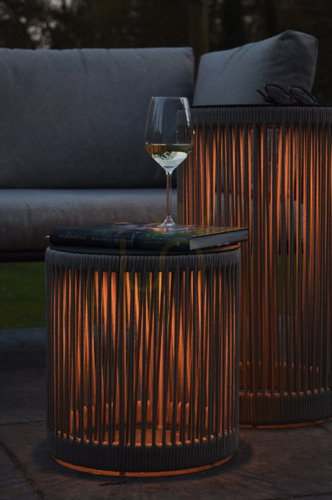
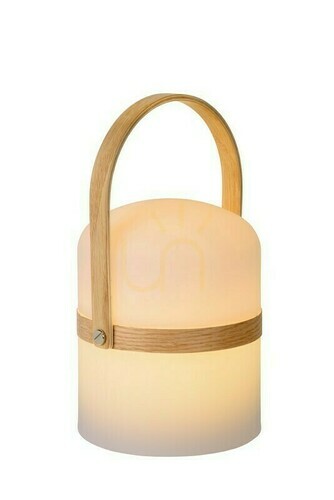
Japandi outdoor lighting is a narrow, deliberate look: a wood or wood-effect body, a matte black or off-white shade, nothing shiny, and a light level closer to a candle than a floodlight. Outdoors it shows up mainly as freestanding lamps you place like furniture, plus a couple of hanging fittings for a covered corner.
Rechargeable or wired — decide this first
A rechargeable lamp goes anywhere: a rented balcony, a table you move, a corner with no cable near it. You carry it in when the weather turns and you charge it every few evenings. A mains fitting stays where you put it and never runs out halfway through dinner, but it has to be fed. In England and Wales, new outdoor circuits are notifiable work under Part P, so the sensible route is an electrician, a 30 mA RCD, and SWA cable buried around 450–600 mm with warning tape above it. Dig once, dig properly.
The mistake people regret is buying on price and then wanting the lamp lit every night. Battery models are for the seat you actually use, not for permanent perimeter light.
What the wood does after one winter
| Finish |
Outdoors it does this |
You do this |
| Real timber, oiled |
silvers off within a season if neglected |
re-oil once a year |
| Wood-effect on powder-coated aluminium |
keeps its tone, no rust bleed |
wipe down, check screws |
| Painted steel |
corrodes first at drilled edges and fixings |
touch up chips early |
Near the coast, or on a drive that gets gritted in winter, aluminium with stainless A4 fixings is the safe combination. Salt finds the screw holes long before it finds the paint.
IP44 tells you where it stands, not that it is weatherproof
IP44 means splashing water from any direction. It does not mean a lamp that sits in a puddle, and it does not mean hours of driving rain landing on an open top. That puts these fittings under a canopy, on a covered terrace, beneath a pergola, or somewhere you can move them from. For an exposed lawn or a bed that floods, step up to IP65 and a base that drains. Hanging versions need the same discipline: if the hook is not under cover, water will eventually sit in the lampholder.
Height changes the whole effect
A low lamp around 60 cm works at table height and reads as a lantern set on the ground — it lights faces and a bit of paving, nothing more. A slim one nearer 150 cm throws light over a seating group and needs a properly closed shade, or it becomes a glare source at eye level for anyone sitting down. Judge it sitting, not standing. Two or three weak points at different heights beat one bright fitting in the middle every time.
Warm light, neighbours and the night sky
Stay at 2200–2700 K. Warmer light suits the palette, attracts markedly fewer insects than cool white, and does not bleach the planting. Aim everything downwards and keep spill off the boundary — a neighbour looking straight into a bare lamp is the most common complaint about garden lighting. A dusk sensor plus a timer means the garden is lit while you are in it and dark at two in the morning, which is the point.
Quick answers
Can I leave a rechargeable lamp outside all summer?
Under cover, yes. The charging port is the weak spot, so close the cover after every charge and bring the lamp in before the first frost.
What bulb suits the hanging versions?
An E27 LED at 2700 K with an opal, not clear, envelope. A bare filament in an open shade sits right in your eyeline over a dining table.
Is this style any use for a driveway?
No. Low warm light will not cover a driveway safely — a bollard or a shielded wall light does that job, and these belong at the seating end of the garden.
Does it work on a small balcony?
It is where the style makes most sense. One low lamp and a rail-height plant is the whole scheme; see the balcony selection for fittings sized for it.