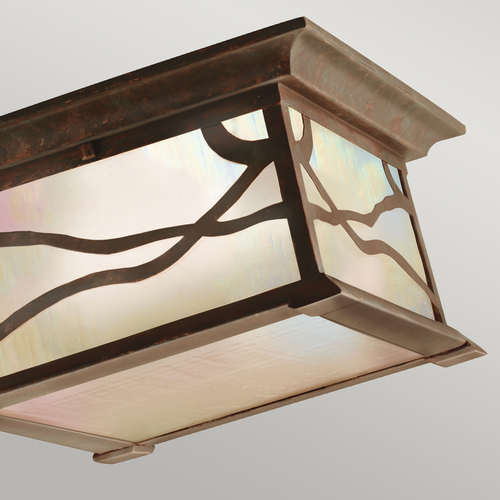
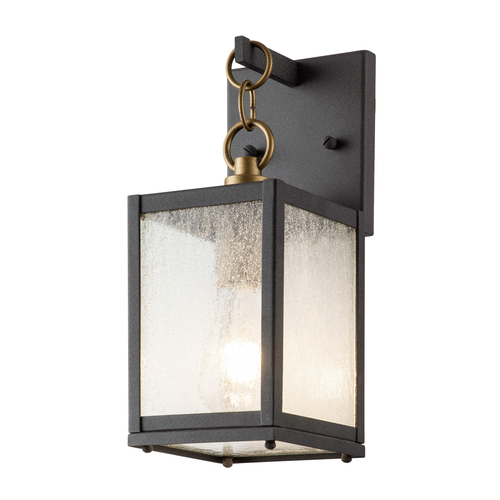
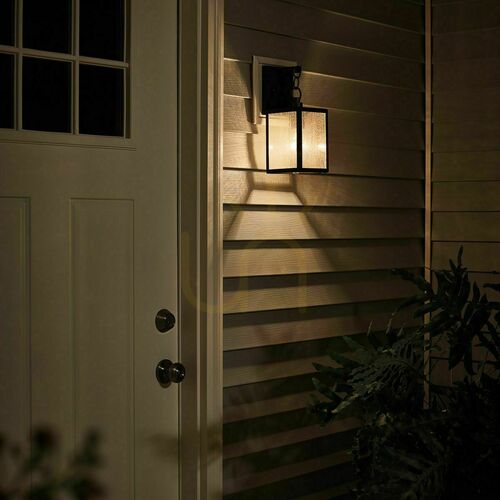
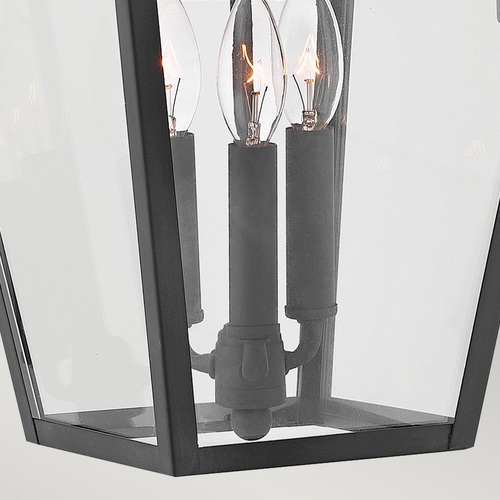
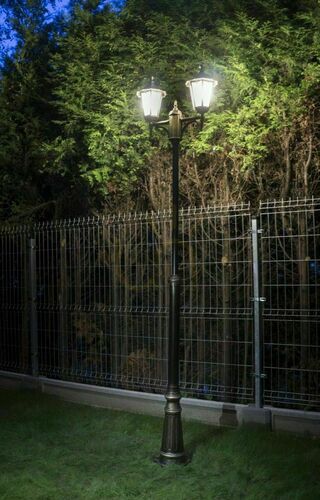
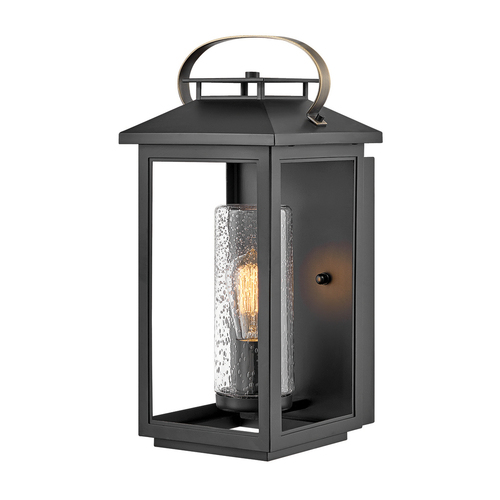
Stylised outdoor lights borrow the outline of an old street or coach lantern and build it out of current parts: a cast aluminium body, a glass panel shade in a metal frame, an E27 lampholder and an IP44 seal. It reads as period from ten paces and services like any modern fitting — you change a lamp rather than hunt for spares. That is the whole point of the style, and it is what separates it from a genuine reproduction.
The lamp you fit changes everything
A classic lantern has clear glass and an open base, so the light source is visible from every angle. With an E27 holder rated to about 60 W, the result is yours to decide. Choose a 2700 K LED at a modest output; a filament lamp in an opal envelope gives the warm glow the shape is asking for. A powerful cool-white lamp in the same housing does the opposite — it glares at eye level and lights the neighbour's bedroom. If you care about how much goes up into the sky, pick the version with a solid top rather than glass all round. The screw fitting means you can change your mind after one evening.
One outline at the door, over the gate and along the path
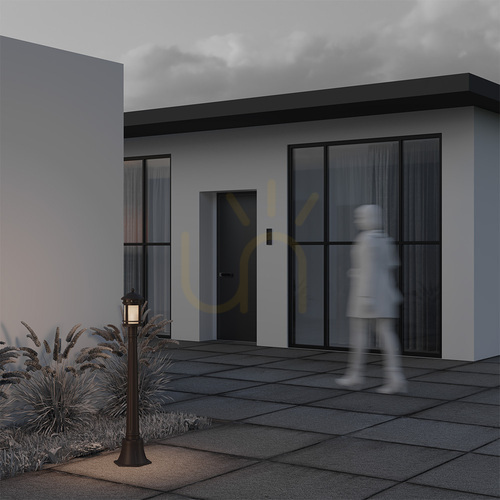
Consistency is what a stylised range is for. The same lantern shape usually comes in three builds: a wall light for the elevation, roughly 31 cm tall and projecting about 24 cm; a pendant to hang over a porch or under a veranda; and a post of around 105 cm for the path edge. The post throws light all round, which is what marks a route; the wall version works with the masonry instead. Bought as a set they read as one façade, which three separately chosen fittings never manage.
What IP44 covers outdoors — and what it does not
IP44 means protection against splashing water from any direction, and that is the normal façade standard. A wall lantern on render, a pendant under a deep overhang, a post in a planted bed: all fine. What it is not rated for is a spot that gets a hose turned on it, the zones around a swimming pool or pond, and anything set flush into the ground — those start at IP65 and pool zones have their own rules. If the post stands beside a drive or where a mower passes, look at impact resistance too; glass and thin pressed metal survive neither a reversing car nor a snow shovel.
Wiring, footings and corrosion
These lanterns run on 230 V in protection class I, so they need an earth and fixed wiring. Taking a new circuit outside the house is notifiable work in much of the UK and belongs with a registered electrician; the post also wants a footing or ground anchor and a cable gland, which is much easier to plan before the paving goes down. If you would rather dig shallow and extend the run yourself later, a 12/24 V system on a transformer is the alternative, though that is a different range. Powder-coated aluminium does not rust the way steel does, but fixings do — near the coast, or on a drive that gets gritted, specify A4 or 316 stainless.
Questions buyers ask
Will a stylised lantern light a garden path?
The metre-high post will, because it emits all round. The wall version will not — it lights the wall and the area immediately at the door.
How far apart should the posts go?
Three to four metres suits that height. Further apart leaves dark gaps; closer together starts to look like a runway.
PIR or dusk-to-dawn?
A PIR belongs at the front door. Lanterns along a path do better on a photocell and timer, because a path that only lights once you are standing on it has not guided anyone anywhere.
Does this suit a modern house?
Dark brown or anthracite on a simple outline holds up against a plain elevation, as long as you stay inside one family. Mixing period and contemporary shapes on the same wall is the usual mistake.
If you want geometry rather than ornament, the rest of the outdoor lighting range covers it.