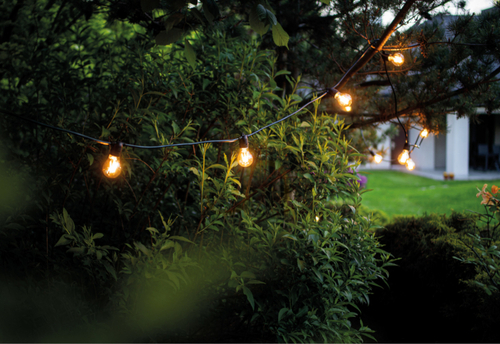
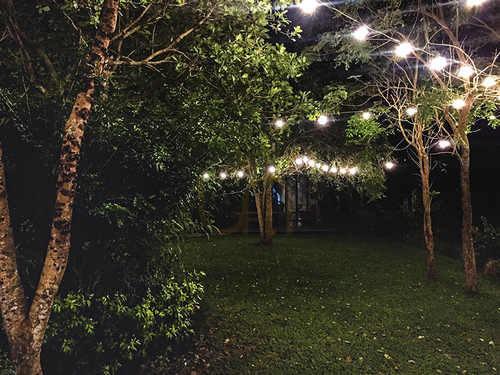
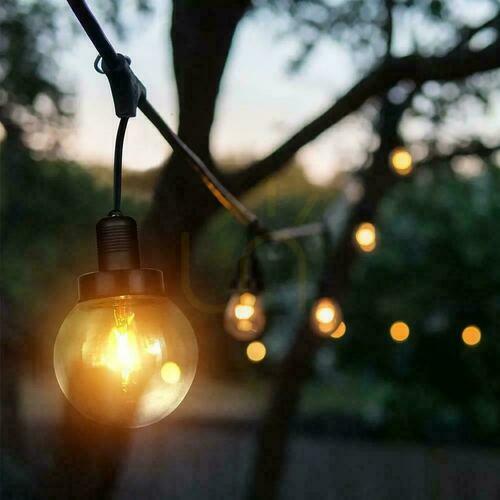
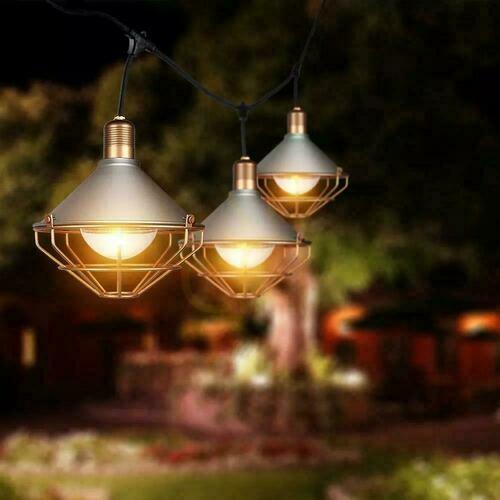
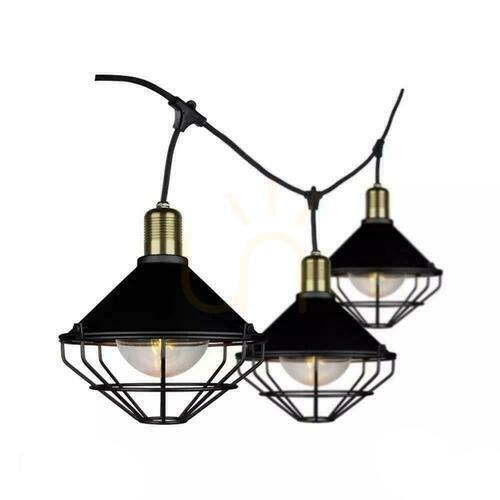
Patio string lights turn a paved terrace into somewhere you actually want to sit after dark, by putting a canopy of soft points of light above head height instead of one bright floodlight on the wall. For a patio, that usually means festoon lights: larger bulbs spaced along a heavier cable, plugged into an outdoor socket and left up for the whole summer rather than pulled out for a single party.
A patio asks more of a string than a balcony rail or a shrub does. The runs are longer, there is often no roof overhead, the British weather gets at every connector, and the cable has to reach a socket somewhere along the house wall.
Festoon or fairy lights over a patio?
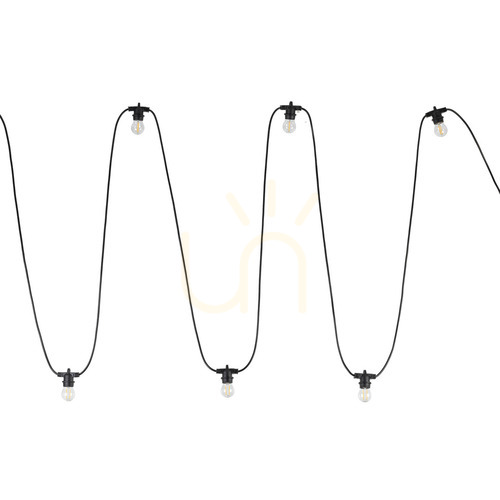
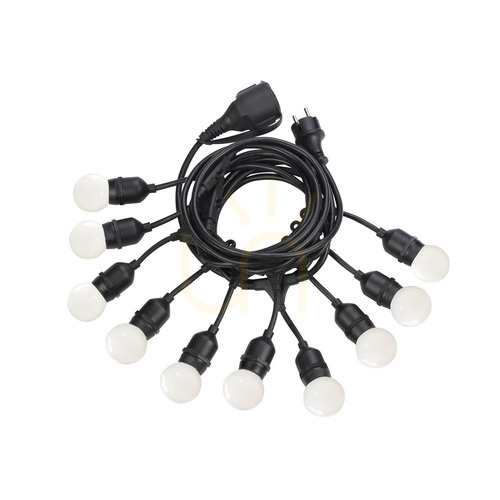
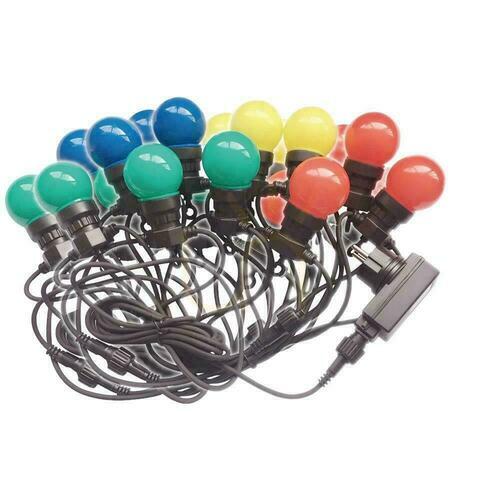
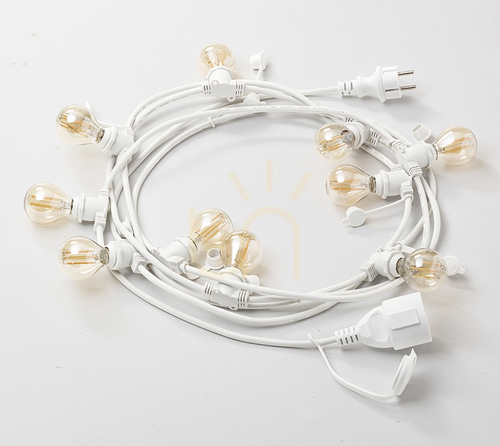
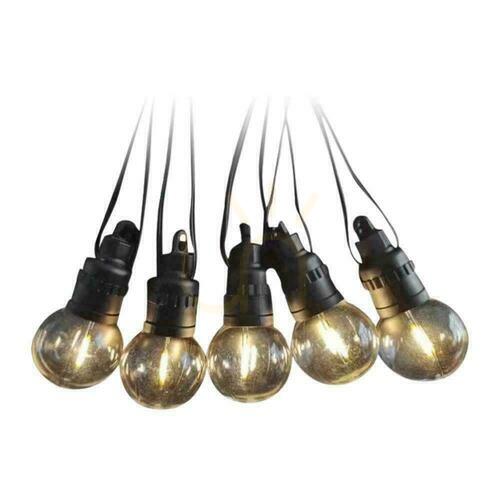
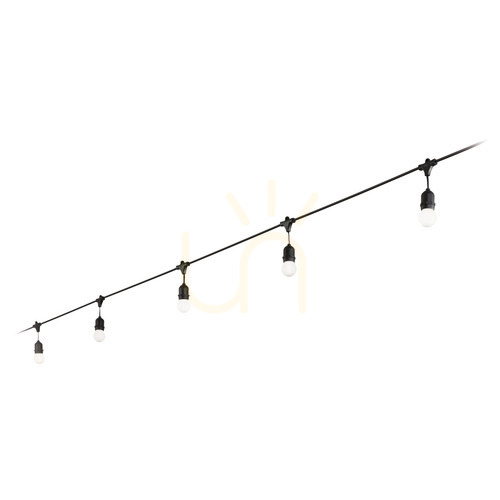
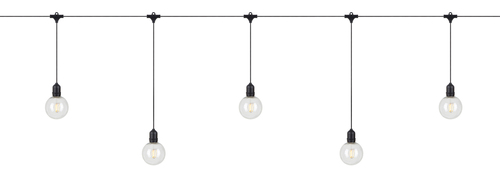
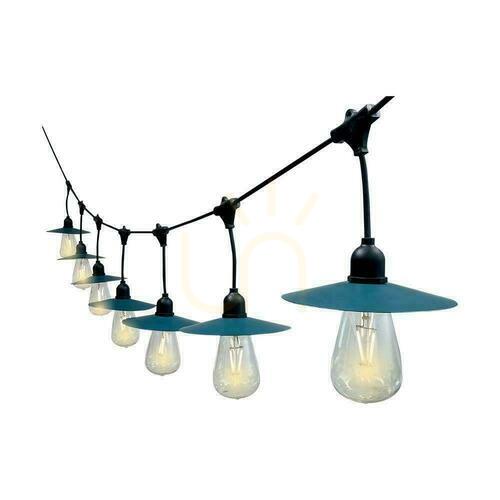
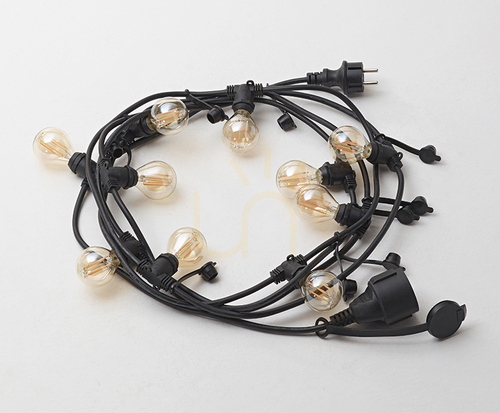
Fairy lights – micro LEDs on thin wire – are lovely wrapped round a pergola post or woven through climbers, but stretched across open space they read as a faint sparkle. Festoon lights are the patio workhorse. Bulbs sit every 45–100 cm, usually in E27 lampholders, so you choose the look: small G40–G45 globes, the classic S14 café bulb, or a bigger Edison-style shape with an LED filament. Sets with integrated LEDs are lighter and less visible by day, but a failed point cannot be swapped.
Shatterproof plastic bulbs are worth considering outdoors. Glass looks the part, yet a windy night or the autumn take-down can cost you a few.
What are the best patio string lights?
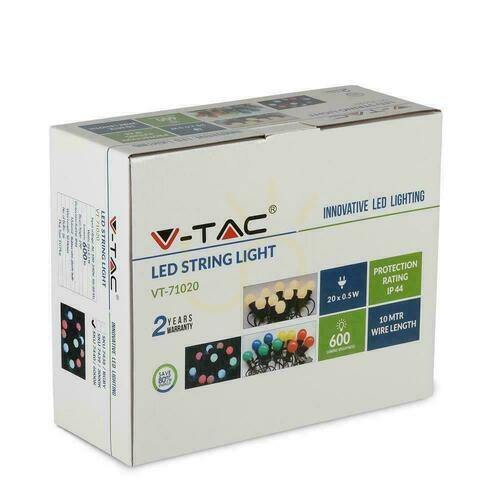
The best set is the one built for permanent outdoor use, not the one with the most bulbs. Look for these figures on the box:
| Spec |
Typical patio range |
Why it matters |
| Ingress protection |
IP44–IP65 |
IP44 under a canopy; IP65 for an open patio that takes the rain |
| Power |
240 V mains or 24–36 V low voltage |
low voltage via a transformer is safer and often connectable |
| Bulb wattage |
1–2 W LED |
1 W for atmosphere, 2 W over a dining table |
| Colour temperature |
2200–2700 K |
the warm, amber glow people expect from festoons |
| Bulb spacing |
45–100 cm |
closer over the table, wider along a fence |
| Set length |
5–20 m |
measure the route, then add sag and the run to the socket |
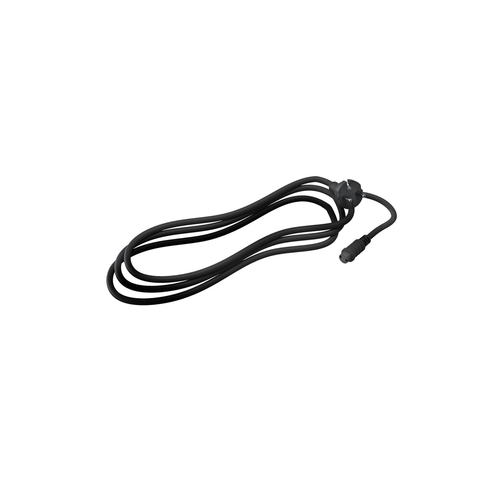
Plug, lead and connectors matter as much as the bulbs. A rubber-sheathed cable copes with cold and sunlight far better than thin PVC, and a sealed connector stops the most common failure: water creeping into the joint between two sets.
Mains powered or solar?
Mains-powered festoons give the same brightness all evening, whatever the week's weather, and suit long runs. Solar sets need no socket, but their run time depends on how much sun the panel caught that day, and from October onwards that is not much. For a patio you use most evenings, mains or low voltage is the dependable choice; solar makes sense at the far end of the garden.
How do you hang outdoor string lights on a patio?
Tension a stainless steel guide wire between fixing points and clip the festoon to it every 50 cm or so. The wire takes the weight and the wind; the cable just carries current. Without one, the lampholders slowly pull the insulation apart.
-
Fixing points: eye bolts in the house wall, pergola beams, fence posts, or festoon poles set in the ground or in heavy planters.
-
Height: roughly 2.2–2.5 m above the paving, so nobody tall walks into a bulb.
-
Sag: allow 5–10% of each span; a gentle swag looks better and puts less strain on the fixings.
-
Patterns: straight lines over the table, a zigzag across a wide patio, or several runs meeting at a central pole for a canopy.
Along a soffit or fascia, hooks or clips about every metre are enough, because the string lies close to the wall. In the UK, outdoor sockets should be RCD protected under BS 7671, and a new weatherproof socket on the patio wall is a job for a qualified electrician.
Looking after them
Screw each bulb fully home: the rubber seal in the lampholder only works when the bulb is seated. Replace failed bulbs like for like, same cap and similar wattage. Close the spare socket at the end of the last set with its cap. If the box does not say the set is rated for year-round use, take it down in late autumn, dry it and store it loosely coiled.
Patio string lights: questions people ask
What type of lighting is best for a patio?
Layers. Festoons give the mood; a wall light by the back door lights the step; low lights along the edge show where the paving ends. Together they make the patio usable as well as pretty.
Are waterproof outdoor string lights really waterproof?
“Waterproof” on a label means little without an IP rating. IP44 resists splashing rain from any direction; IP65 also withstands jets of water and is dust-tight. For a set left up all season in the open, aim for IP65.
Can I connect several sets together?
Many festoon systems link end to end, up to a maximum stated by the maker for one socket. Only join sets from the same system; 240 V and low-voltage strings are not interchangeable.
Do warm white lights attract fewer insects?
Generally yes. Warm light around 2200–2700 K draws noticeably fewer moths than cool white, which is another reason festoons are usually warm.
How do I switch them on without going outside?
A plug-in timer, a dusk sensor or an outdoor smart socket does the job, and many sets come with a dimming remote.
For other ways to light the garden with strings, see outdoor string lights; if you would rather light the table with a single fitting, read about hanging patio lights.