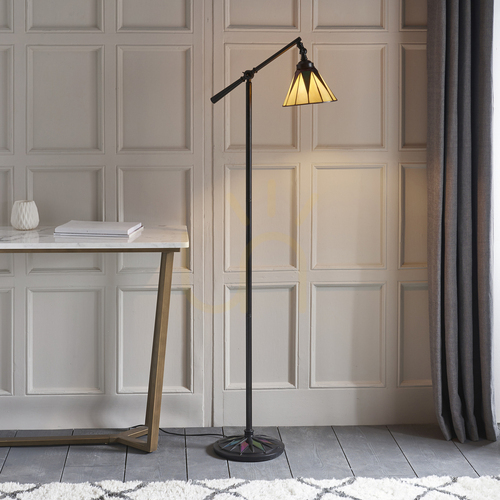
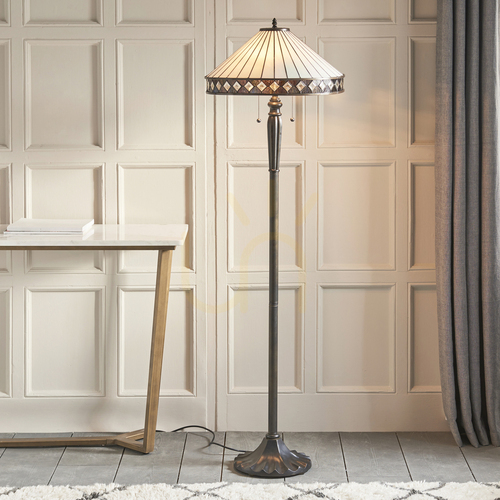
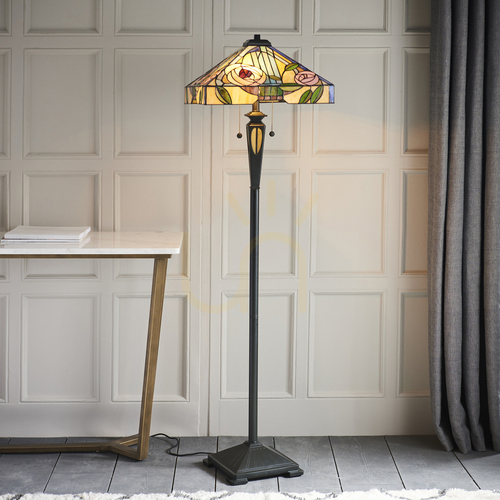
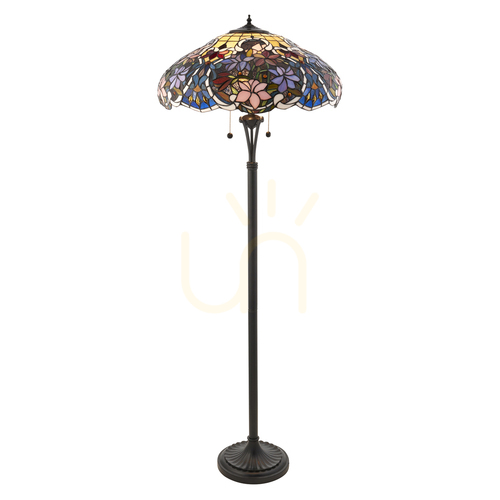
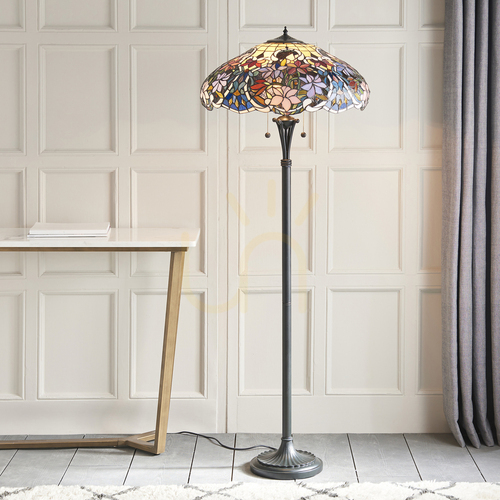
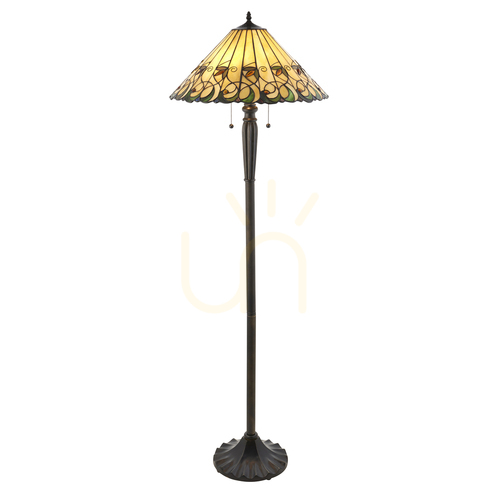
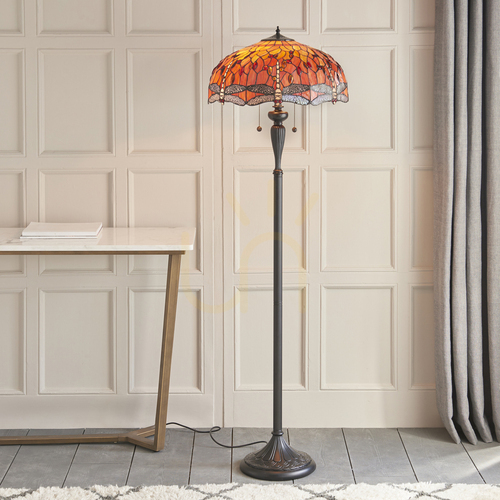
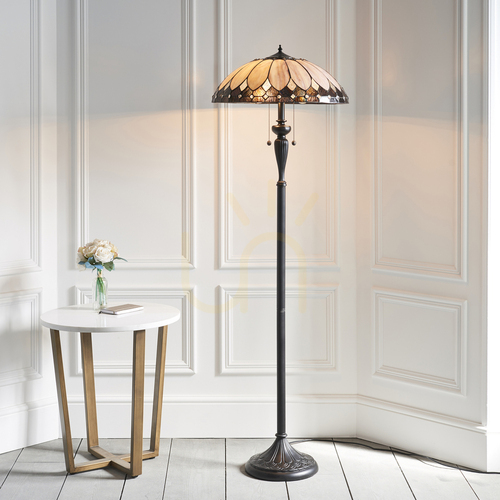
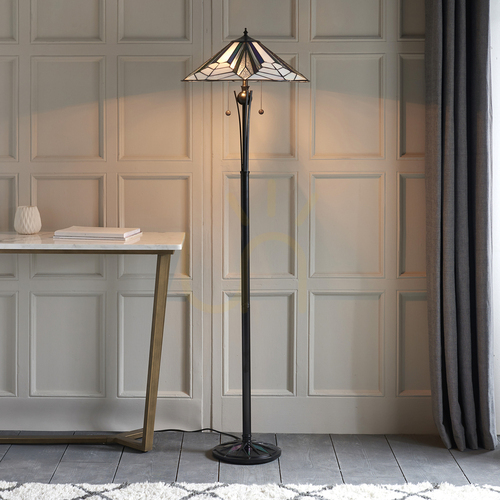
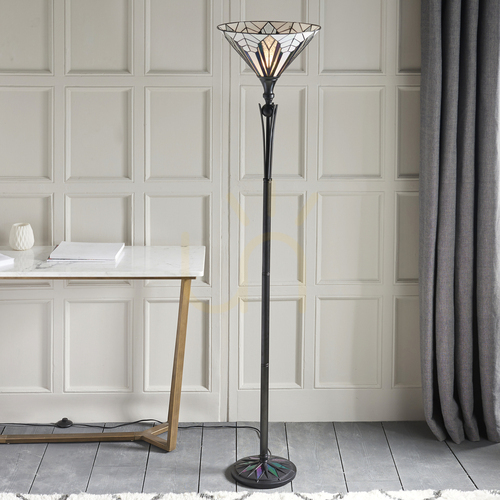
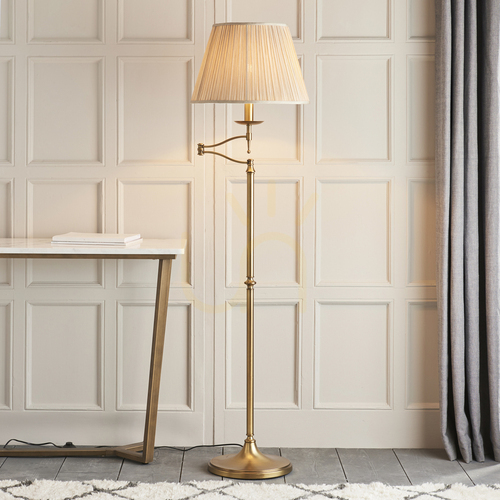
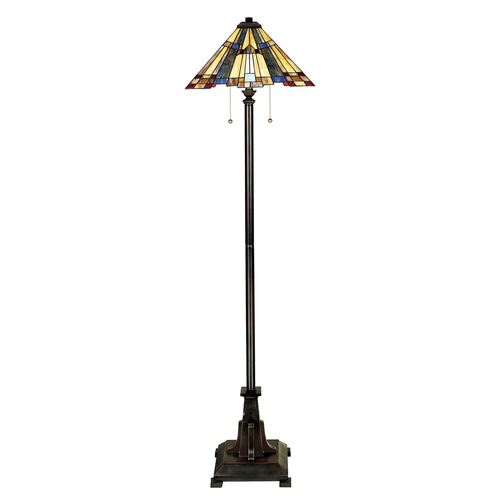
A Tiffany floor lamp is a standard lamp topped with a shade made of coloured glass pieces, each edged in copper foil and soldered to its neighbours. That shade changes what a floor lamp does: rather than throwing plain white light into a corner, it glows from within and washes the walls with amber, green and ruby tones.
Standing at seated eye level, the glass is seen up close, pattern and all, which is where the style works best. A pendant shows you mostly the underside; a floor lamp puts the whole dome on display beside the armchair.
Tiffany style and genuine Tiffany
The name comes from Louis Comfort Tiffany, the American designer whose New York studios made leaded-glass lamps famous around the turn of the twentieth century. Lamps from those studios now sell through major auction houses and sit in museum collections. When a lamp today is called Tiffany, it means the technique and the look, not the maker.
The technique itself has barely changed. A pattern is drawn on card and every piece is numbered and given a colour. The glass is cut and ground to shape, its edges wrapped in adhesive copper foil, and the pieces soldered together. The seams are then patinated, usually to bronze, copper or black. A large floor lamp shade can contain anything from a few dozen to several hundred pieces, which is why a handmade one takes many hours to build.
Choosing the right size and fitting
| Feature |
Typical range |
What it means for you |
| Overall height |
usually 150–165 cm, larger pieces up to about 185 cm |
150–160 cm suits a reading chair; taller lamps need a generous room |
| Shade diameter |
30–50 cm (roughly 12–20 inches) |
30–35 cm for bedrooms and tight corners, 40–50 cm for a large sitting room |
| Bulb fitting |
mostly ES (E27), sometimes SES (E14) |
check before buying bulbs; bayonet caps are rare on these lamps |
| Number of bulbs |
1–3 |
two or three bulbs light the glass more evenly |
| Maximum wattage |
often 40–60 W per fitting for incandescent |
a heat limit; a few watts of LED stays well within it |
| Weight |
about 6–10 kg |
a heavy base keeps the glass shade steady |
Most designs have a pull chain under the shade for each bulb, and some add a foot switch on the flex. Beyond the classic dome there are uplighters with a glass bowl facing the ceiling, task lamps with a smaller angled shade, and mother-and-child lamps with a second small light lower down the stem for reading.
Light, bulbs and placement
Coloured glass gives soft, diffused light. It is lovely for an evening on the sofa but not enough on its own for long reading sessions, so pair it with a task lamp or pick a model with a reading arm. Choose warm white, around 2700–3000 K: cool white drains the colour and makes amber look grey. A clear bulb brings out the richness of the glass but can leave a bright spot; a frosted one spreads the light more evenly. Small golf-ball bulbs fit comfortably under a low dome.
Place the lamp beside or slightly behind an armchair, at the end of a sofa or in a corner of the sitting room. Aim for the lower edge of the shade to sit around 100–120 cm from the floor, roughly at eye level when seated, so you never look straight at a bare bulb. Keep it out of walkways: a glass shade makes the lamp top-heavy, and it will tip more easily than one with a fabric shade. Period homes with dark wood and deep colours suit the style naturally, but a single geometric amber shade sits happily in a plainer modern room too.
Plugs, safety and care
A floor lamp simply plugs in. If one arrives with a continental two-pin plug, have a fused UK three-pin plug fitted by a competent person rather than relying on a travel adaptor. Rewiring, a worn flex or a faulty lampholder are jobs for a qualified electrician, especially on an older lamp.
To clean, switch off and let the lamp cool, then dust the glass with a soft dry microfibre cloth or a feather duster. For grime, wipe with a barely damp cloth and dry straight away. Avoid ammonia-based glass cleaners, vinegar and scourers, which can dull the patina, and never spray directly onto the shade. Stick to the maximum wattage on the label, as solder and patina do not like sustained heat.
Frequently asked questions
How do you tell if it’s a real Tiffany lamp?
Studio originals are usually signed, have documented provenance and are authenticated by specialist auction houses. For a modern lamp, the useful question is whether it is genuinely handmade: real glass, slightly irregular hand-soldered seams and a heavy base. Perfectly uniform, moulded seams point to a cast imitation.
How much is a Tiffany floor lamp worth?
It depends entirely on what it is. A studio original is a collector’s piece valued at auction; a modern handmade lamp is valued by its glass quality, the number of pieces and the workmanship; a resin copy has little resale value.
Why are real Tiffany lamps expensive?
Because every piece of glass is cut, foiled and soldered by hand, and a large floor lamp shade can take days of work. Good opalescent glass and a solid metal base add to it.
Is a vintage Tiffany floor lamp a good buy?
It can be, as long as the glass is uncracked and the seams are sound. Expect to replace the flex, plug or lampholder, and have an electrician check it before regular use.
What bulb should I use in a Tiffany floor lamp?
A warm white LED with the right cap, usually ES. It barely warms the glass, which helps the solder and patina last.
Which Tiffany pattern should I choose?
Dragonflies, lilies and other nature motifs suit traditional and eclectic rooms, while geometric shades in amber or green are easier to place in a modern space. Green glass in particular pairs well with dark wood and leather.
More about floor lamps in general: standing lamps. If you want the same glass above a dining table, look at Tiffany pendant lights.