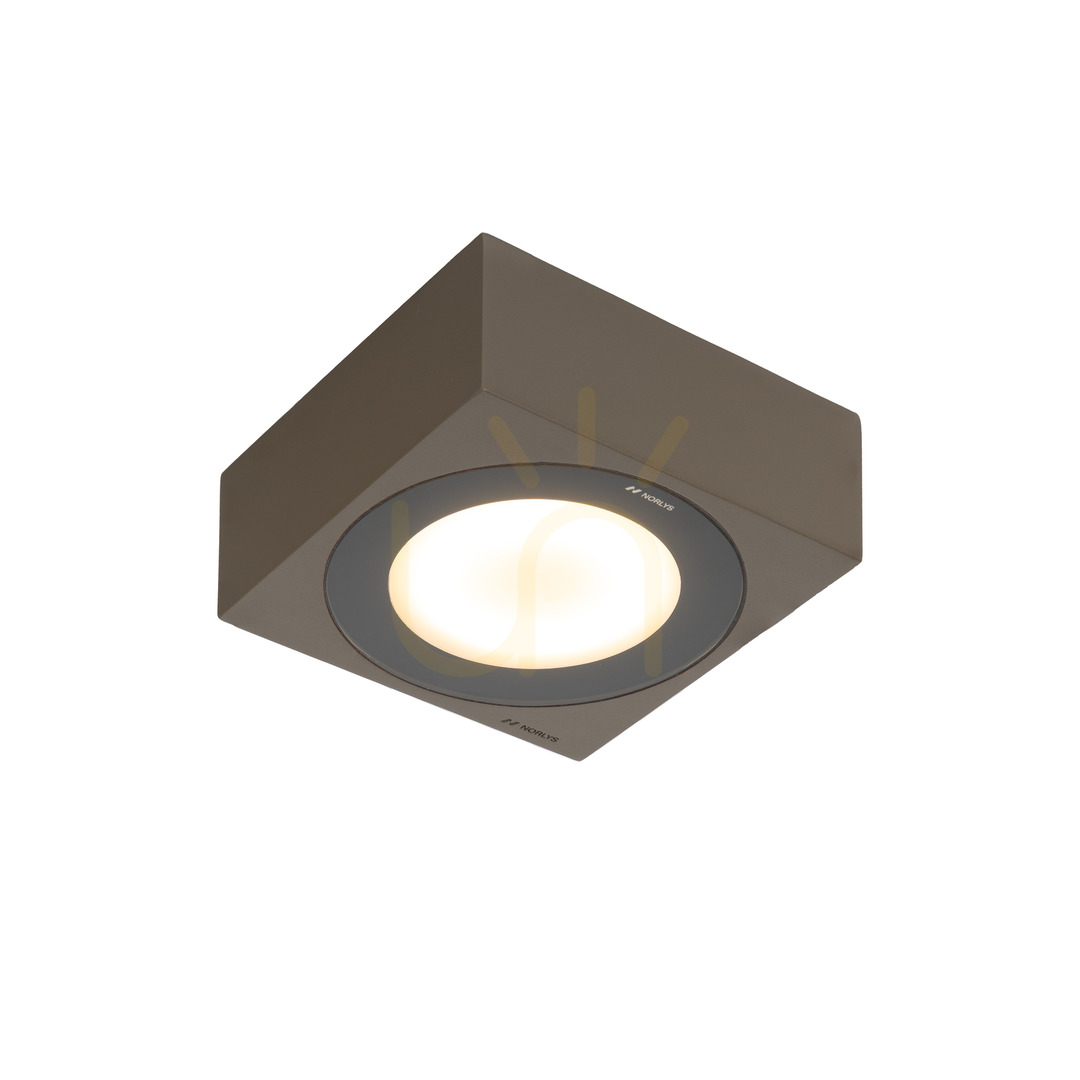
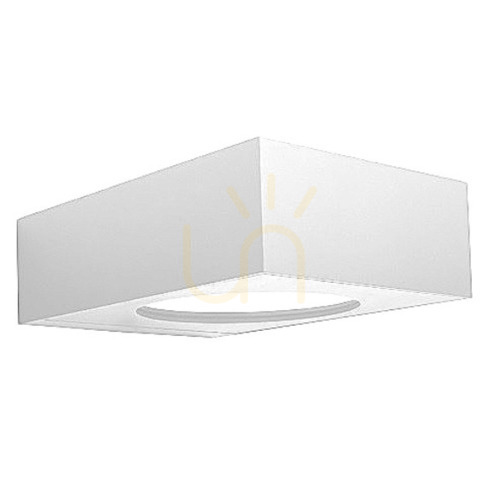
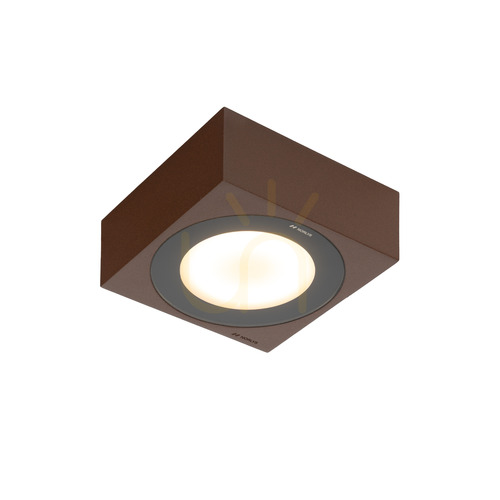
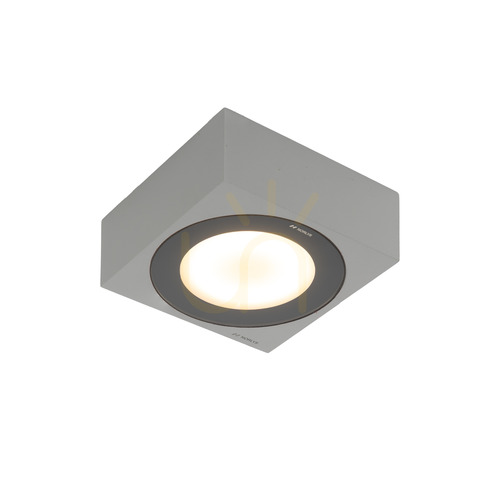
Hitra 2460GB is an outdoor ceiling light with a flat, square body of cast aluminium powder-coated in beige grey RAL 7006. A round satin safety-glass diffuser in a dark ring sits in the underside, and behind it works an integrated Cree LED module with a built-in driver — the light needs no bulb.
What light it gives
The light is symmetrical and directed only downwards (ULOR 0 %), so the fitting lights the floor, steps or wall beneath it and not the sky — hence its dark-sky-friendly marking. The LED module produces 2071 lm, and 1063 lm leave the fitting at a consumption of 14.5 W, more than the roughly 800 lm of an old 60 W bulb: light for an entrance, a covered terrace or a passage under the eaves.
The 3000 K colour temperature is a warm white, and Ra 80 gives the colour rendering typical outdoors. The satin glass diffuses the light, so the LEDs are not seen as individual points. The light is controlled in a DALI2/TD system: switching and brightness are set from the building's control installation.
Dimensions and installation
The body measures 13 x 13 cm and is only 6 cm high. The producer intends it for horizontal surfaces — a ceiling, the underside of a canopy or a soffit — fixed through two ø5 mm holes spaced 63 x 112 mm. The light weighs 1.08 kg.
The terminals take conductors up to 5 x 2.5 mm², further lights can be looped through with cable up to 5 x 1.5 mm², and the round cable should be 7 to 10.5 mm in diameter. It is a protection class I luminaire, so it needs a protective earth conductor. One B 10 A breaker can supply up to 46 lights, a B 16 A up to 74.
Resistance, lifetime and service
IP65 protects the light against dust and water jets, and IK10 is the highest impact resistance on that scale — useful where the light is within reach. The producer states an LED module lifetime of over 102,000 h (L80) and 100,000 h for the driver. The module and driver are replaced only by a professional service, using kits ZN2460XX0009 and ZS2460XX0009.
The plain square form without ornament suits modern, minimalist and Scandinavian architecture — on a terrace, in a gazebo and under the eaves of a facade.