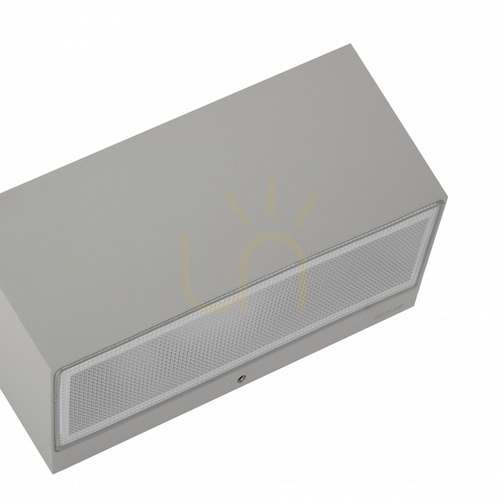
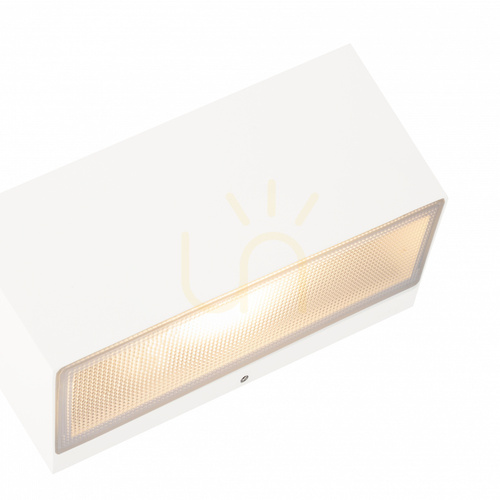
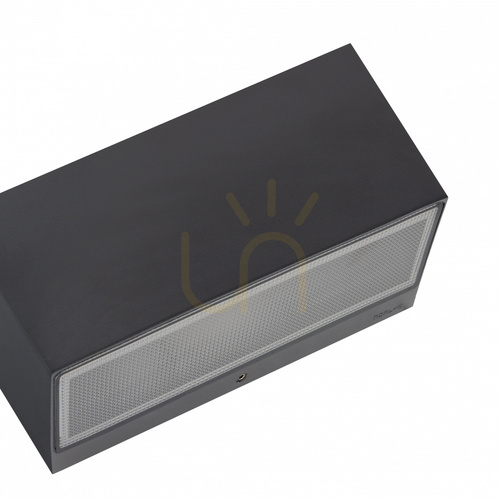
Asker 5102WH is an outdoor wall light shaped as a flat rectangular box: 22.5 cm wide, 11 cm high and only 8.5 cm deep. The body is cast aluminium, powder-coated white (RAL 9003), and the light openings at the top and bottom are closed with clear, textured, UV-stabilised polycarbonate.
How it spreads the light
The fitting lights upwards and downwards at the same time, drawing two bright bands on the wall above and below it. The manufacturer designed it for washing walls and façades. Half of the output (ULOR 50 %) goes upwards, so check what sits above the light: an eave, soffit or window will be lit together with the wall.
The integrated LED module draws 8.8 W and the complete fitting delivers 329 lm. That is accent-lighting level – enough to mark an entrance, a house number or a section of façade, but not a replacement for a floodlight over a driveway. 4000 K is neutral white with no yellow tint, at CRI 80. The light source is included, so there is no bulb to buy.
Dimming and servicing
The wall light is phase-dimmable and works with both trailing-edge and leading-edge dimmers, so an existing dimmer in the installation can usually stay. The LED module and driver are not meant to be swapped by the user, but a service technician can replace them: the manufacturer keeps a dedicated service kit, ZS5102, for this fitting, so a module failure does not mean replacing the whole light.
Installation and durability
IP65 means a dust-tight housing protected against water jets, so the light can be mounted on a wall without a canopy. Impact resistance IK08 matters at an entrance or on a fence, where accidental knocks happen. It is a protection class I fitting: it needs a protective earth conductor and should be connected by an electrician.
The light weighs 1.35 kg and is fixed through two ø4.5 mm holes spaced 180 × 60 mm apart. The terminals take conductors up to 3 × 2.5 mm² and allow the supply to be looped through to the next fitting (up to 3 × 1.5 mm²); the gland suits a round cable of 7–10.5 mm diameter. Several lights along one wall can therefore run from a single supply line.