
Garden Floor Lamps – Spheres, Posts, or Lanterns? A Complete Guide to Garden Lighting
A freestanding garden lamp is the most important decision in garden lighting design—once installed, it shapes the look of your property for years to come. The selection is vast: decorative globes, low posts, classic lanterns, patio lights—and each of these types provides different lighting and serves a different purpose. In this guide, we cover everything you need to know before making a purchase: types of floor lamps, choosing the right height, placement along pathways, technical specifications, and common mistakes.

Table of Contents
- Four types of standing garden lamps
- Garden globes – a decoration that shines
- Lighting posts – light for paths
- Garden lanterns – a classic in front of the house
- How to arrange lamps along a path and driveway?
- Technical specifications: IP rating, materials, light sources
- Power supply: 230 V, 12 V, or solar?
- What light color for the garden?
- Common mistakes in garden lighting
- How many lumens, what optics, and how to reduce glare
- Summary
Four types of standing garden lamps
Before comparing specific models, it’s worth understanding the different roles:
- Garden globes – glowing spheres on the lawn, flower bed, or patio, primarily decorative, with a soft, diffused glow.
- Lighting posts (40–100 cm) – low lamps directing light downward, onto a path or driveway, the garden’s primary “wayfinding” function.
- Garden lanterns (150–250 cm) – tall lamps with a wide range for driveways, gates, and larger spaces.
- Portable patio lamps – battery-powered or solar-powered lamps for a table or next to a lounge chair, portable lighting, no installation required.
The best results come from combining different types: a lantern by the gate, posts along the path, and globes as accents in the greenery. Twenty of the same type look monotonous and don’t light up the garden as well as a well-thought-out mix.
Garden balls—a decoration that glows
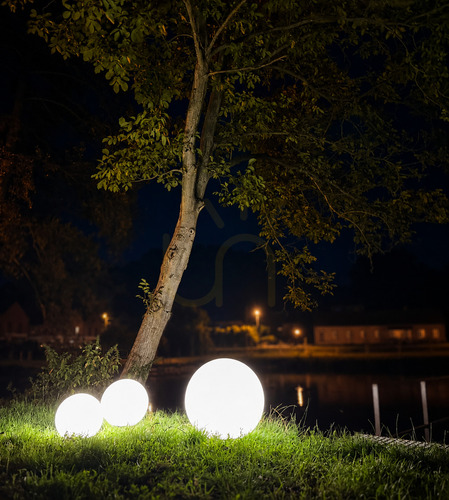
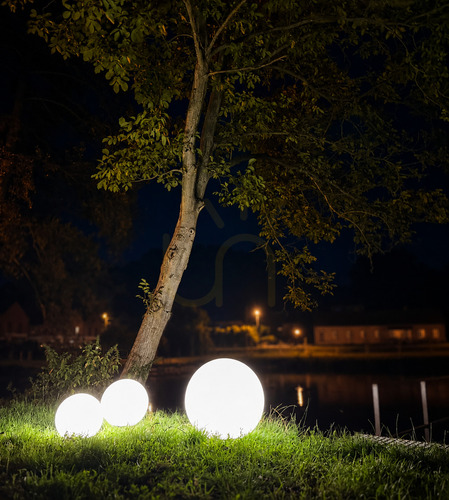
Ornamental balls have been all the rage in recent years—and they’re our specialty. Their strength lies in their simplicity: the perfect sphere looks sculptural against the green backdrop, and after dark it turns into a glowing lantern. A few practical tips:
- Sets of different diameters (e.g. 25/30/40 cm) look more natural than a few identical balls—the group resembles a composition of boulders.
- Choose the size to suit the space: 20–30 cm balls for flower beds and patios, 40–50 cm for a large lawn or front yard.
- The milky polyethylene shade with UV stabilization is impact-resistant and does not yellow.
- In winter, they usually do not need to be stored away —high-quality spheres have an IP44 rating and a manufacturer-specified operating temperature range that includes freezing conditions (the IP rating itself indicates water resistance, not frost resistance—check the technical specifications). The snow cap on a glowing ball looks spectacular, by the way.
You can connect the balls to a 230 V power supply (grounded wire) or choose the solar versions—no digging and no bills, though they do shine for a shorter time in winter.





Lighting posts – light for paths
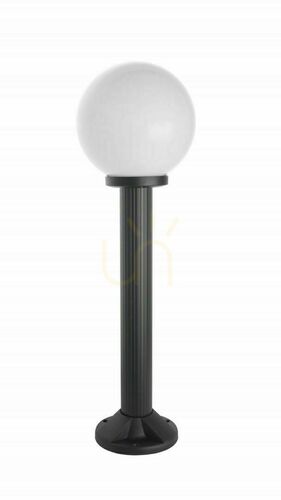
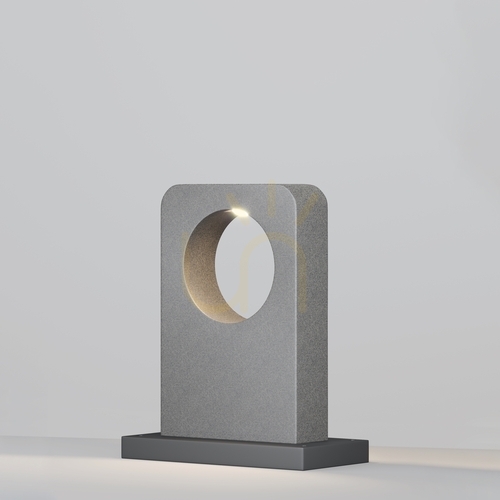
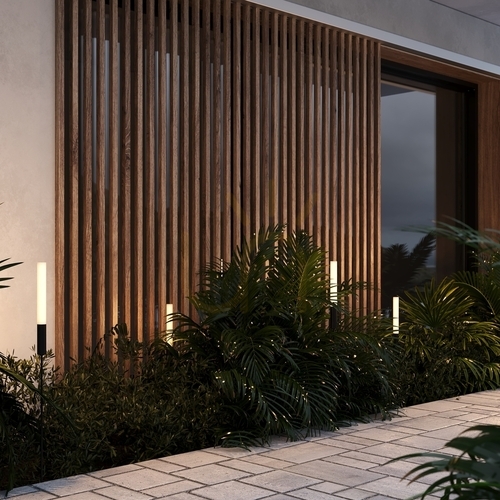
A light post is the workhorse of garden lighting: it’s designed to safely guide you along paths, steps, and driveways without blinding anyone. What should you look for?
- A height of 40–60 cm is sufficient for a typical path—the light falls on the surface, and the light source remains below eye level. Choose posts that are 80–100 cm tall for wider driveways.
- Direct the light downward or to the sides, never upward. The best models feature a shade covered from above by a cap or asymmetrical optics—in the dark, you see an illuminated path rather than a row of glaring spots.
- Material: powder-coated aluminum and stainless steel (inox) withstand Polish winters best. Near the coast and on salted driveways, look for corrosion resistance rated at least “seaside air.”
- Stable installation: the post is secured to a concrete base or ground anchor—if loosely driven into the lawn, it will topple over at the first gust of wind.

Garden lanterns – a classic in front of the house
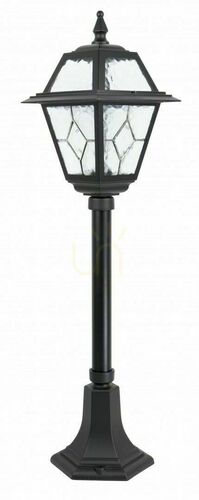
A garden light works where “high” light is needed: at the gate, the side gate, and on the driveway. At a height of 150–250 cm, a single light fixture can illuminate several square meters, so fewer streetlights are needed than light poles—but each one stands out more prominently in the landscape. Stylized lanterns with stained-glass shades will complement a classic facade and wrought-iron fence. For modern architecture, simple posts with linear LED lighting will work better.
Two practical considerations. A spherical shade that emits light in all directions sends half of the light into the sky—choose lanterns with a shade that is covered on top. The pole and the fixture are sometimes sold separately —which is an advantage: you can mount a single or triple fixture on a single pole, and replace just the head if necessary.




How should you arrange the lights along the path and driveway?
The most common question is: how many meters apart should the lights be placed? Practical guidelines:
- 40–60 cm posts: every 2.5–4 m along the path. The light beams from adjacent posts should overlap slightly—that way, no one walks into “dark spots.”
- Lights 200 cm+: every 6–10 m on the driveway or along the fence.
-
Alternating, not opposite: placing lamps on both sides of the path in a checkerboard pattern provides even lighting with half the number of fixtures compared to installing them in pairs.
-
Essential spots: every change in level (steps!), path turns, gates, and the area by the front door. That’s where things can go wrong.
- Less is more: the goal isn't to light up the entire garden like a sports field, but to guide the eye and the footsteps. The dark green areas are part of the design.
A good tip from designers: before buying, place inexpensive solar lights at the planned locations and live with this setup for a week—you’ll immediately see where light is missing and where it’s unnecessary.
Technical specifications: IP rating, materials, light sources
A garden light operates in rain, frost, and full sun, so technical specifications are more important than for indoor lighting:
- Water resistance: minimum IP44 for ground-mounted lamps, IP65 for fixtures exposed to water spray and drive-over lamps.
- Mechanical resistance: for driveways, pay attention to the IK rating (impact resistance) – IK08 and higher.
- Light source: fixtures with replaceable E27 bulbs offer complete flexibility (power, color, smart features). Integrated LEDs are more weatherproof, but after years of use, the entire fixture must be replaced. In a garden where the lamp is expected to last a decade, a replaceable light source is a real advantage.
Power supply: 230 V, 12 V, or solar?
- 230 V installation – the brightest and most stable light. Requires underground wiring (min. 60 cm, in a conduit) and a ground-fault circuit interrupter.
- 12 V low-voltage system – the golden mean: a transformer in the garage, with a safe, shallowly laid cable running through the garden. Moving a lamp is simply a matter of switching the connector.
- Solar – no wires, complete freedom of placement. The downside is shorter lighting time in winter – we wrote about this in a separate guide.
A hybrid system works best: 230 V for streetlights and the main path, solar and 12 V for decorations in the garden.
What color of light for the garden?
Warmer tones are preferred in the garden than in the home: 2700–3000 K. Warm white brings out the colors of wood, brick, and greenery. It isn't harsh and doesn't disturb the nighttime environment as much as cool tones do. Reserve the neutral 4000 K for the gate area and house number at most, where visibility is key. Avoid using cold 6000 K lighting in the garden altogether—the lawn looks like a parking lot under that kind of light.
It’s also a good idea to stick to a single color scheme throughout the garden. A mix of hot and cold spots is the most common reason why a property’s lighting looks haphazard, despite the considerable expense.
Common mistakes in garden lighting
- Blinding lights in the line of sight from the couch —a decorative light near the patio shouldn’t shine directly into the windows.
- Lights only near the house – the garden ends three meters from the patio after dark. A few light sources further back visually expand the property.
- Excessively bright light sources – in a dark setting, 400–800 lumens per post is too much. Excessive brightness creates harsh contrasts and deep shadows.
- No twilight sensor – manual switching means the garden is either lit all night or not at all.
- Cutting corners on installation —loose posts, cables without conduit, twisted pairs instead of gel-filled connectors will take their toll after the first winter.
How many lumens, what optics, and how to reduce glare
In the garden after dark, the eye adapts to low light levels, so outdoor lamps do not need to—and should not—be too bright. Approximately:
- the post by the path: ok. 200–400 lm per fixture,
- : entrance/gate light: ok. 600–1200 lm,
- accent lighting in green / decorative globe: even 100–200 lm is enough to set the mood.
More important than the power itself are the optics and the direction of the light:
- choose downlights or fixtures with asymmetrical beam patterns for the path—the light should fall on the surface, not in your eyes or into the sky,
- spherical shades that shine in all directions create glare and light pollution (a glow over the garden). If you like them, treat them as an accent, not as the main source,
- A warm color temperature of 2700–3000 K is more insect- and wildlife-friendly than cool light.
Fewer, but better-directed spotlights create a more attractive and safer garden than a dozen or so glaring streetlights—and lower bills to boot.
Summary
Good garden lighting is all about division of roles: lanterns at the entrance, posts every 2.5–4 m along the paths, spotlights, and accents in the greenery—all in a single, warm color temperature of 2700–3000 K, with IP44/IP65 protection and reasonable power. Add a twilight sensor, and your garden will welcome you with light every evening. You’ll find our full selection—from LUNA BALLS to posts and streetlights—in the following categories: Outdoor Standing Lamps, Lighting Posts, and Outdoor Lamp Posts.
Victoria


Maybe you will be interested in products from these categories?
Outdoor Standing Lights, Outdoor Post Lights, Outdoor Pole Lights, Garden Ball Lights
Tags & Blog Categories