
Outdoor Lights – How to Plan the Whole Lighting Scheme Around Your Home
Outdoor lighting usually grows one fixture at a time: first a wall light by the door, a year later a few lamps along the path, and later still a floodlight over the garage because someone tripped in the dark. The result is a random mosaic of lights that never quite work together. This guide shows how to plan lighting for the whole property in one go: entrance, façade, driveway, terrace and garden as a single coherent system, not a pile of separate purchases.

Table of contents
- Three layers of outdoor light
- Entrance and façade – the first impression
- Driveway and paths – a safe way home
- Terrace – light for evening gatherings
- Garden – accents in the greenery
- Ratings: IP and IK, and why they matter
- Power and control: 230 V, 12 V, solar, dusk and motion
- What colour temperature outdoors?
- Your lighting plan, step by step
- The most common mistakes
- Summary
Three layers of outdoor light
Good exterior lighting, just like indoor lighting, is built from several layers that work independently:
- Safety light – lights up steps, the threshold, the driveway and anywhere you could trip or lose your way in the dark. This is the mandatory layer, switched on every evening.
- Orientation light – guides your eyes and your feet: bollards along the path, fixtures by the gate, markers along the plot boundary. It works even at low brightness levels.
- Mood and decorative light – garden spheres, up-lit plants, string lights on the terrace. Switched on in the evening for pleasure, not necessity.
The common mistake is investing in only one layer – usually the strongest safety floodlights – and skipping the rest. A property lit purely with floodlights is functional but looks like a car park. A good plan combines all three layers and lets you switch them on independently, depending on the occasion.
Entrance and façade – the first impression
The entrance zone does the work of a first impression and makes the house number visible, so it deserves the most attention:
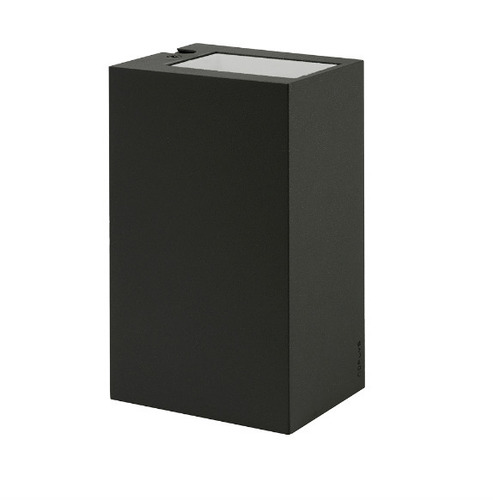
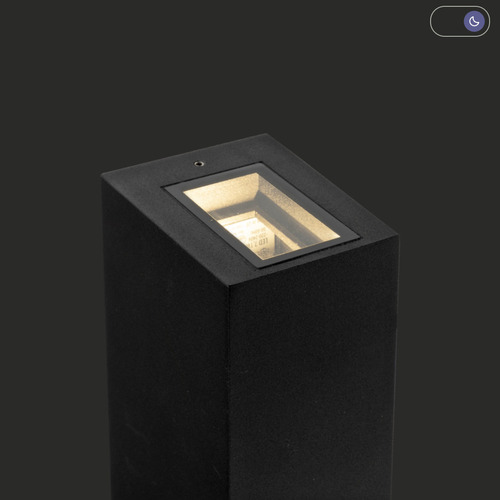
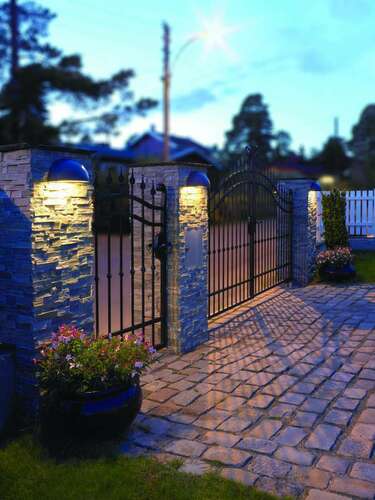
- Wall lights on both sides of the door, mounted 170–180 cm above the ground – your guest’s face is then lit rather than hidden in shadow. We covered choosing the height and style of wall lights in detail in a separate guide.
- Up-and-down distribution on a smooth façade brings out the texture of render or brick and is by far the most photogenic treatment for the front of a house.
- An LED floodlight with a motion sensor by the garage or a side entrance closes the safety gap where constant lighting would be overkill – it switches on only when someone approaches.
- The house number is worth lighting separately, even with a small spotlight – it is the one element that should be legible from the street at any hour.
You will find the full range in the Outdoor Wall lamps category, and LED floodlights in LED Floodlights.





Driveway and paths – a safe way home
The driveway and paths are the working zone – the priority here is safety, not effect:
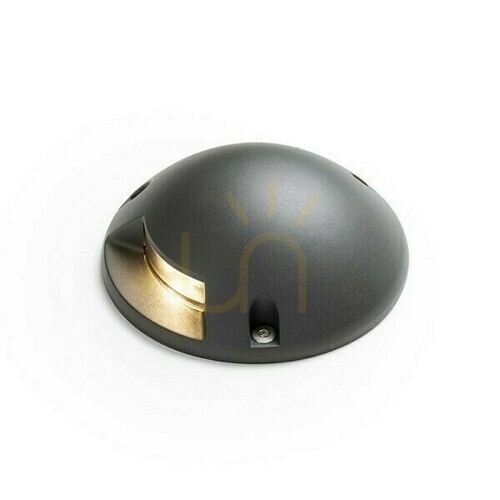
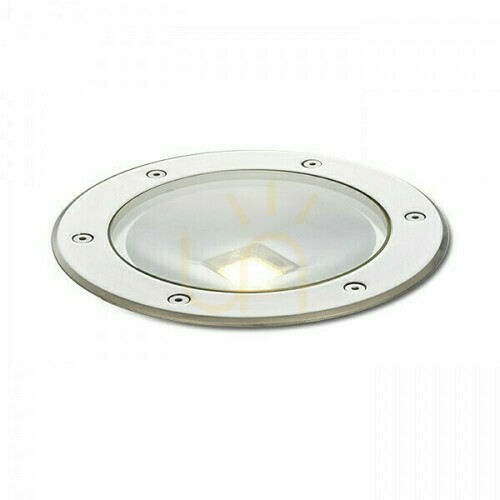
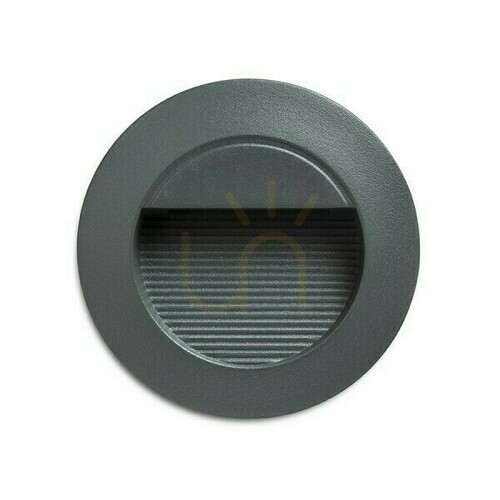
- Walkover ground lights built into the surface (pavers, slabs, concrete) mark the edges of the driveway without getting in the way of cars or the lawnmower. They must have a housing rated to withstand pressure (the IK rating, see below).
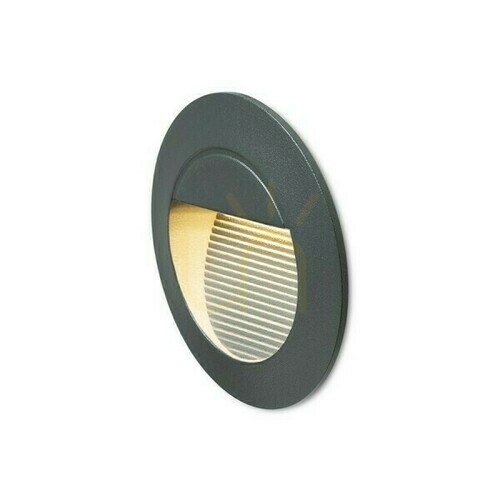
- Bollards or recessed fixtures along the path, spaced 2.5–4 m apart and alternating on both sides, give even light with fewer fixtures than fitting them in pairs.
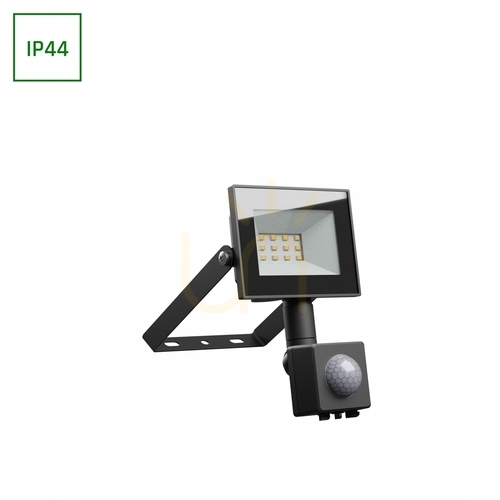
- A motion-sensor floodlight by the gate or garage is the cheapest way to light up the whole driveway exactly when it’s actually needed.
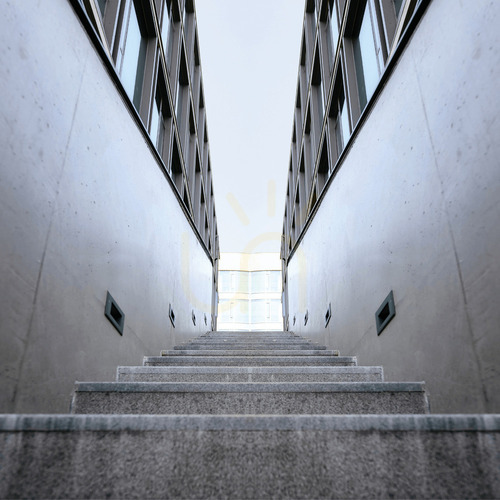
- Every change of level – a step, a kerb, a ramp – is a mandatory lighting point, regardless of the rest of the plan.



Terrace – light for evening gatherings
The terrace bridges indoors and the garden, so it works best with a mix of sources:
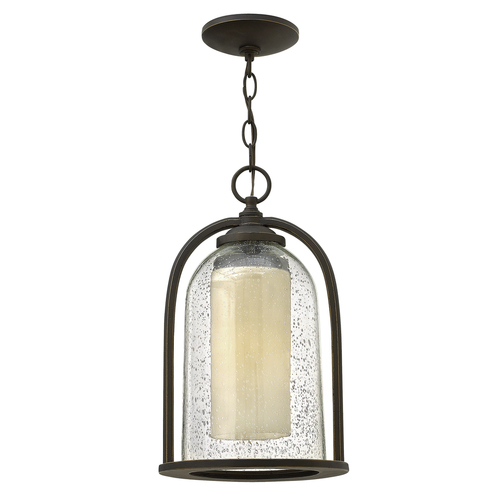
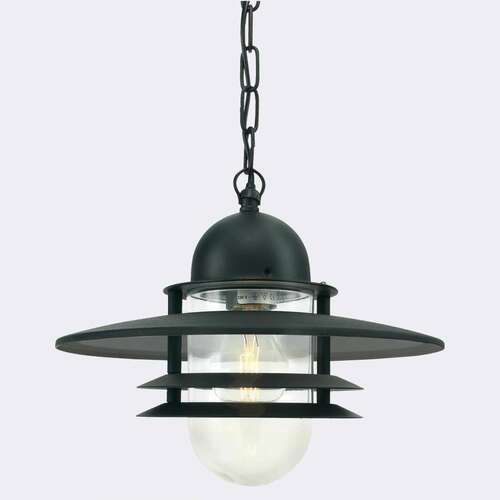
- An outdoor pendant light under a roof, hung at a height similar to a pendant over a dining table (see our guide on pendant lights over the table) – it creates a focal point and lights the tabletop.
- Decorative string lights hung over the terrace are the fastest way to add evening atmosphere without touching the wiring – we cover them in a separate guide on terrace string lights.
- Wall lights on the house wall by the terrace take the load off the central fixture and give working light by the grill or the outdoor counter.
- A dimmer and a separate circuit for the terrace zone is a comfort you will appreciate every evening – one setting for dinner, another for wine on the terrace afterwards.



Garden – accents in the greenery
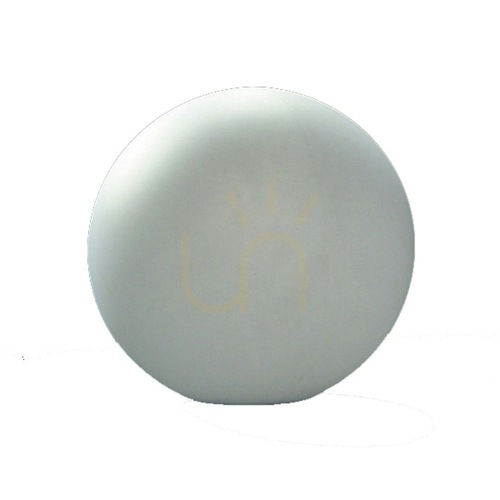
Deeper in the garden, purely decorative forms take over. Our speciality is LUNA BALL garden spheres – glowing orbs that work as an accent on the lawn, by a flower bed or on the terrace, whatever the garden’s style. We covered the full choice of spheres, lanterns and bollards – with concrete heights and spacing – in our comprehensive guide to standing garden lights. Here’s the short version: mix the types – a lantern by the gate, bollards along the path, spheres as accents in the greenery – instead of repeating one model across the whole plot.
You will find the full range in the Garden lamps and garden lighting category.


Ratings: IP and IK, and why they matter
Outdoors, technical ratings decide how long a lamp lasts more than its design does:
- Ingress protection (IP): at least IP44 for sheltered fixtures (wall lights under an eave, terrace lamps), IP54–IP65 for lamps fully exposed to rain, and IP67–IP68 for walkover and in-ground fixtures where water can pool.
- Impact resistance (IK): by the driveway, along paths and anywhere a fixture could get hit by a wheel, a kick or a snow blower, check the IK rating – the higher, the better it withstands impact. Walkover lights without adequate IK crack after the first winter.
- Operating temperature range – the IP class tells you about dust and water, not frost. The manufacturer’s datasheet should state the temperature range the lamp can run in year-round.
- Housing material – powder-coated aluminium and stainless steel (inox) hold up best through winters; near the coast and on salted surfaces look for “marine air” corrosion resistance.
Power and control: 230 V, 12 V, solar, dusk and motion
- A 230 V installation – the strongest and most stable light, requiring buried cables in conduit (min. 60 cm deep) and a residual-current breaker. Best for fixtures running all night: the entrance, the driveway, lanterns.
- A 12 V system – the middle ground: a transformer in the garage, a safe cable laid closer to the surface, and easy repositioning of fixtures.
- Solar – no wiring and full freedom of placement, at the cost of shorter runtime in winter. We covered the strengths and weaknesses of solar lights in a separate guide on solar lights in winter.
- A dusk sensor switches the whole installation on automatically at sunset – without one, the lights either stay on all day or someone forgets to turn them on.
- A motion sensor adds extra light where constant illumination would be overkill: by the garage, the gate, the back of the house. We dedicated a separate guide to choosing motion sensor lights.
- A schedule or app control is handy for decorative zones – spheres and up-lit plants can be switched off after midnight, saving power without losing safety.
A hybrid setup works best: 230 V for the entrance and the main route, 12 V or solar for the decorative greenery.
What colour temperature outdoors?
Outdoors, just like in the garden, a warmer tone works better than indoors:
- 2700–3000 K is the safe choice for the whole property – warm white brings out the colours of brick, wood and greenery, doesn’t glare and doesn’t disturb nocturnal wildlife as much as cold light.
- Neutral 4000 K should be reserved for purely functional zones: the driveway, the garage, places where sharpness of vision matters more than mood.
- Avoid cold 5000–6500 K near the house altogether – in a dark setting this light looks clinical, and your neighbours will notice it first.
- One colour temperature across the whole property ties everything together. A mix of warm wall lights and a cold floodlight is the most common reason a house’s lighting looks accidental.
Your lighting plan, step by step
Before you start buying lamps, it pays to sketch the whole thing out:
- Draw a plan of the property – entrance, façade, driveway, terrace, garden boundaries – and mark the power points you already have.
- Number the mandatory safety points: the threshold, the steps, level changes, the driveway, the gate. Plan these first, regardless of budget.
- Add the orientation layer: paths, plot boundaries, the way to the bin store or the summer house.
- Add the decorative layer last: spheres, up-lit plants, terrace string lights – this is the part you can build up gradually over the following seasons.
- Check power points against the plan – if the outlets don’t line up with the planned lamps, that’s the moment to decide between a buried cable, a 12 V system, or solar.
- Settle on one colour temperature for the whole property before you place the first order – changing it later means swapping bulbs in every single fixture.
- Plan the controls: what should switch on automatically at dusk, what should run on a motion sensor, and what should only go on by hand for special occasions.
The most common mistakes
- Only one layer of light – a property lit purely with security floodlights, with no decorative accents, looks stark and unwelcoming.
- No plan before buying – lamps bought one at a time, whenever something is “missing”, rarely add up to a coherent look.
- Too low an IP or IK rating – an indoor fixture, or a cheaply rated walkover light, won’t survive its first winter outside.
- Mixing colour temperatures – warm wall lights by the door and a cold floodlight over the garage is the most common reason a façade looks accidental.
- Forgotten power points – planning lamps without checking where power can actually be run ends in extension cords trailing across the lawn.
- No automation – switching the whole installation on and off by hand ends with the lights staying on all night, or not coming on when they’re needed most.
Summary
Good outdoor lighting is a plan, not a series of random purchases: three layers of light (safety, orientation, mood), one colour temperature across the whole property, the right IP and IK for each zone, and automation that switches on without you. Start with the entrance and driveway, add the terrace, and build up the garden season by season. You will find the full range in the Garden lamps and garden lighting, Outdoor Wall lamps, Outdoor Hanging Lamps and Outdoor Standing Lamps categories.
Bartosz Dziedzic


Maybe you will be interested in products from these categories?
Outdoor Lights, Outdoor Wall lamps, Outdoor Pendant Lights, Outdoor Standing Lights
Tags & Blog Categories