
Tiffany and stained glass lamps – coloured glass in a classic edition
There are lamps that light an interior, and there are lamps that are its jewellery. The Tiffany lamp belongs to the second category twice over: by day it’s a colourful sculpture in glass, by night – a glowing stained-glass window that turns an ordinary corner of the room into the cosiest spot in the house. Though the technique is more than a hundred and twenty years old, the dragonflies, wisteria and geometric mosaics are returning to classic and modern interiors with equal force. We explain how a real Tiffany shade is made, how it differs from an ordinary stained glass lamp, where it fits best and how to care for coloured glass so it pleases the eye for generations.

Table of contents
- What is a Tiffany lamp?
- How a Tiffany shade is made – the copper foil technique
- Patterns and colours: dragonflies, wisteria, mosaics
- Where a stained glass lamp fits best
- Table, pendant, wall or floor lamp?
- What kind of light coloured glass gives
- Caring for stained glass
- How to recognise a good stained glass lamp
- Frequently asked questions
- Summary
What is a Tiffany lamp?
The name comes from Louis Comfort Tiffany – the New York artist whose studio, at the turn of the 19th and 20th centuries, carried stained glass out of church windows and into domestic drawing rooms. At Tiffany Studios – where whole teams of designers and artisans worked on the patterns, with Clara Driscoll and her women’s glass-cutting department at the forefront – lamps were created that today fetch fine-art prices at auction: shades assembled from hundreds of pieces of hand-coloured glass, each set separately and joined into a glowing mosaic.
Contemporary Tiffany lamps continue that tradition: the shades are still made by hand, from real coloured glass, using the same technique as a century ago. Honesty demands one clarification: what you’ll find in shops – ours included – are Tiffany-style lamps, made with the original technique, not antiques from Tiffany Studios itself; those are auctioned by the great houses.
You’ll find the collection of lamps in this style – from table lamps to chandeliers – in the Tiffany Lamps category.
How a Tiffany shade is made – the copper foil technique
The hallmark of these lamps is the so-called copper foil technique – patented at the end of the 19th century and brought to mastery precisely at Tiffany Studios. Unlike the heavy lead cames that still serve in stained glass windows, the foil allows intricate, fine and three-dimensional designs:
- The shade’s pattern is drawn out into templates – one for every piece of glass; rich designs can run to several hundred.
- Each element is cut by hand from a sheet of coloured glass and ground along the edges.
- The edges are wrapped in a thin band of copper foil.
- The elements are laid out on a dome-shaped form and joined with tin solder along every seam – from inside and out.
- The soldered seams are coated with patina, which gives them the dark, noble tone of old metal.
Add to this a very particular kind of glass: opalescent, with streaks and shifts of colour within the sheet, which Tiffany’s studio made famous (its iridescent variety went down in history under the name Favrile). It’s what makes a shade feel alive – the same lamp looks different in the morning, different in the sun, and different again lit from within. Which is also why two lamps of the same pattern are never identical – the run of streaks in the glass is different every time. That’s not a production flaw; it’s the signature of handicraft.
Patterns and colours: dragonflies, wisteria, mosaics
The classic Tiffany motifs fall into three families:
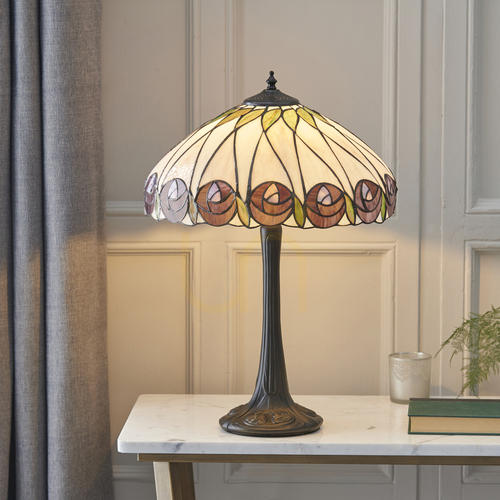
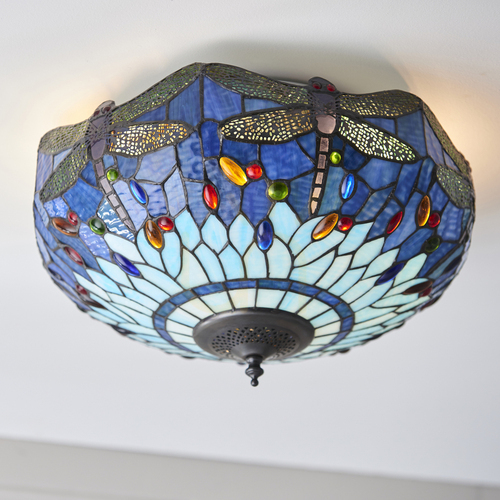
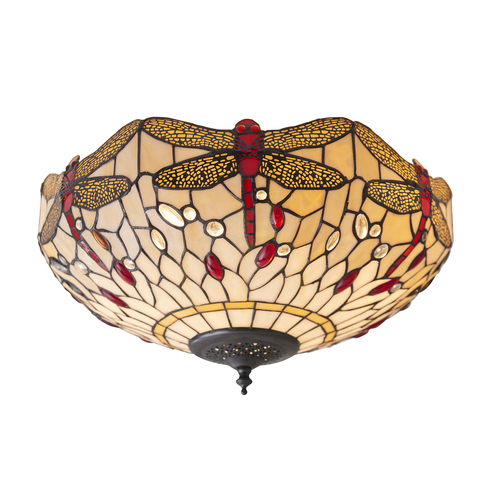
- Nature – the most famous patterns in the genre’s history: dragonflies, wisteria, morning glories, peacock feathers. Rich, multicoloured, with hundreds of elements; these are what make a lamp a work of art, and they warm classic interiors naturally.
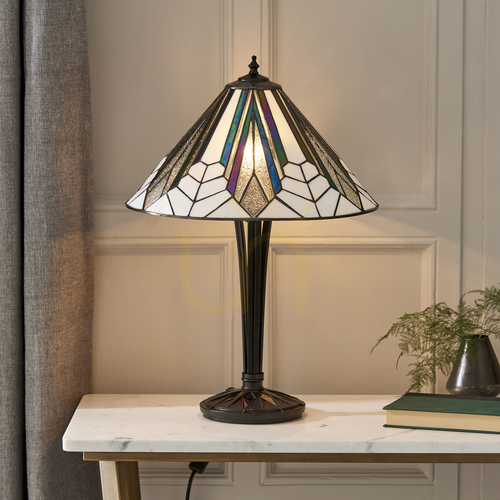
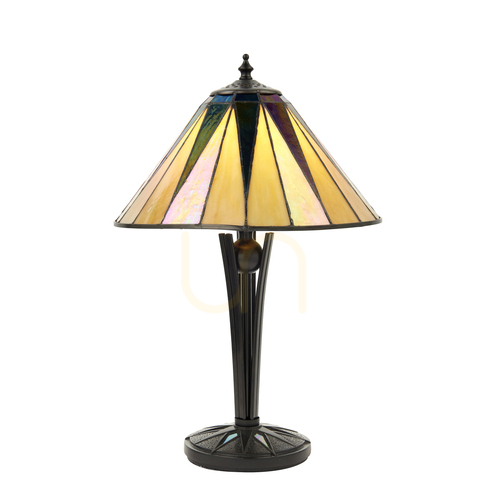
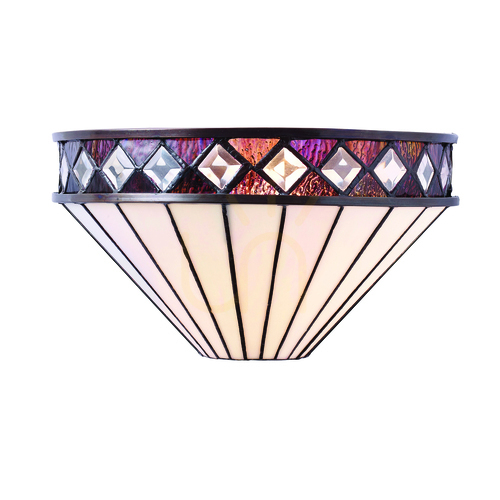
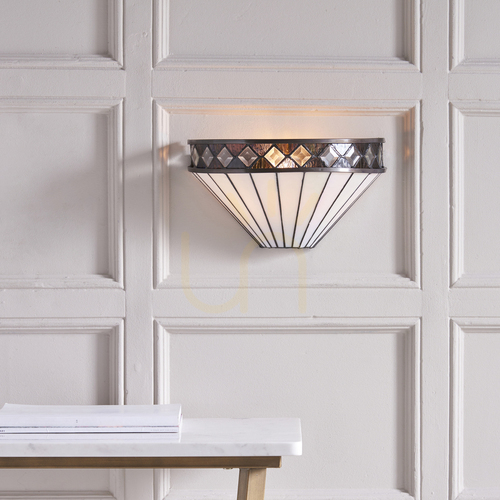
- Geometry – mosaics of diamonds, scales and bands in two or three tones. Calmer and more universal; a geometric shade in ambers and white will find its place even in a modern study.
- Art Nouveau and Art Déco – flowing lines, tulips, lilies, fans; the bridge between stained glass and the style of the twenties.
The colour scheme hints at the use: ambers and honeys warm the most and build a library mood; blues and greens feel fresh and look beautiful in daylight; reds and purples are the most decorative, evening option. The more white and opalescent milkiness in the pattern’s background, the more light the lamp will actually give back to the room.







Where a stained glass lamp fits best
- The dining room – a stained glass pendant over the table is the most classic use of all: a colourful dome hung low over the tabletop gathers the household the way a shade over a café table once did. It works over round and square tables; over a long rectangular one, two smaller pendants beat one huge dome.
- The study and library – a Tiffany table lamp on a desk or chest of drawers is an icon of the “club” style: warm amber light, dark wood, a leather armchair. Paired with brass accents it makes an interior that never goes out of fashion.
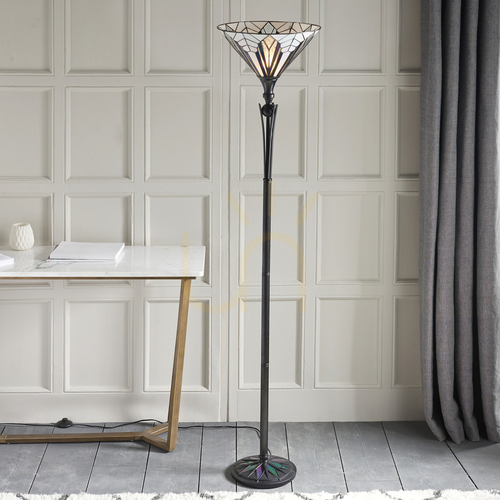
- The reading nook – a stained glass floor lamp by the armchair gives soft, colourful background light; for the reading itself add an ordinary directional lamp, because coloured glass dims by design.
- The bedroom – a small stained glass lamp on the bedside table works like a night light with a soul: subdued, warm light and none of the blinding white.
- Modern interiors – contrary to appearances, one of the most interesting uses: a single Tiffany lamp in a minimalist room acts like a painting – one strong, colourful accent on a calm background. The condition: let it play solo, don’t mix several stained glass patterns in one room, and keep it away from patterned wallpaper.
Stylistically, stained glass lamps are at home in classic, vintage, Art Nouveau and Art Déco rooms, in “club-room” colonial interiors, in eclectic schemes – and, as a solo accent, in modern classic too.
Table, pendant, wall or floor lamp?
- The table lamp – the classic and the safest start: a dome on a decorated base, usually 30–50 cm in diameter. Place it where it can be seen from the side – on a chest of drawers, a desk, a side table by the armchair – because a Tiffany shade is beautiful even switched off.
- The pendant – a stained glass dome over the table or the kitchen island; bottom edge about 70–80 cm above the tabletop, so the dome doesn’t hide the faces of those seated. Match the diameter to the table: a dome about 1/2–2/3 of the tabletop’s width looks proportionate.
- Wall lamps – most often in pairs, flanking a mirror, a fireplace or a bed; small wings of coloured glass that create mood without taking up space.
- The floor lamp – the most spectacular form: a lit dome at eye level turns a living room corner into a stage. It needs space – in a tight room the table version will work better.
- Flush ceiling lights – stained glass flush lights are the rarer but practical choice for a hallway or bedroom: coloured glass at the ceiling instead of the usual milky diffuser.



What kind of light coloured glass gives
A stained glass lamp is mood light, not task light – and it’s worth planning it that way:
- Coloured glass absorbs a good share of the flux – the same bulb will give noticeably less light in a stained glass shade than in a milky one. Treat the Tiffany lamp as the interior’s mood layer, and add a separate source for work and reading.
- The bulb: warm, 2700 K – cooler white distorts the colours of the glass. A classic E27 LED bulb of 400–800 lm is enough; dark, saturated shades need the top of that range, while light and milky ones let more through. In domes with an open bottom a decorative bulb looks lovely – as long as it isn’t so strong that it glares from under the shade.
- A dimmer works magic – a dimmed stained glass lamp saturates the colours and brings out the streaks in opalescent glass; choose dimmable sources.
- Avoid strong heat sources – modern LEDs are an ally here: they heat the glass and the soldered seams far less than the old high-wattage bulbs.
Caring for stained glass
A well-treated stained glass lamp serves for decades – the rules are simple:
- Regular dry dusting – a soft cloth or a dusting brush; that’s enough day to day and protects against the film that dulls the colours.
- Wet cleaning only gently – a slightly damp cloth, perhaps with a drop of mild soap; no soaking the lamp and no ammonia-based liquids or harsh solvents, which destroy the patina on the soldered seams. Wash your hands after cleaning the seams – in older and handcrafted lamps the solder may contain lead.
- Don’t polish the patina – the dark seams are a deliberate effect; “cleaning” them to a shine strips the lamp of character and value.
- Carry it by the base, not the shade – the dome is soldered, not glued; lifting by the glass strains the seams.
- A sensible spot – glass coloured in the mass is extremely colour-fast, so fading isn’t a worry; the more real problem is constant overheating (a windowsill above a radiator, harsh southern sun in summer), which works away at the soldered seams over the years.
The general rules for cleaning different lamp types – from metal to fabric – we gathered in our post on caring for lamps.
How to recognise a good stained glass lamp
The market is full of plastic imitations “in the tiffany style” – a few tests separate handicraft from a hollow copy:
- Weight – real glass and soldered seams weigh something; a 40 cm shade can run to several kilograms. A suspiciously light “stained glass” dome is almost certainly plastic.
- Touch and sound – glass is cool and hard, and rings gently when tapped; plastic is warm and dull.
- The seams – in the copper foil technique the solder lines are slightly irregular, raised, with visible handwork. Perfectly even, moulded-in “cames” betray a cast from a mould.
- Irregularities in the glass – streaks, bubbles and differences in shade between pieces are a feature of art glass, not a defect. Two identical lamps of “hand-made glass” should precisely NOT be identical.
- The base – in good lamps it’s metal (often decorated, with a heavy casting), not plastic with a metallised coating.
Frequently asked questions
Does a Tiffany lamp suit a modern interior? Yes – on condition it plays the soloist. One stained glass lamp on a calm, uniform background acts like a painting; geometric patterns in two or three colours cooperate with modern interiors most easily.
What bulb for a stained glass lamp? Warm (2700 K), ideally dimmable, with a flux of 400–800 lm; an LED doesn’t heat the glass and seams. Cool white distorts the shade’s colours, so avoid it.
Does coloured glass fade with time? No – glass coloured in the mass keeps its colour for decades and doesn’t fade like fabric. What really “extinguishes” a lamp is a layer of dust dulling the colours and the overheating of the seams on a sunny windowsill or above a radiator – regular dusting and a sensible spot settle the matter.
Why are Tiffany lamps expensive? Because every shade is dozens of hours of handwork: hundreds of elements cut, ground, wrapped in foil and soldered in one by one. The price grows with the number of elements, the dome’s diameter, the pattern’s complexity and the quality of the cast base – you’re paying for handicraft and real art glass, hence the gulf between stained glass and a plastic imitation.
How to clean a Tiffany shade? Day to day a dry, soft cloth or a brush; every now and then a slightly damp cloth with mild soap. No ammonia, no solvents and no polishing of the soldered seams – the patina is meant to stay dark.
Summary
Tiffany and stained glass lamps are the most pleasant proof that lighting can be artistic craftsmanship: hand-cut glass, copper foil and solder turn a lamp into a stained-glass window that adorns the interior even when switched off. Choose the form for the role – a table lamp for the desk and chest of drawers, a pendant over the table, a floor lamp for a living room with space – give it a warm, dimmable bulb and treat its light as the interior’s mood layer. In return you get an object that never ages stylistically and, with a little care – a dry cloth, no chemicals on the patina – will glow with colour longer than many a piece of furniture in the same room.
Andrzej Garbień


Maybe you will be interested in products from these categories?
Tiffany Lamps
Tags & Blog Categories