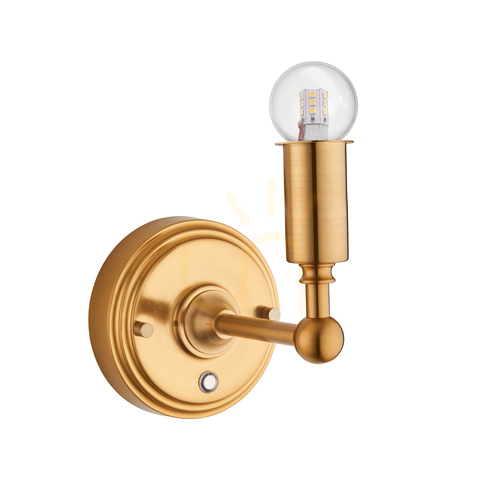
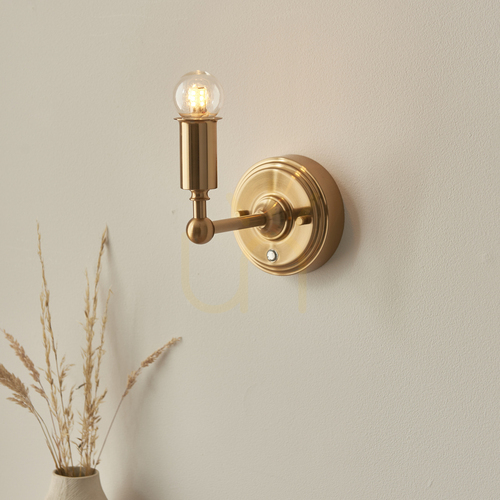
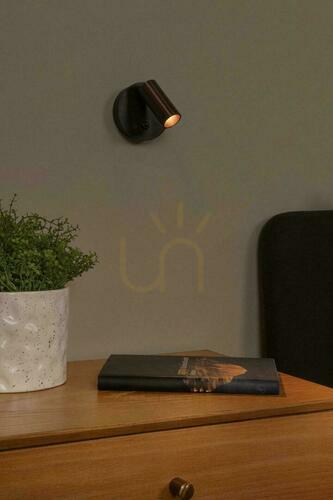
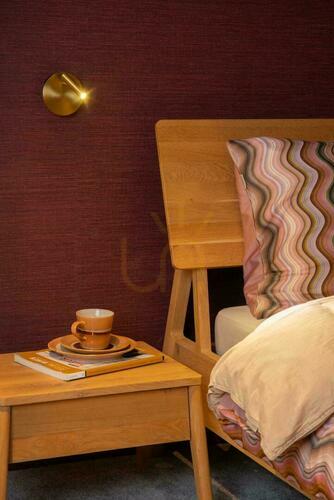
Rechargeable wall lights are wall lights with their own battery, so they can go on any wall without a supply behind it – you fix a small plate, hang the light and charge it over USB when it runs low. What changes compared with a hardwired fitting is simple: no chasing plaster, no new circuit and no electrician, but the battery now decides how bright the light is and how long it stays on.
That trade-off suits renters, freshly decorated rooms and all the spots a builder never planned for: either side of a headboard, a dark alcove, the turn of a landing or above a favourite print.
What a battery changes in a wall light
Most cordless wall sconces run on a built-in lithium-ion cell charged through USB-C (older designs use micro-USB). Some take replaceable AA or AAA batteries instead. The light source is almost always integrated LED, which draws little power and stays cool.
With no wall switch involved, control moves to the fitting itself: a touch pad where a short tap switches on and a long press dims, a push button or pull cord, a remote, or a motion sensor. Many designs lift off a magnetic backplate, so you carry the light to a charger and the plate stays put.
The other change is output. Battery wall lights usually give around 100–400 lumens, with a few reaching roughly 700. That is plenty for reading in bed or picking out a painting, but it won't light a whole room, so treat them as task, accent or guide lights alongside the ceiling light.
Choosing the power option
| Option |
Typical runtime |
Charging or upkeep |
Best for |
| Built-in rechargeable battery |
about 6–20 h per charge, longer on low settings |
USB-C, usually 2–4 h from empty |
bedside and reading lights used every evening |
| Replaceable AA/AAA batteries |
weeks to months with a motion sensor |
swap cells; NiMH rechargeables (1.2 V) can look slightly dimmer than alkaline (1.5 V) |
cupboards, under-stair storage, rarely used corners |
| Rechargeable bulb in a conventional fitting |
similar to built-in batteries |
remove the bulb or charge in place, depending on design |
keeping a shade or style you already like |
| Plug-in wall light (corded) |
unlimited |
none, but the flex shows on the wall |
a socket within reach and long evening use |
Then check the light itself. Warm white at 2700–3000 K is the comfortable choice for bedrooms and living rooms; colour-adjustable (CCT) models usually span 2700–6500 K, and something near 4000 K helps when reading. A charge indicator is worth having, and some lights dim themselves slightly as the battery runs down, which is a useful warning.
Where they work best
-
Bedside: around 120–140 cm from the floor, aimed at the page rather than the pillow. A swing arm or downward shade keeps glare off your partner.
-
Hallways and landings: 160–180 cm up, ideally with a motion sensor, so the light runs for minutes a day and a charge lasts weeks.
-
Stairs: low on the wall, 20–40 cm above the tread, as a guide light at night.
-
Artwork and shelves: 15–25 cm above the frame, with a narrow, warm beam.
-
Children's rooms: a very low setting makes a good night light, and low-voltage LED stays cool to the touch.
Fixing it to the wall
Adhesive pads hold lightweight fittings on smooth, dry, sound paintwork. Degrease the wall, press the plate firmly for at least 30 seconds and leave it up to 24 hours before hanging the light. On textured plaster or wallpaper, screw the plate with wall plugs; on plasterboard, use cavity fixings. Two small holes fill easily when you move out.
Battery care and common mistakes
- Lithium-ion cells dislike heat and being run flat. Don't charge on a radiator, and don't leave the light empty for weeks.
- Store an unused light about half charged.
- Capacity fades after a few hundred cycles, and built-in batteries are often not user-replaceable, so check before you buy.
- Use the charger the instructions specify.
- Take spent batteries and old fittings to a recycling point or a shop's battery bin, not the household bin.
Frequently asked questions
How do you recharge rechargeable wall lights?
Plug a USB cable into the port on the light, or lift the light off its magnetic plate and charge it at a USB adapter like a phone. A full charge usually takes 2–4 hours; a mains adapter is quicker than a laptop port.
Are there any rechargeable wall sconces?
Yes. Rechargeable sconces come in many of the shapes wired ones do: shaded, up-and-down, swing-arm and slim picture-light styles, in metal, glass, fabric or rattan.
Are rechargeable wall lights good for a bedroom?
They are among the best uses: no cables down the wall beside the bed, dimming at a touch and warm light for winding down. Choose 250 lumens or more if you read in bed.
How long does the battery last?
Per charge, roughly 6–20 hours of continuous light depending on brightness. Over its life, a lithium-ion cell gives a few hundred full cycles before noticeably losing capacity.
Can I put a battery wall light in a bathroom?
Only if it is rated at least IP44, and only where the manufacturer allows. In UK bathroom zones 1 and 2, BS 7671 calls for at least IPX4, so check the rating before fitting one near the bath or shower.
What makes the best rechargeable wall lights for indoors?
Clear figures for lumens, runtime and charge time, USB-C charging, a charge indicator, dimming and a fixing method that suits your wall.
If you'd rather have a light wired into the circuit, browse wall lights. For a corded option that only needs a socket, read more about plug-in wall lights.