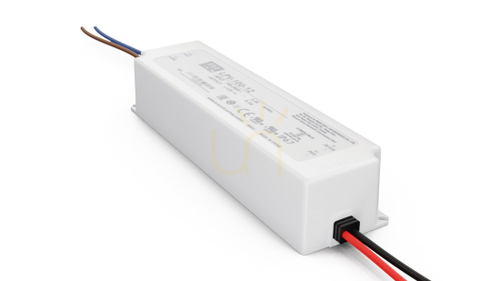
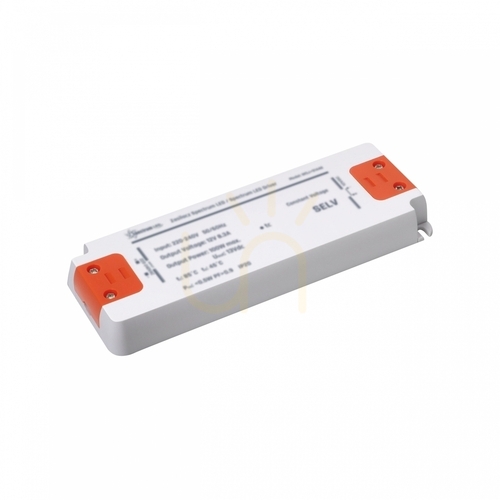
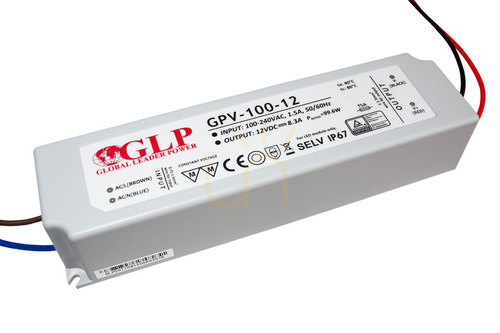
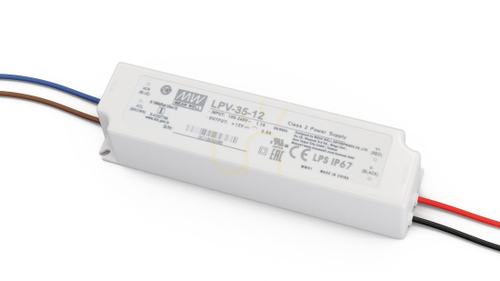
A 12 V power supply for LED lighting turns 230 V mains into a steady 12 V DC, which is what most LED tape, under-cabinet strips and small low-voltage fittings run on. Choosing one comes down to three things: the voltage has to match your lights exactly, the wattage has to cover the load with some spare, and the housing has to suit the place it will live – a dry kitchen cupboard, a loft space or a wet patio wall.
Almost every LED driver sold for tape is a switch-mode, constant-voltage (CV) unit. Don't confuse it with a constant-current driver, which is rated in milliamps and made for LED panels and some downlight modules. Tape needs constant voltage; feed it constant current and it will either not light or be damaged.
Reading the label: volts, amps and watts
The voltage on the label is fixed. The current is a ceiling, not something the supply pushes into your lights. A 12 V 2 A unit can deliver up to 24 W (12 × 2), and the tape connected to it will only draw what it needs. That is why a bigger supply at the right voltage is harmless, while one that is too small runs hot, cuts out or makes the tape flicker as its overload protection kicks in.
To size it, take the tape's rating in watts per metre, multiply by the length you are fitting and add 20–25 % headroom. Five metres of 9.6 W/m tape draws 48 W, so a 60 W driver is the sensible pick. Running a driver at around 80 % of its rating keeps it cooler and helps it last.
| What you are powering |
Typical load |
12 V driver to choose |
| Under-cabinet tape, 2 m at 4.8 W/m |
about 10 W |
12–24 W plug-in adapter |
| Shelf or cove, 5 m at 9.6 W/m |
about 48 W |
60 W (5 A) |
| Bright kitchen run, 5 m at 14.4 W/m |
about 72 W |
90–100 W |
| Six G4 or MR16 LED lamps for DC, 2–5 W each |
12–30 W |
24–36 W, check the lamps accept DC |
| Two 5 m runs of 9.6 W/m in parallel |
about 96 W |
120–150 W, or two separate 60 W units |
Why 12 V, and where it runs out of steam
12 V tape can usually be cut every three LEDs, so it fits short kickboards, wardrobe shelves and display niches neatly. The trade-off is current. At the same wattage a 12 V system carries twice the amps of a 24 V one, so voltage drop sets in sooner. As a rule of thumb, feed a single 12 V run from one end for no more than about 5 m; beyond that the far end dims or shifts colour. For longer runs, feed both ends or take separate cable tails to each section. If a room needs ten metres or more of continuous light, 24 V tape and a 24 V driver are often the tidier solution.
Plug-in, enclosed or waterproof?
Plug-in adapters look like a laptop charger and normally end in a 5.5/2.1 mm barrel plug. They suit short runs up to roughly 60 W and need nothing more than a socket, which makes them the easiest DIY option.
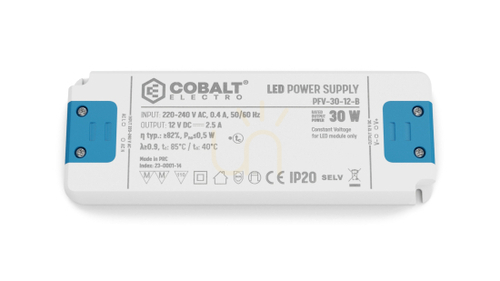
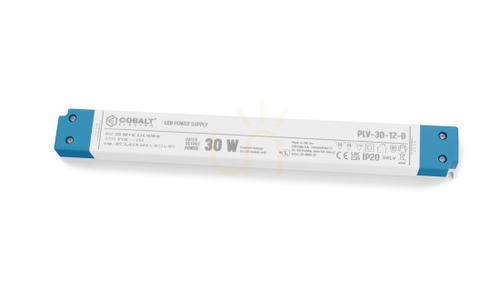
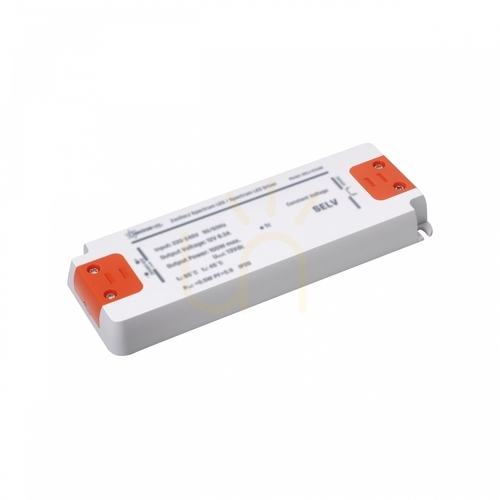
Enclosed drivers come in two main styles. Slim plastic, double-insulated (Class II) units have no earth terminal and slip into cabinets or above a suspended ceiling. Perforated metal units (IP20) cover higher powers but expose their mains terminals and usually need an earth, so they belong in a plant room, cupboard or enclosure. Some go in a consumer unit on DIN rail.
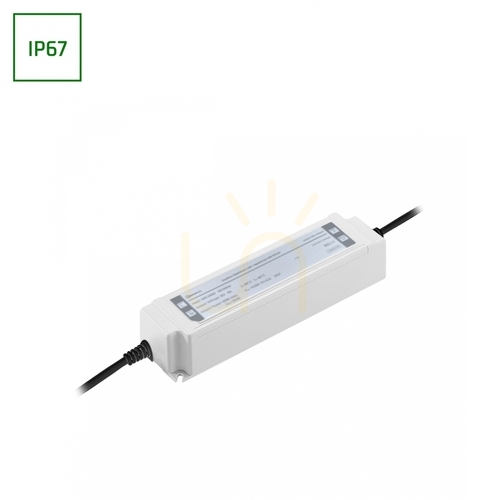
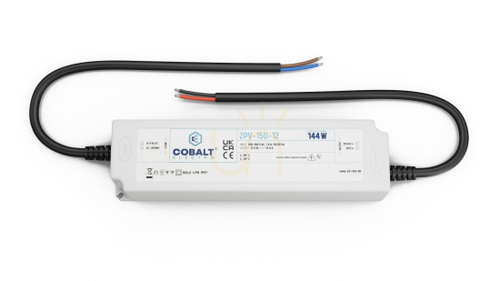
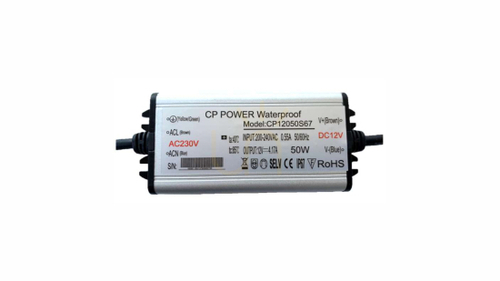
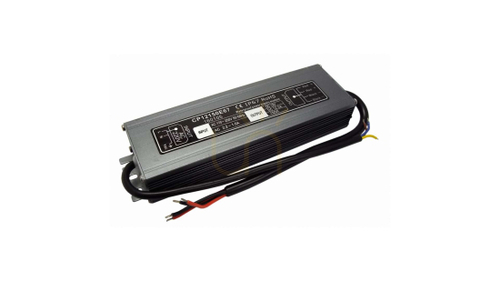
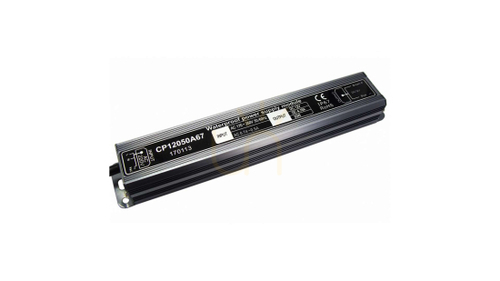
Waterproof drivers, typically IP67, are potted in resin with flying leads. Use them outdoors, in bathrooms and anywhere steam or splashes reach. Remember the connections count too: an IP67 driver joined with an open terminal block is not an IP67 installation.
Installation and dimming
Whatever the housing, drivers need air. Avoid burying them under loft insulation or in a sealed box, and put them somewhere you can reach – a hatch in a plasterboard ceiling saves a lot of grief when a driver eventually needs replacing. A plug-in adapter is fine to set up yourself; anything wired into a fused spur or lighting circuit should be done by a qualified electrician to BS 7671, especially in a bathroom.
Standard 12 V drivers are not dimmable from the mains side. Put one behind an ordinary wall dimmer and it will flicker or fail. Either fit a PWM dimmer or controller between driver and tape, or choose a driver marked as triac (phase-cut) dimmable and check its minimum load. Commercial schemes also use 1–10 V and DALI drivers.
Frequently asked questions
What does 12 V 2 A mean?
It means the supply holds 12 V and can deliver up to 2 A, or 24 W. Allowing for headroom, that covers about 4 m of 4.8 W/m tape or 2 m of 9.6 W/m tape.
Will a 24 V power supply work on 12 V lights?
No. Doubling the voltage overloads the LEDs and resistors on 12 V tape and can ruin it quickly. The reverse – 12 V on 24 V tape – is not dangerous, but the tape will glow faintly at best and usually not light at all.
What will a 12 V supply power?
In lighting: LED tape, cabinet and shelf lighting, low-voltage step lights and DC-rated G4 or MR16 bulbs. Beyond lighting, the same voltage runs CCTV cameras, door entry kits and small pumps, each with its own wattage to check.
Can I use a USB power bank or adapter instead?
USB gives 5 V, not 12 V, so it will not drive 12 V tape unless the adapter is specifically a 12 V output type. Tape made for USB is a 5 V product.
Is a power supply with more amps safe?
Yes, provided the voltage matches. The lights take only the current they need. A much oversized driver simply runs less efficiently.
Can a 12 V driver run off a battery backup?
Not as it stands. Battery-backed 12 V supplies are made for alarms and CCTV; a standard LED driver has no battery or charging circuit. A 12 V battery can run tape directly, but it needs its own charger.
Replacing an old halogen transformer and wondering whether it will cope with LEDs? That question belongs with 12 V transformers. For 24 V systems and choosing a driver more generally, see LED power supplies.