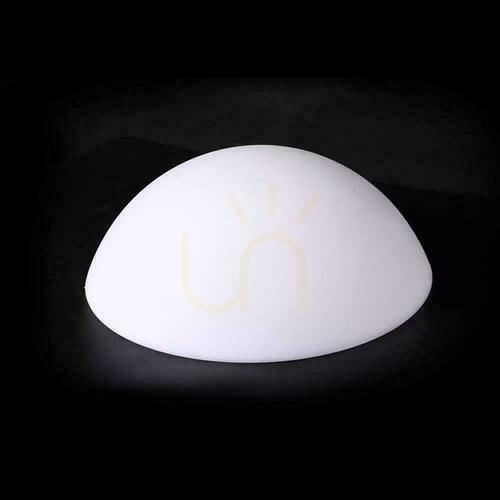
Garden light balls with integrated LEDs have the light source built in for good – the diodes sit in the base or at the centre of the globe, and there is no E27 lamp holder waiting for a bulb. That means the colour of the light, the brightness and the way it is powered all come with the sphere itself, so it pays to settle them before you buy.
By day the ball reads as a smooth, matt sculpture on the lawn; after dark it gives a soft, even glow in every direction. LEDs run cool and take up very little room, which leaves space inside the globe for a battery, a solar panel, a remote-control receiver or colour-changing electronics. That is why the format stretches from a small solar orb tucked into a border to a large mains-powered ball cycling through colours on the patio.
How do you run outdoor lights with no plug?
It is one of the most common questions about garden lighting, and integrated-LED balls answer it in two ways.
-
Solar: a panel in the top of the globe charges a lithium-ion battery, and a dusk sensor switches the light on. After a sunny summer day expect roughly 6–10 hours. Through a grey British November and December, that can shrink to an hour or two, and the glow is gentle – a marker rather than a path light.
-
Rechargeable via USB: charge it indoors, carry it out to the table, the summerhouse or the balcony. Ideal where neither a cable nor much sun can reach.
If you want a ball that is bright every evening of the year, mains power is still the dependable choice.
Integrated LED or a bulb holder?
Globe lights with an E27 holder are essentially shells: you choose the bulb, and you can swap it for a warmer, brighter or smart one whenever you like. With an integrated LED that freedom goes, but the light is ready out of the box, the housing is usually sealed more tightly, and power draw is low. The trade-off comes years down the line – when the LEDs fade, you replace the light module if the manufacturer sells one, or the whole fitting.
Choosing the right garden light ball
| What to check |
Typical options |
Best for |
| Diameter |
20–30 cm, 40–50 cm, 60–80 cm |
small along paths and borders, mid-size on lawns and patios, large as a focal point |
| Power |
mains plug-in, hard-wired, low-voltage plug-in kit, solar, USB battery |
mains or low-voltage for year-round light, solar and battery for cable-free spots |
| Colour |
2700–3000 K warm white, about 4000 K neutral, RGB or RGBW |
warm white suits planting and timber, colour-changing for parties |
| Weather rating |
IP44, IP65, IP67–IP68 |
IP44 under cover, IP65 in the open, floating only where the maker says so |
| Material |
polyethylene, acrylic, glass, stone effect |
polyethylene is light, frost-proof and shrugs off knocks; glass looks finer but breaks |
| Control |
remote, dusk sensor, app, dimming |
a dusk sensor saves battery on solar balls |
How to connect a mains garden light safely
Plug-in balls go into a weatherproof outdoor socket protected by a 30 mA RCD. Most come with a lead a few metres long; keep it out of the mowing line or run it along a fence or edging. Low-voltage plug-in kits are another route: a transformer sits at the socket and only safe extra-low voltage runs through the borders, so you can lay it yourself.
Anything hard-wired is different. A permanent cable across the garden should be armoured (SWA), buried deep enough to be clear of spades and forks, and the work must meet BS 7671. In England and Wales a new outdoor circuit is notifiable under Part P, so it is a job for a registered electrician.
Placement ideas
A sphere wants to roll, so on a lawn it sits on a ground spike, and on a patio it is bolted to a base fixed to the paving. Keep the base slightly proud of the ground so rainwater does not pool underneath. Three balls in different sizes look more natural than a row of identical ones. Because the light is diffused there is no glare, so they work right beside a path, at the edge of a pond or by a hot tub.
Care and common mistakes
Wipe the globe with a soft cloth and warm soapy water. Solvents dull plastic, and a pressure washer held close can force water past the seals. Each spring, check the lead and the cable gland. The usual mistakes: a solar ball parked under a tree, an IP44 model in the path of a sprinkler, and a loose cable left in the grass.
Frequently asked questions
What are the best mains-powered garden light balls?
Look for IP65 or better, a polyethylene shell, warm white or switchable colour, and a lead long enough to reach your outdoor socket without an extension.
Are solar garden light balls bright enough?
For a soft accent in summer, yes. They will not light a path, and in midwinter their running time drops sharply.
What size should a large garden ball light be?
50 cm holds its own in the middle of a lawn; 60–80 cm becomes a centrepiece but can overwhelm a small courtyard.
Can garden light balls stay out all winter?
Polyethylene balls cope with frost and mains models can stay put. Switch solar ones off and store them, because lithium batteries dislike charging below freezing.
Can the LED in a garden light ball be replaced?
You cannot fit a standard bulb. Some manufacturers sell spare light modules or batteries; otherwise a failed module means replacing the fitting.
Can I float a light ball in my pond?
Only if the manufacturer says it is made to float. IP65 covers water jets, not immersion – that needs IP67 or IP68.
Prefer a globe with a bulb holder? Read more about sizes, finishes and power options for garden ball lights.