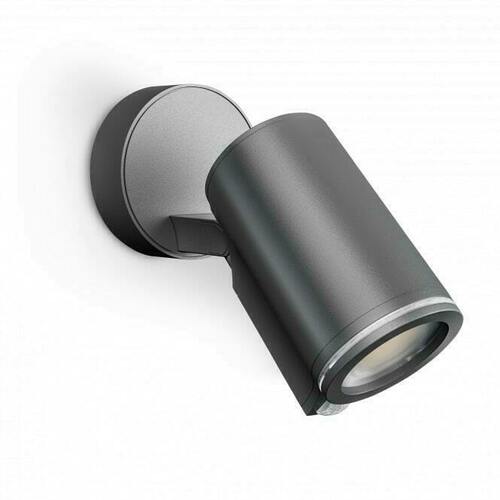
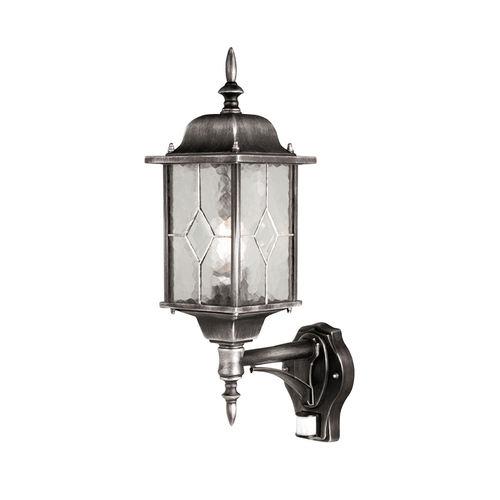
An outdoor motion sensor light switches itself on when someone walks up to the front door, the side gate or the garage, then turns off again once the area has been quiet for a set time. You get light exactly where and when you need it, without hunting for a switch in the dark or leaving a porch light burning all night.
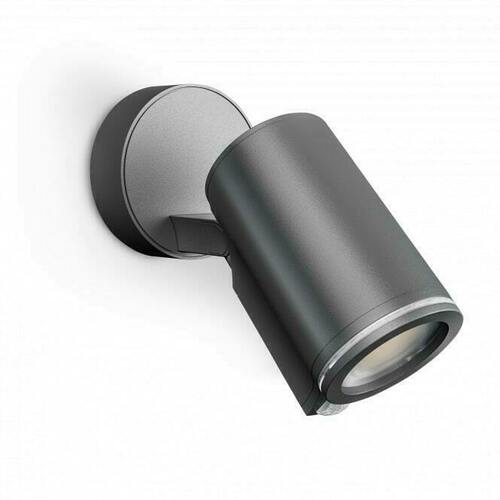
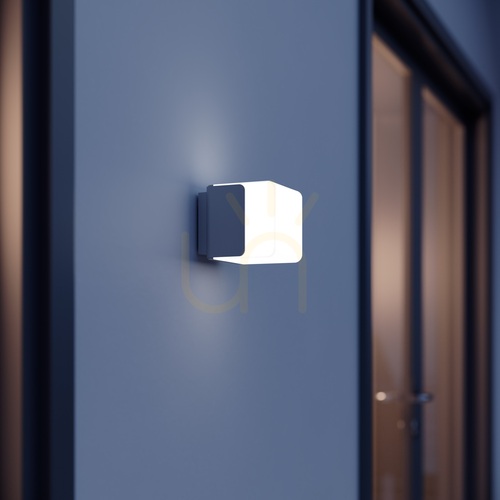
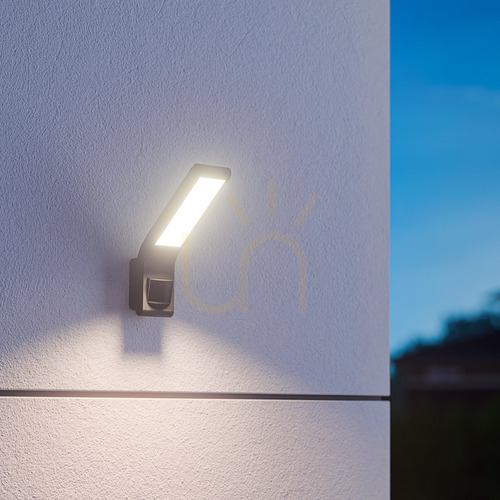
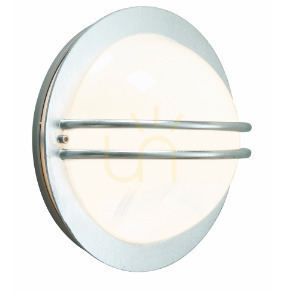
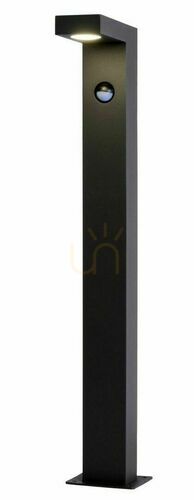
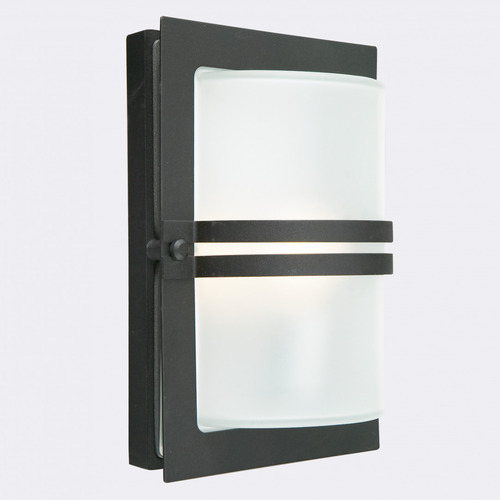
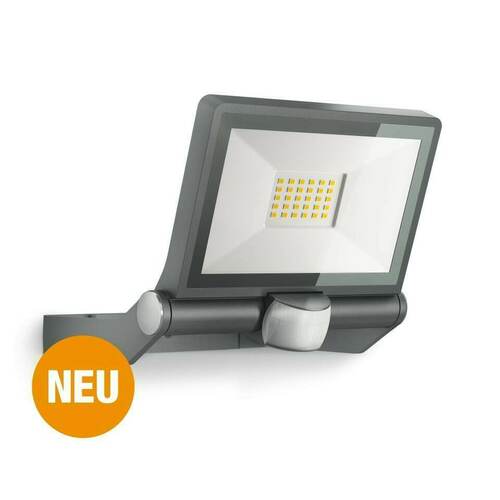
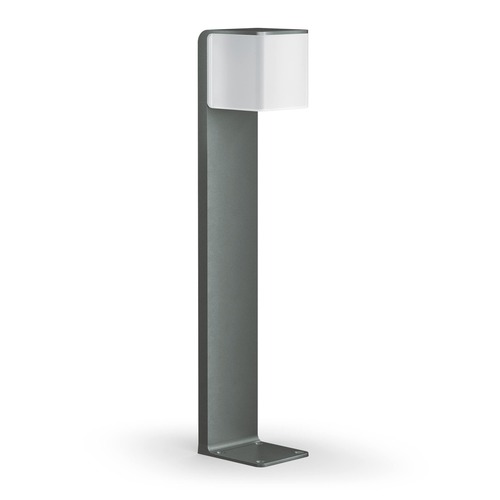
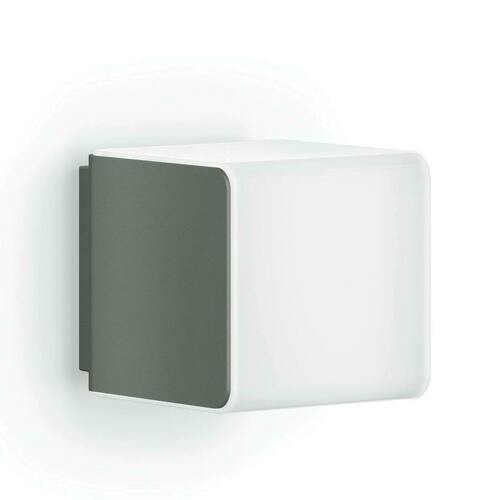
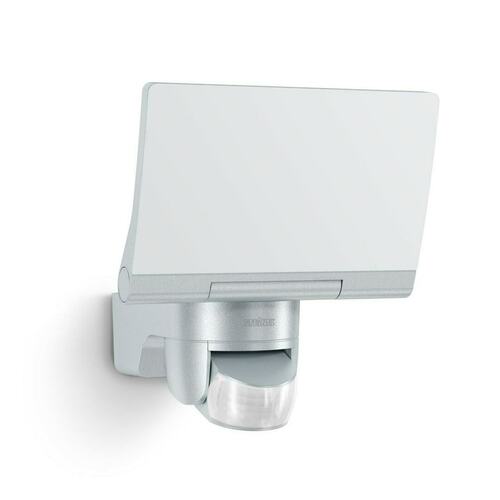
The fitting itself can be a wall light by the door, a low post light along the path, a ceiling light under a porch canopy or a floodlight over the drive. What makes or breaks it day to day, though, is how well the sensor covers the spot you actually walk through.
PIR or microwave: which sensor suits outdoors?
Most outdoor sensor lights use a PIR (passive infrared) detector. It picks up changes in heat as a person, car or animal moves across the zones of its lens. PIR is at its best with movement across its field of view and slower to react when someone walks straight towards it. It cannot see through glass.
Microwave sensors – often sold as HF or radar – send out a low-power signal and measure what bounces back. They notice movement head-on, are not bothered by air temperature and can be hidden inside the housing for a cleaner look. The catch is that they also see through fences, timber and thin walls, so without a reduced range they may fire for people on the pavement.
For a front door or driveway, PIR is usually the simpler choice. Microwave earns its place where the fitting should look plain or the sensor sits behind a diffuser.
Built-in sensor or a separate detector?
A light with a built-in sensor is one fitting and one connection. A separate PIR detector on the wall can switch several lights at once – every post light along a path, say – and can sit wherever it gets the clearest view, regardless of where the lights stand. For a single doorway the built-in version is simpler; along a long drive, one shared detector often works better.
What to check before you buy
Stand where the light will go and watch which way visitors arrive. Measure the distance to the gate or the end of the drive. Those two observations tell you the detection angle and range you need.
| Feature |
Typical values |
In practice |
| Detection angle |
wall lights 110–240°, ceiling and post lights up to 360° |
180° is plenty on a house wall |
| Detection range |
usually 8–12 m, stronger units up to around 20 m |
A shorter range by the door beats a light that fires for every passing car |
| Mounting height |
commonly 1.8–2.5 m |
Higher extends the reach but weakens detection right below the light |
| Time setting |
a few seconds to 15–30 min |
1–3 min is enough at the front door |
| Lux (dusk) setting |
adjustable, roughly 2–2000 lx |
Set it so the light never triggers in daylight |
| Light output |
door 400–800 lm, path 100–300 lm, drive 1000–2000 lm |
Low glare matters more than raw brightness |
| IP rating |
IP44, IP54, IP65 |
IP44 under a canopy, IP65 on an exposed wall |
For colour, warm white at 2700–3000 K looks welcoming on a house front and in the garden, while neutral 4000 K suits a garage, carport or bin store. Fittings with an E27 lampholder let you choose the bulb – check the maximum wattage and use LED. Integrated LED fittings are slimmer and usually better sealed, but the whole unit is replaced at the end of its life.
Where to fit them around the house
-
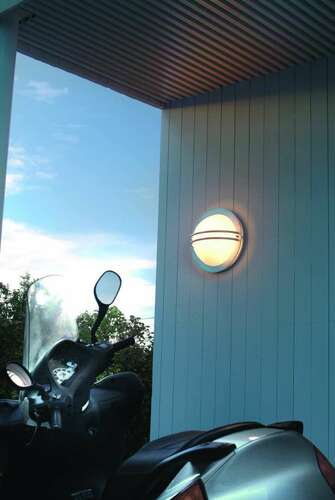
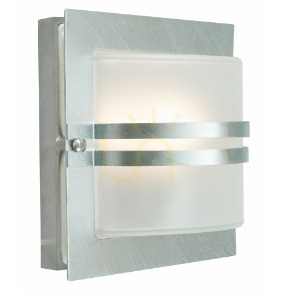
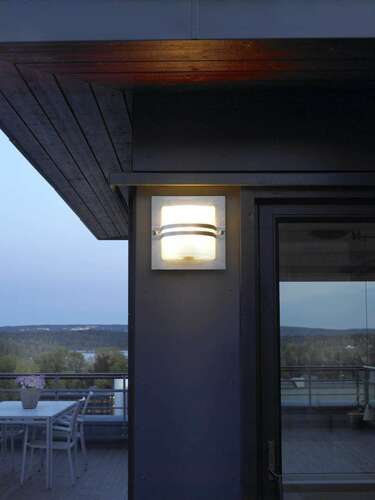
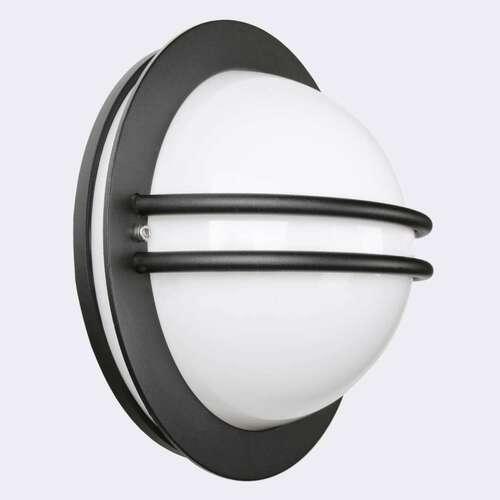
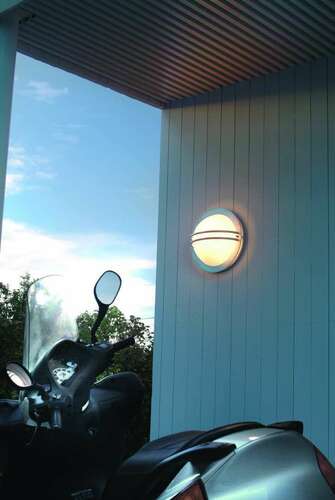
Front door and porch – a wall light at about 2 m, sensor aimed at the approach rather than the street.
-
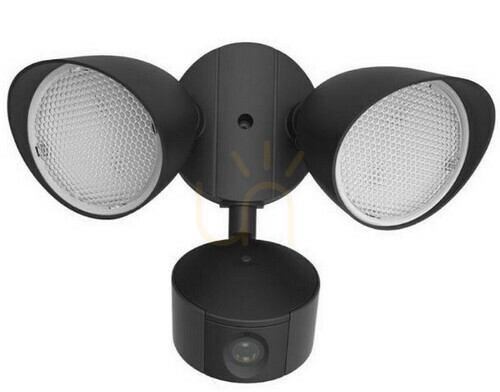
Driveway and garage – a brighter fitting mounted higher, or a floodlight, where a longer range is useful.
-
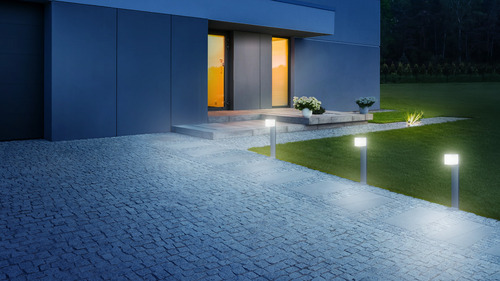
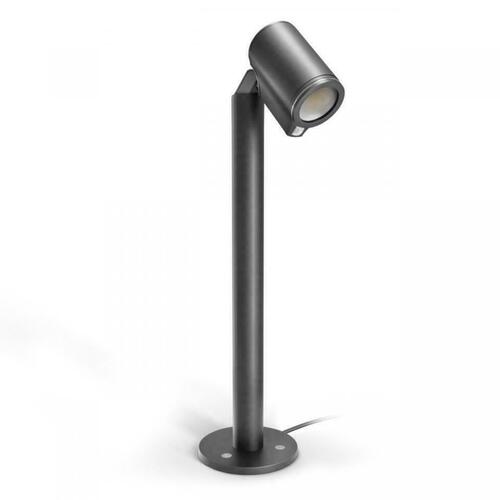
Paths and garden steps – low post lights with 360° sensors light the way step by step and cut the risk of tripping.
-
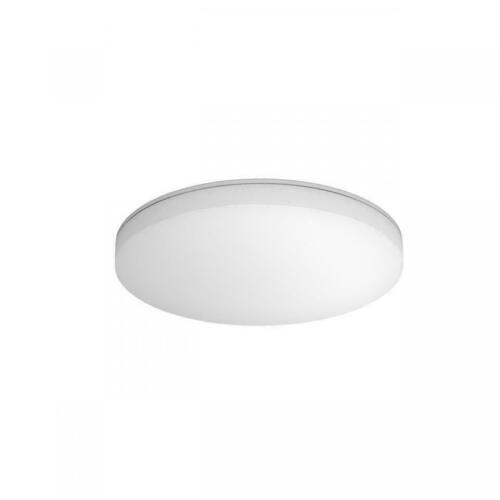
Back door, shed and bin store – a covered ceiling or bulkhead light with a short time setting.
Many fittings also offer a low-level mode: the light glows dimly all night and jumps to full brightness when someone moves. It keeps the front of the house lit without running at full power until dawn.
Living with a sensor light: settings and upkeep
Most ‘faulty sensor’ complaints come down to positioning. A sensor facing the road reacts to traffic, one facing shrubs reacts to branches moving in warm air, and one near a heat-pump fan or boiler flue reacts to the plume of warm air. Lens masks, a swivelling head and lower sensitivity sort out most of it.
Aim the light down rather than across the garden. Beyond being kinder to wildlife, a light that shines into a neighbour’s home can be treated as a statutory nuisance by the council in England and Wales. Wipe the sensor lens a couple of times a year, clear snow off it in winter and check the seals. Never jet-wash a fitting rated IP44.
Frequently asked questions
What is the best sensor light for outside?
The one whose sensor matches the spot. For a front door, a PIR wall light with a 180° field and adjustable range; for the middle of a path or yard, a 360° sensor; for a long driveway, a brighter fitting with a longer reach and a lens mask to keep it off the road.
What are the downsides of motion sensor lights?
Badly set, they switch on for cats and passing cars, or go off while you stand still at the door. PIR sensors are a little less responsive on hot summer evenings, when body and air temperature are close. Careful aiming and adjustment remove most of the annoyance.
Which is better, PIR or microwave motion detection?
Neither wins everywhere. PIR is predictable outdoors because it does not see through fences or glass. Microwave reacts to head-on movement and hides inside the fitting, but its range needs limiting so it ignores the street.
What IP rating does an outdoor sensor light need?
IP44 protects against splashing water and suits a sheltered porch. On an exposed wall or by the drive, IP65 – dust-tight and protected against water jets – is the safer choice.
Mains-powered, rechargeable or solar?
A mains light gives strong, dependable output all year. Rechargeable and solar models need no cable but deliver noticeably less light and shorter run times in a British winter.
Can I wire a sensor light myself?
Mains fittings usually have live, neutral and earth terminals, and the wall switch feeding them stays on. Outdoor wiring must meet BS 7671, so if you are not fully confident – or a new circuit is needed – use a registered electrician.
Looking for a light for the house wall specifically? Browse outdoor wall lights with motion sensor. For garden and patio lighting in general, with or without a sensor, see outdoor lights.