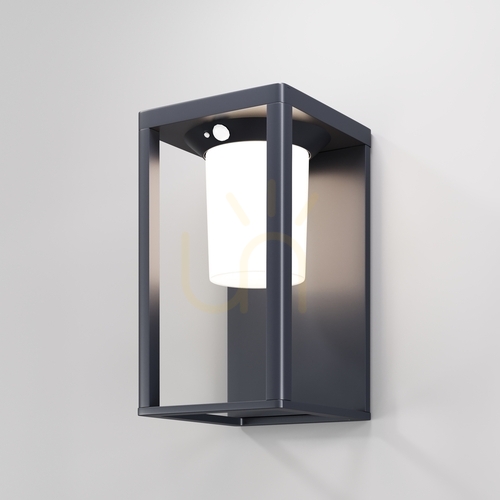
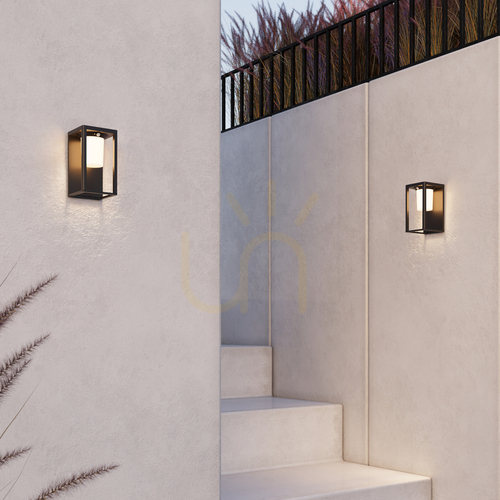
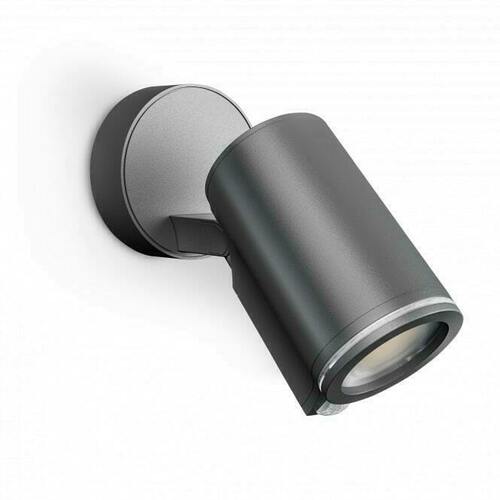
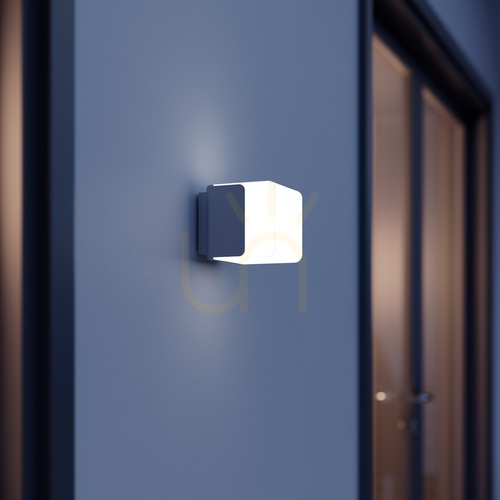
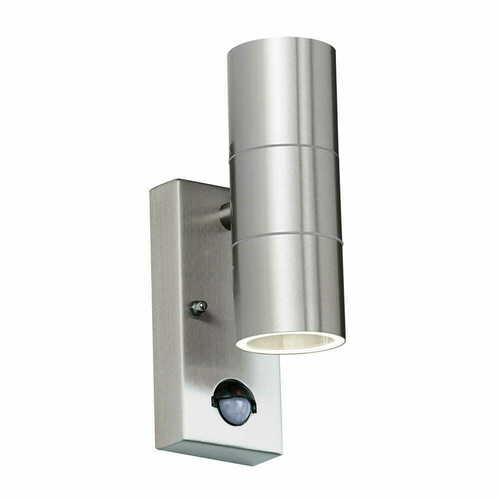
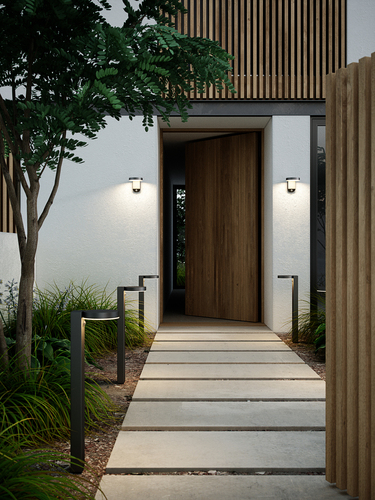
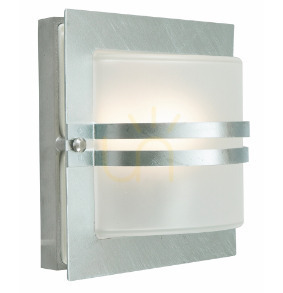
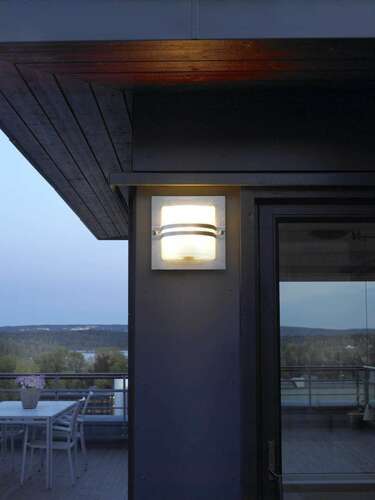
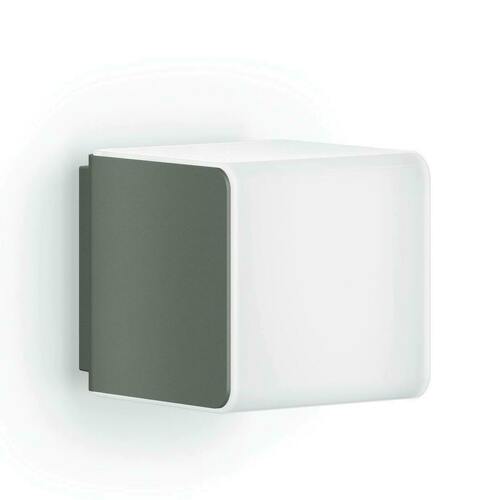
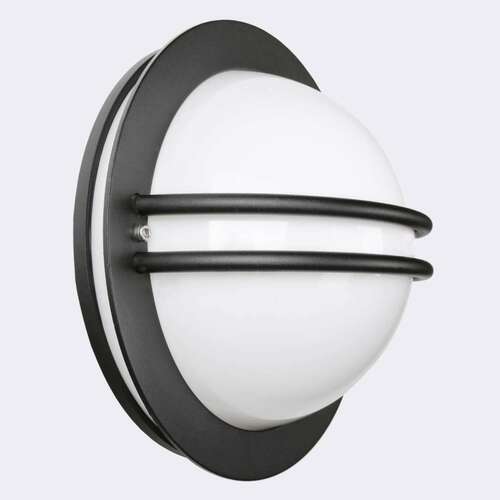
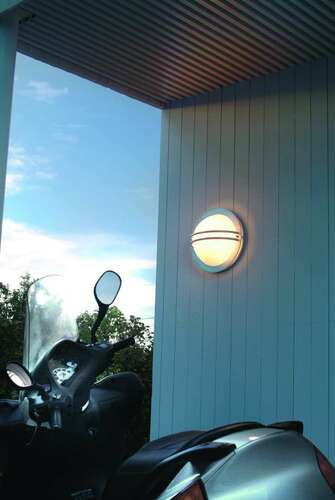
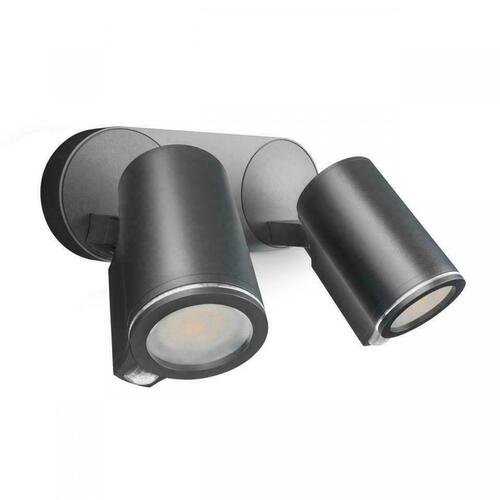
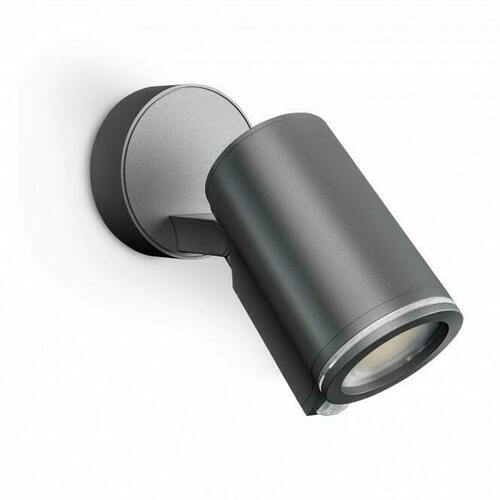
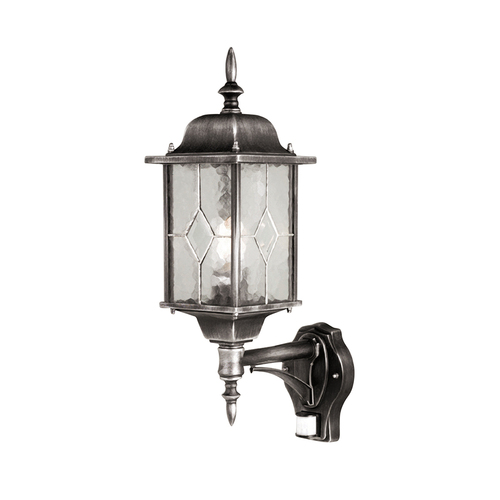
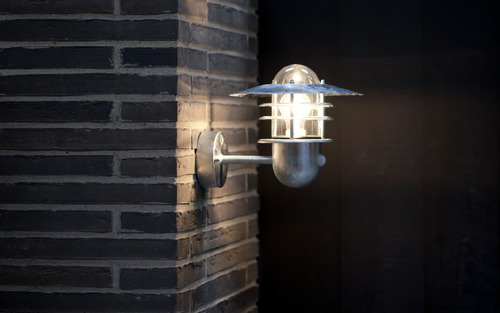
An outdoor motion sensor light fixed to the wall switches on as someone walks up to the front door, side gate or garage, then switches itself off once the area is clear again. On a wall light the sensor matters as much as the lantern: where it sits, how far it looks and what it ignores decide whether it greets you with the keys in hand or flicks on every time a cat crosses the drive.
What a wall-mounted sensor can and cannot see
A ceiling or soffit fitting looks down in a full circle. A wall light only covers the half in front of the brickwork, usually 110–180°, with some corner designs reaching 240–270°. That suits porches, back doors and side returns. A long drive where cars arrive from the side is usually better served by a floodlight.
Two sensor types are common. A PIR (passive infrared) sensor notices warm bodies moving across its lens zones. It is most sensitive to someone walking across its view, a little slower to react to someone walking straight towards it, and it cannot see through glass. Reach is typically 8–12 m. A microwave sensor sends out a low-power radio signal and picks up movement in any direction, so it reacts earlier and can be hidden inside the housing. The catch is that it also senses through glass, timber fences and thin walls, so it needs its range turned down near a pavement.
Nearly all of these lights also have a photocell, so they only respond after dark. If you would rather have a gentle glow from dusk to dawn with no reaction to movement, look at wall lights with a dusk-to-dawn sensor instead.
Choosing the right one for your wall
| Setting |
Typical UK values |
Practical note |
| Fixing height |
1.8–2.5 m |
Above roughly 3 m the sensor can miss someone close to the wall |
| Detection angle |
110–180°, corner models up to 270° |
140–180° is plenty beside a door |
| Detection range |
PIR 8–12 m, microwave up to about 15 m |
More range means more false triggers from the street |
| Time on |
about 10 s to several minutes |
1–3 minutes covers finding keys at the door |
| Light output |
400–800 lm porch, 800–1500 lm side path or garage |
A whole driveway calls for a floodlight |
| Colour temperature |
2700–3000 K warm, 4000 K neutral |
Warm suits a front door, neutral helps a doorbell camera |
| Weather rating |
IP44 under a canopy, IP54–IP65 on an open wall |
West- and south-west-facing walls take the driving rain |
Integrated LED fittings need no bulbs, but when the LEDs eventually fade the module or the whole light is replaced. Fittings with an E27 or GU10 holder let you change brightness and colour later; check whether a bulb is supplied and the maximum wattage. Near the coast, marine-grade 316 stainless steel or a composite body copes with salt air far better than standard steel.
Fitting and wiring
Mount the light beside the door rather than above it, so it lights faces and the lock instead of the tops of heads. Two lanterns either side of a door only come on together if one sensor controls both, either through a separate wall-mounted PIR or a master fitting with a switched output for a second light.
Mains-powered fittings are wired with live and neutral, plus earth for Class I (metal) fittings; Class II fittings are double insulated and must not be earthed. Have a registered electrician do the work to BS 7671. Leave the indoor switch on: turning it off cuts power to the sensor as well. On rendered external wall insulation, use a proper fixing block so the light does not sit on soft insulation and the cable entry stays sealed.
Avoiding false triggers and looking after it
- Angle the sensor along your own path, not towards the pavement or a neighbour's garden; mask part of the lens if the fitting comes with shields.
- Heat pumps, air-conditioning units, boiler flues and sun-warmed walls can set off a PIR.
- A street lamp shining on the photocell can stop the light coming on at all; adjust the lux setting.
- Wipe the lens every few months to clear dust and cobwebs, and do not jet-wash an IP44 fitting.
Frequently asked questions
Are motion sensor lights a good idea?
For doors and side paths, yes. The light is there when you need it, uses energy only for minutes a night, and a light that switches on suddenly tends to put off anyone lurking. Where you want steady ambience on a terrace, a light that stays on is the better fit.
Can I turn off the motion sensor on outdoor lights?
Many fittings have a manual override: switch off and on again quickly at the wall switch and the light stays on until the next off–on or until morning. Without that, the only way is to cut the power, and that turns the light off too.
Which is better outdoors, PIR or microwave?
PIR is the safer choice beside a pavement because it does not see through fences. Microwave reacts sooner when people walk straight at the wall and suits a sheltered porch where its range can be limited.
Are mains powered or solar sensor lights better?
Mains lights are brighter and work the same in December as in June. Solar wall lights avoid wiring but have shorter range and lose charge on dull winter days, so they suit a shed or back gate more than a front door.
What does waterproof mean for a wall light?
Look at the IP rating. IP44 handles splashing rain under shelter, IP65 is dust-tight and resists jets of water, which suits an exposed wall.
More on choosing a style and finish for the front of the house: outdoor wall lights. To light a whole drive rather than a doorway, read about LED floodlights with motion sensor.