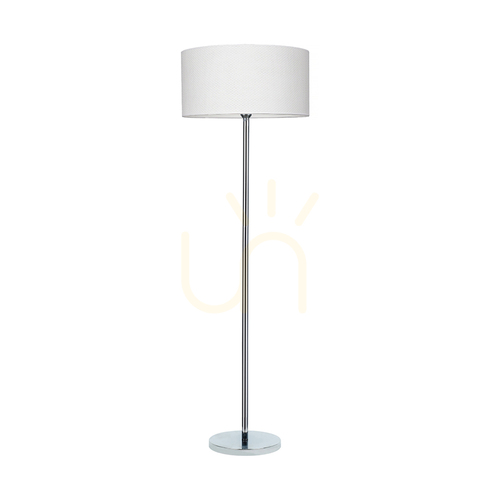
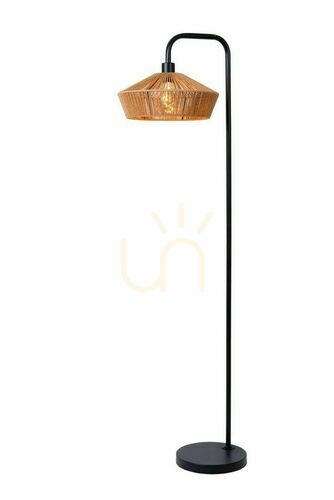
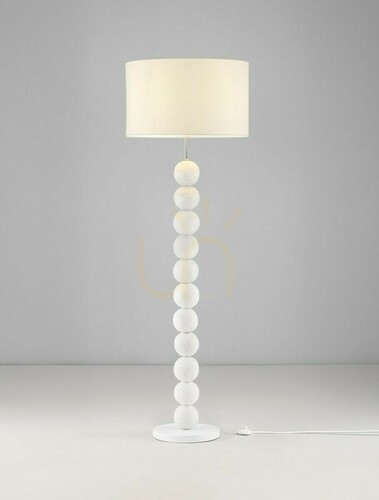
A paper floor lamp puts a lantern-like shade on a stand, a tripod or a tall column, so light passes through thin paper rather than glass or fabric. The result is a soft, even glow in every direction instead of a bright pool under the shade, which makes it a mood light first and a reading light second.
That one fact shapes everything else: how tall it should be, which bulb goes in, and where in the room it earns its place.
What paper changes in a floor lamp
A paper pendant hangs above head height and is mostly seen from a distance. A floor lamp stands at eye level, often right beside the sofa, so you notice the fibres, the folds and the ribs of the frame showing through. Build quality matters more here than on a ceiling light.
Paper also changes the light itself. Most of it spreads sideways and upwards, washing the nearby wall and ceiling, which makes a corner feel larger. A pleated or open-bottomed shade sends more light downwards and copes better with an occasional book.
Tall, Japanese or vintage: the main shapes
-
Tall column or lantern: paper stretched over a wire or bamboo spiral that glows from top to bottom, close to a light sculpture. This is what most people mean by a Japanese paper floor lamp.
-
Globe or drum on a stem: the familiar round rice paper shade raised to seated height or above.
-
Tripod with a paper shade: steady on uneven floors, often with timber legs and a mid-century or Scandinavian feel.
-
Pleated shade: folded paper on a metal frame, stiffer and closer to a vintage table-lamp look scaled up.
-
Woven paper, papier-mâché or card: thicker, textured surfaces that let less light through but hold sculptural shapes.
“Rice paper” is a loose term. In lighting it usually means thin, translucent plant-fibre paper in the Japanese style, typically white, cream or beige.
Bulbs, sizes and safety
Before buying bulbs, check the cap: alongside the screw-in E27, many UK fittings use a B22 bayonet, and smaller ones an E14. Check the plug type on the rating label too; changing a plug or wiring a lamp is a job for a qualified electrician.
| What to check |
Typical range |
Why it matters |
| Overall height |
usually 120–180 cm |
beside an armchair, the bottom of the shade sits roughly at the shoulder of a seated person |
| Shade diameter |
usually 30–60 cm |
a wider shade diffuses more gently and keeps the bulb further from the paper |
| Bulb cap |
E27, B22 or E14 |
read the rating label before buying bulbs |
| Bulb type |
LED, typically 5–10 W |
never exceed the maximum wattage marked on the lamp |
| Colour temperature |
2700–3000 K |
warm white flatters cream paper; cool white can make it look grey |
| Brightness |
roughly 400–800 lm |
806 lm matches an old 60 W bulb; mood lighting often needs less |
| Base |
weighted disc or tripod |
the shade weighs almost nothing, so stability comes from the base |
A traditional 60 W incandescent bulb can exceed 100 °C on the glass, while an LED of a few watts runs far cooler. Even so, the bulb should hang centrally and never touch the paper. A frosted bulb avoids the bright hotspot a clear one leaves on thin paper, and a dimmable LED paired with a dimmer switch or a smart bulb gives you that low evening glow paper is made for.
Where a paper floor lamp works best
Living rooms beside the sofa, bedrooms in place of one bedside lamp, and that dark corner that never gets any light in winter. Standing close to a pale wall, it bounces light back into the room. Paper sits naturally with Japandi, Scandinavian and minimalist schemes, with oak, linen and wool. For a boho room, woven or natural-toned paper looks warmer than bright white. A matching paper pendant over the dining table ties an open-plan space together.
Care and the things paper dislikes
-
Dust dry only: a soft brush, a feather duster, a lint roller or a hairdryer on its cool setting.
-
Keep it out of damp rooms: in a bathroom or next to an airer, paper loses its tension and starts to sag.
-
Mind strong sunlight: white paper slowly yellows in a south-facing window.
-
Small tears: patch them from the inside with a strip of thin paper.
-
Children and pets: choose a tripod or heavy base and route the cable where nobody trips on it.
Paper floor lamp FAQs
Are paper floor lamps safe?
Yes, with an LED bulb within the stated maximum wattage that does not touch the shade. Keep the lamp away from candles, open fires and heaters.
What bulb should I use in a rice paper floor lamp?
A frosted LED in warm white, around 2700 K, with the cap the lamp holder takes. Check whether that is a screw E27 or a B22 bayonet before you order.
Are rice paper lamps made from rice?
Usually not. The name covers thin, translucent paper in the Japanese tradition made from plant fibres. What matters is how evenly it lets light through.
How tall should a paper floor lamp be?
For a reading chair, the shade should sit around shoulder height when you are seated. A tall column for an empty corner can go up to around 180 cm in a room with a standard ceiling.
Do paper lamps go yellow?
White paper can yellow over time in strong sunlight or in rooms with smoke or cooking fumes. Natural and cream tones show it far less.
How do you clean a paper lamp shade?
Dry methods only. Water marks and grease are almost impossible to remove from paper, so keep the lamp away from the hob.
To weigh paper against other shade materials and shapes, start with standing lamps. If you only need to replace a worn shade, read up on sizes and fittings under paper lampshades.