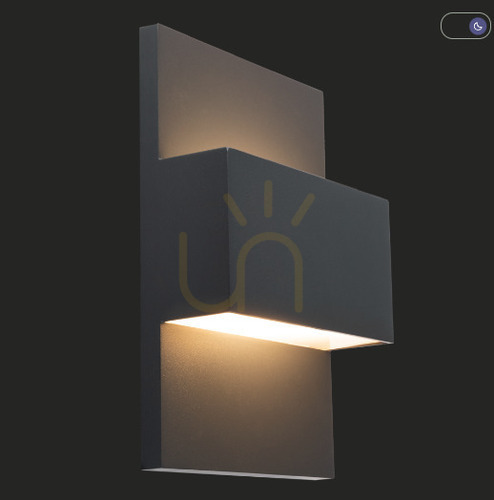
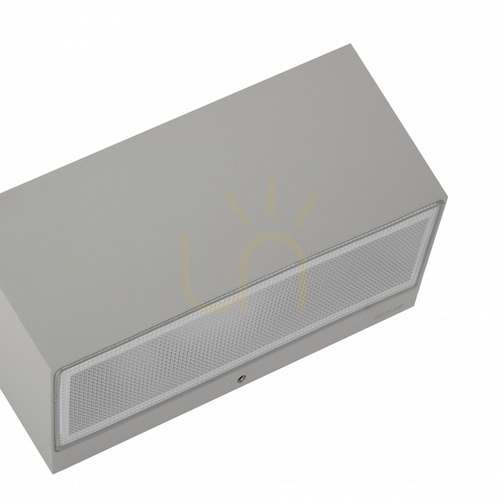
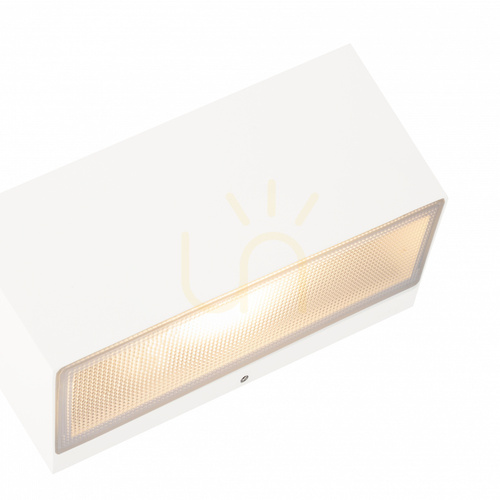
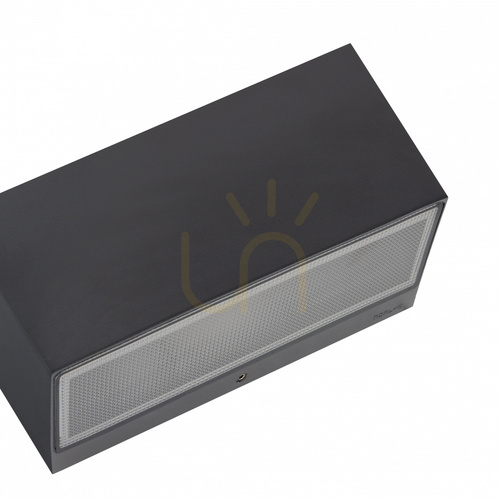
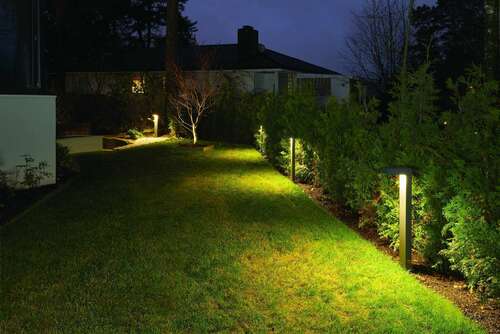
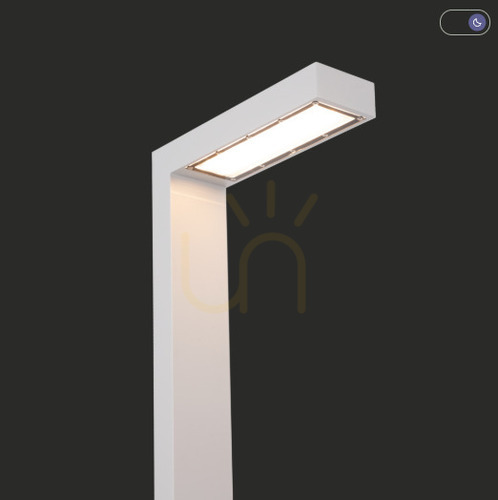
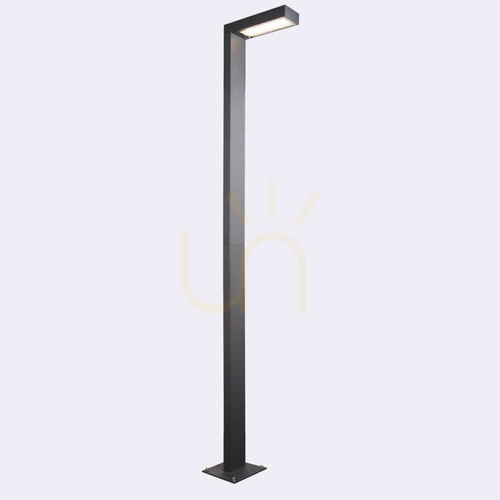
The Asker Pro 1322GR is an 85 cm bollard shaped like an inverted L: a cast aluminium shaft ends in a horizontal arm that projects 20 cm and shines down. The body is powder-coated graphite RAL 7016, with a clear PMMA lens under the arm.
How the light is spread
In the Pro version the LED module sits behind a Ledil VSM lens with a symmetric IESNA type V distribution: the light forms a round pool under the head instead of stretching along one line. That suits a small square, a path junction or an entrance, where the whole area around the bollard needs light. ULOR is 2 %, so practically all the light goes down, not into the sky.
The 5.8 W Cree module produces 828 lm; after the losses in the lens the luminaire delivers 616 lm at 7.8 W, or 79 lm/W. 4000 K is a neutral white, noticeably cooler than warm 2700–3000 K light.
DALI2 control and connection
The driver works in a DALI2 system: brightness is set digitally from a DALI controller over a two-wire bus with its own power supply, and a phase-cut wall dimmer cannot dim it. One B10 circuit breaker carries up to 82 of these bollards, a B16 up to 130.
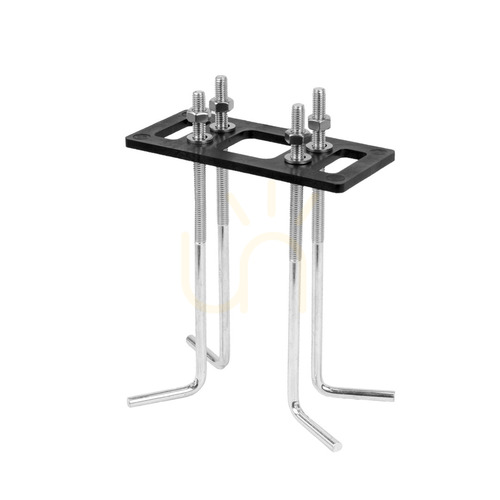
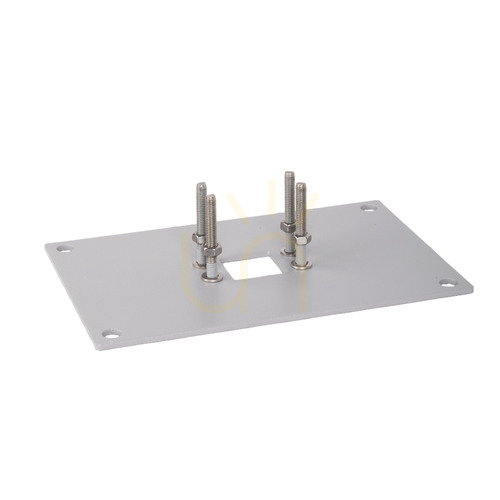
The luminaire is fixed through four ø8 mm holes spaced 18 × 50 mm. Norlys sells the foundation anchors and adapters separately, so the foundation is chosen together with the light. The terminals take conductors up to 3 × 2.5 mm², further bollards loop through with up to 3 × 1.5 mm², and the gland seals round cable up to 12.5 mm. As a protection class I luminaire it needs a protective earth conductor.
Durability and service
IP65 means dust-tight and protected against water jets, so the light runs outdoors without a cover. Impact resistance is IK08 and the operating range −20 to +45 °C. The manufacturer states an L90 lifetime of 109,000 h: after that the module still gives at least 90 % of its initial flux. The LED module and driver are replaced only by a professional service.
Where it belongs
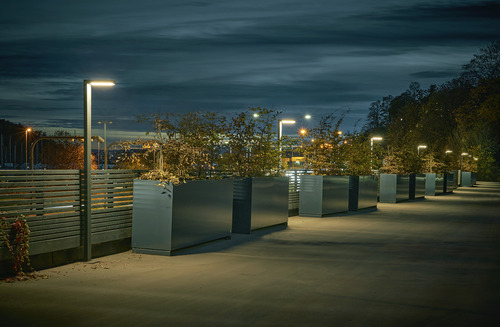
Norlys intends the Asker Pro for gardens and other private grounds: garden paths, terraces and driveways, hotel and restaurant grounds, parks and access roads. The plain geometric form without ornament fits a modern and modernist style.