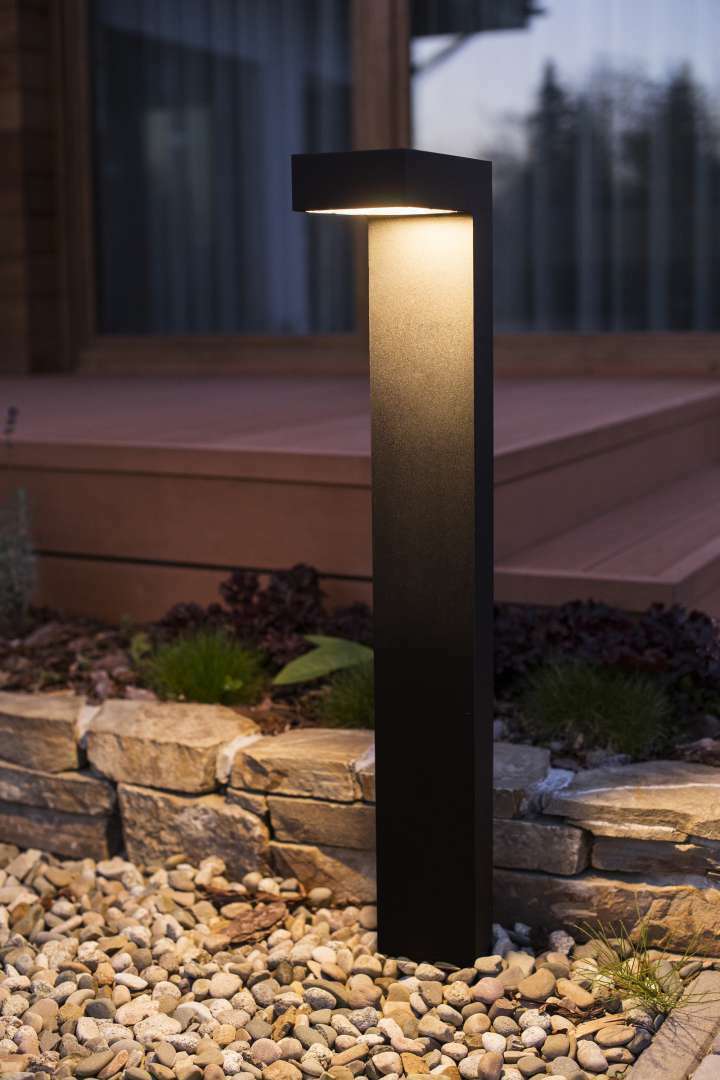
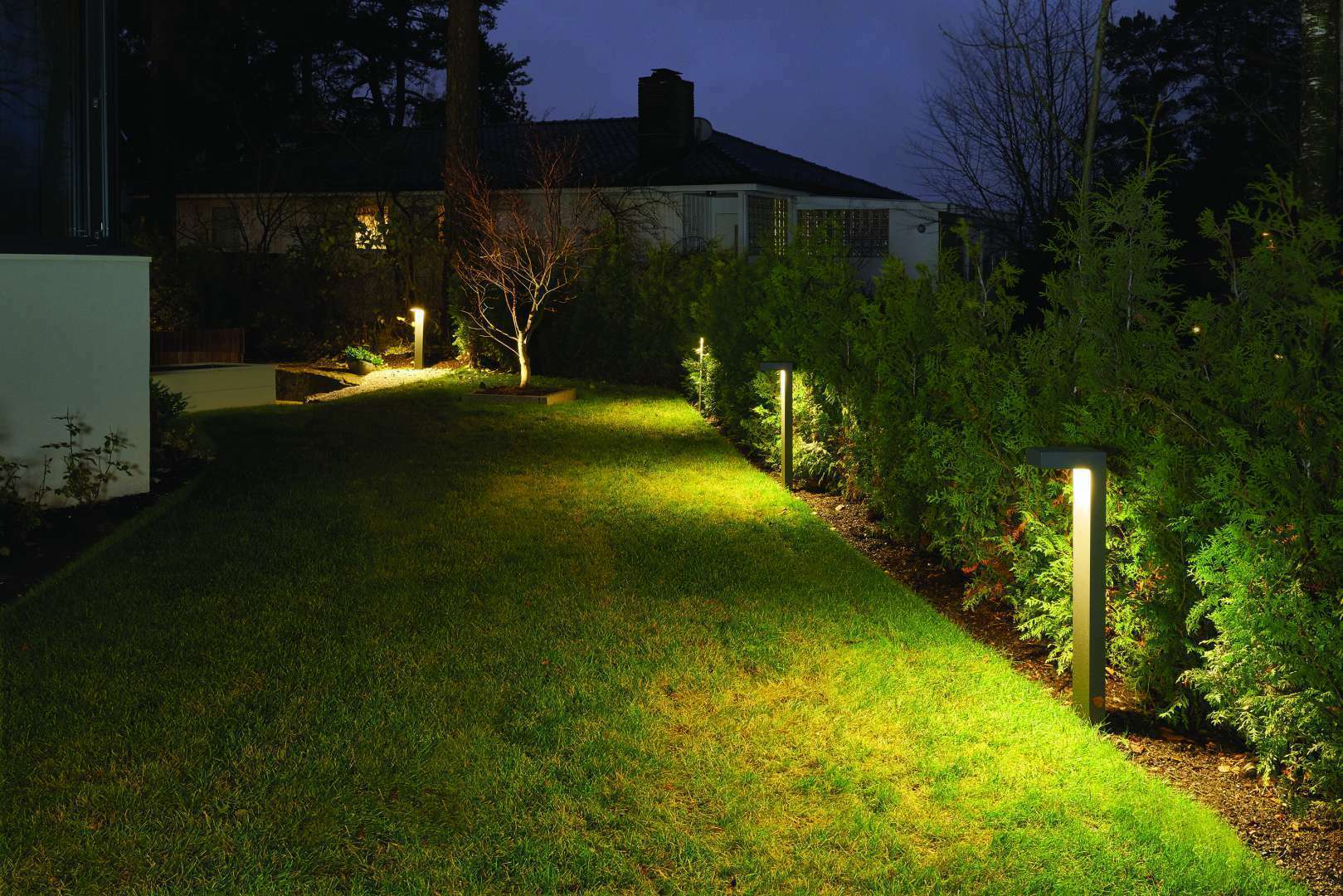
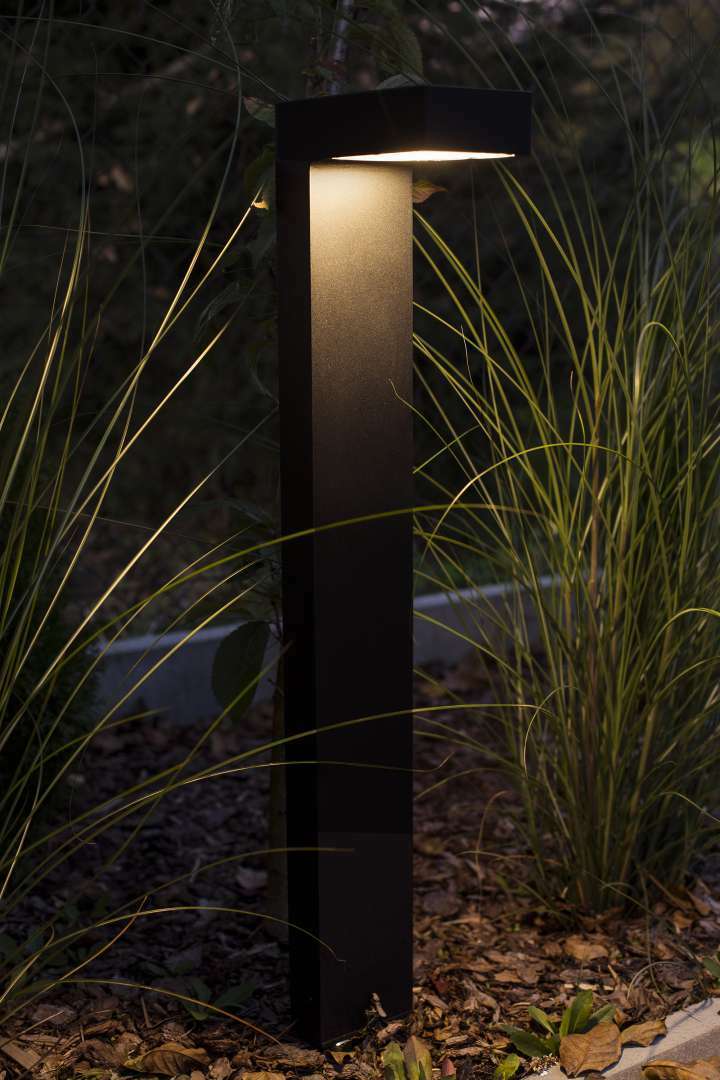
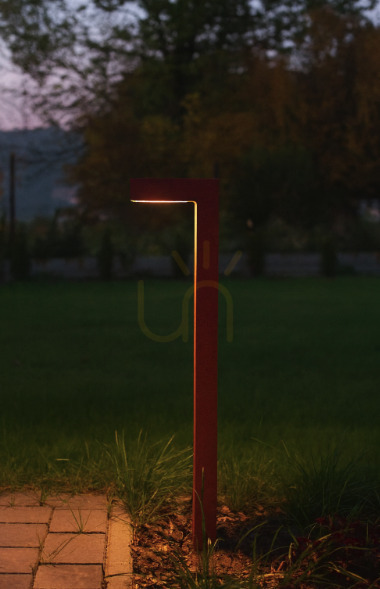
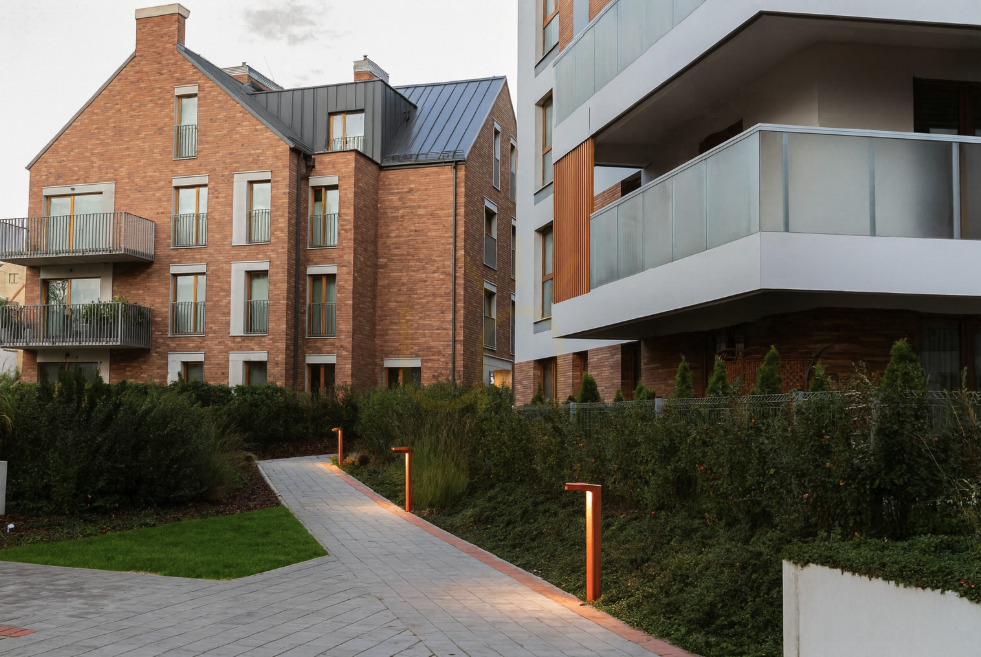
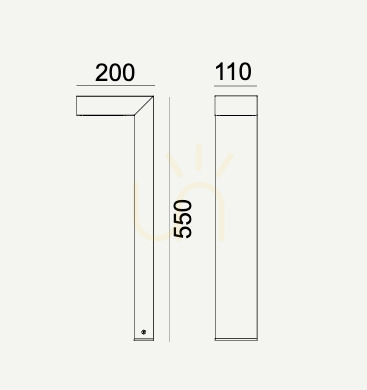
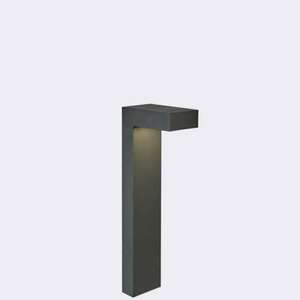
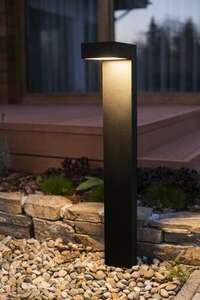
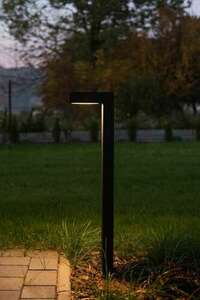
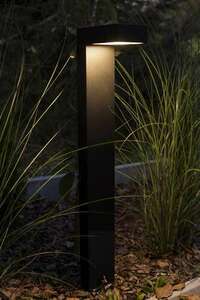
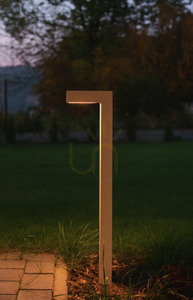
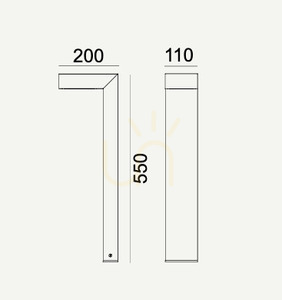
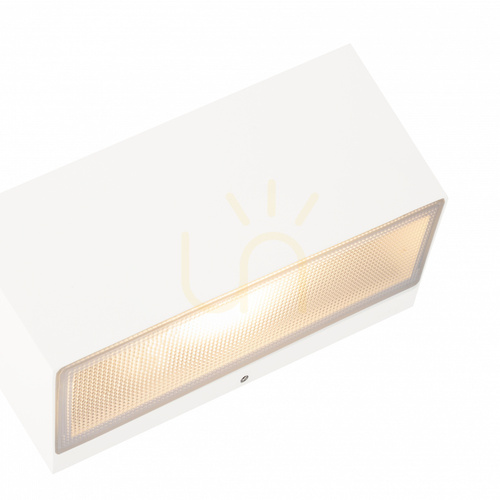
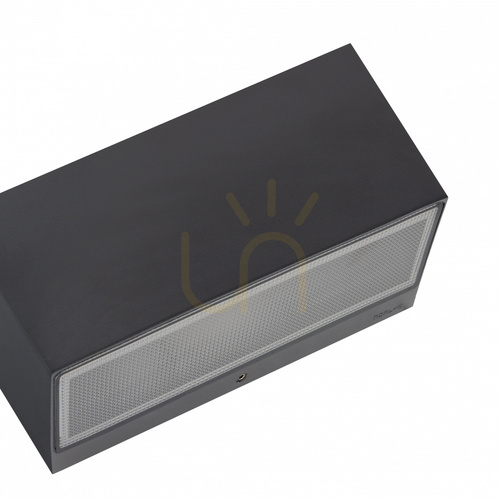
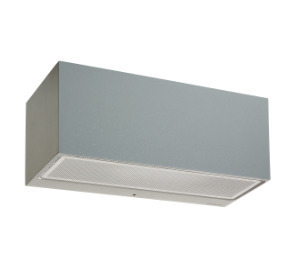
Asker Pro 5216GR is a 55 cm NORLYS bollard shaped like an inverted letter L. From a rectangular shaft 11 cm across, a head with a 20 cm reach extends at the top and shines downwards through a flat, clear PMMA lens. The body is cast aluminium, powder-coated in graphite RAL 7016, and the LED module and driver are built in.
What light it gives and where it falls
The luminaire draws 7.7 W and emits 604 lm, or 78.4 lm/W. 3000 K is a warm white, CRI 80 renders paving and plants correctly, and SDCM3 means successive bollards along a path glow in the same shade. The Ledil VSM lens gives an IESNA type V distribution: the light spreads evenly all round the bollard, which suits a junction of paths, the corner of a terrace or a small paved area. 1 % of the output goes upwards (BUG B1-U1-G1).
It dims by phase control with a trailing-edge (TE) dimmer only — the driver is a Philips Xitanium TE, so the dimmer has to match that type.
Installation and connection
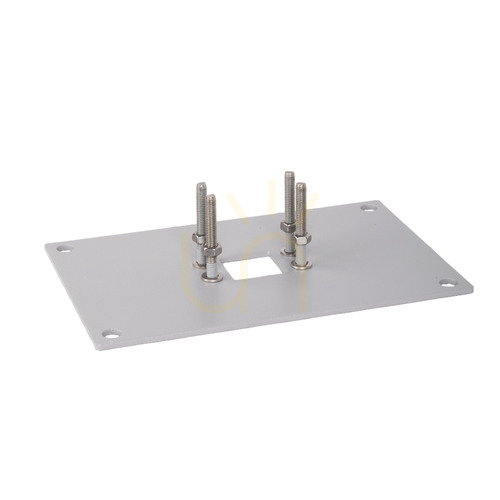
The base is screwed down through four ø8 mm holes spaced 18 × 50 mm. No anchoring is included: the concreting anchor 1907ZX0009, ground anchor 1908GA0009, concrete-foundation adapter 1909GA0010 or mounting adapters 3090GA0009 and 3081XX0009 are ordered separately. The bollard weighs 3.04 kg and ships in a 57 × 23 × 14 cm box.
The terminals take conductors up to 3 × 2.5 mm², or 3 × 1.5 mm² when looping through, so several bollards along a path can run from one line. A round cable up to 12.5 mm in diameter enters through an EPDM gland. The luminaire is protection class I and needs the protective earth.
Durability, service and intended use
IP65 means dust-tight and protected against water jets, and the LED module with its lens forms an IP67 optical unit, so the bollard stands uncovered in rain and snow. IK08 means resistance to a 5 J impact. After 109,000 h the module keeps at least 90 % of its output (L90), the driver is rated for 50,000 h, and a professional service replaces both with the repair set ZS5216zx0009.
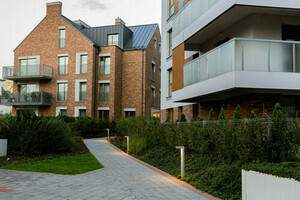
The maker intends the Asker Pro for gardens, private grounds and architectural schemes — along paths, on a terrace and by a driveway. Its plain, square-edged form without ornament suits modern, modernist and minimalist settings.