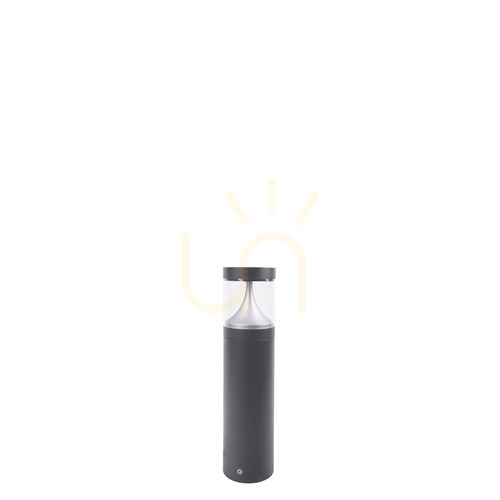
The Norlys Lillesand 2330GR is a bollard light shaped as a plain cylinder, 85 cm tall and 12 cm in diameter, cast in aluminium and powder-coated graphite RAL 7016. The top 16 cm is a satin PMMA diffuser closed by a flat cap, and an integrated LED module works inside.
How much light, and what kind
The luminaire draws 9.2 W and delivers 897 lm, a little more than an old 60 W bulb – enough to light a path and its immediate surroundings rather than merely mark it. The light spreads evenly all round the bollard. A ULOR of 33% means roughly a third of the flux leaves above the level of the diffuser, which is worth remembering if the bollard is to stand below a window.
A colour temperature of 3000 K is warm white, and CRI 80 keeps the colours of paving and plants natural. The bollard can be dimmed with a phase-cut dimmer, trailing edge (TE) or leading edge (LE), so it works with both dimmer types.
Installation and connection
The bollard bolts down through three ø9 mm holes set 120° apart on a 65 mm circle. Nothing for fixing it into the ground is included: Norlys sells a concrete-in anchor (205), a ground anchor (206), a concrete-foundation adapter (206S) and the mounting adapters 3080GA and 3086GA separately, to be chosen according to the ground.
The terminals take conductors up to 2 × 4 mm² and allow the supply to be looped on to the next bollard with conductors up to 2 × 2.5 mm²; the gland takes a round cable of 8–12.5 mm diameter. Protection class II means double insulation with no protective earth conductor. The bollard weighs 5.48 kg.
Durability and servicing
IP65 means dust-tight and protected against water jets, so the bollard stands in the rain without any cover. IK08 is resistance to a 5 J impact, which matters for a bollard placed right next to a path.
The LED module and driver are not user-replaceable; a professional service replaces them, using Norlys repair kit ZS2330zx0009. The manufacturer rates the module for more than 102,000 hours to 80% of its flux (L80) – at 3 hours a day that is more than 90 years.
The plain, unornamented cylinder suits modern and Scandinavian architecture, gardens, and the surroundings of hotels and restaurants.