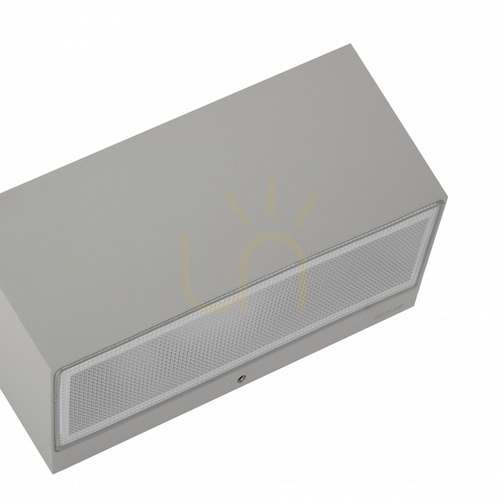
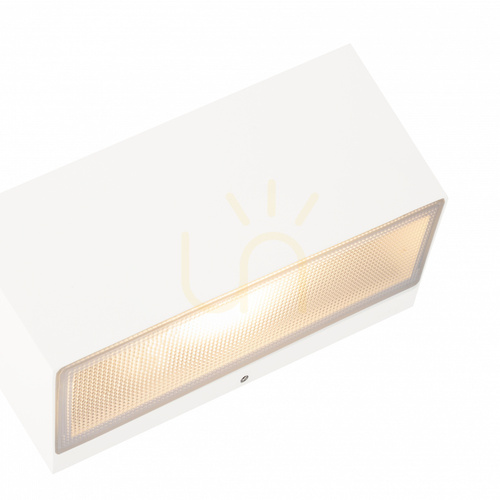
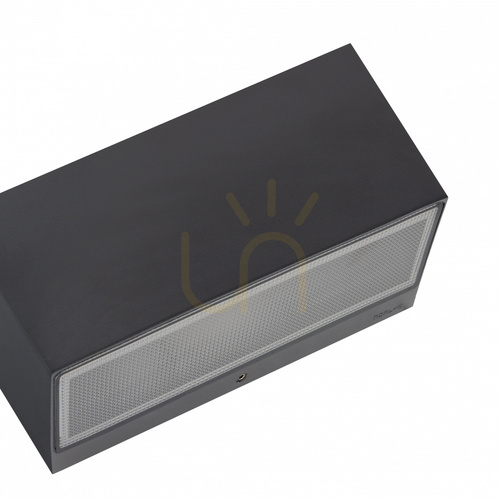
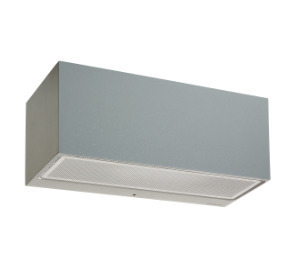
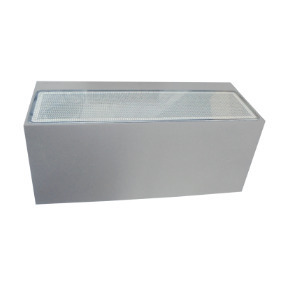
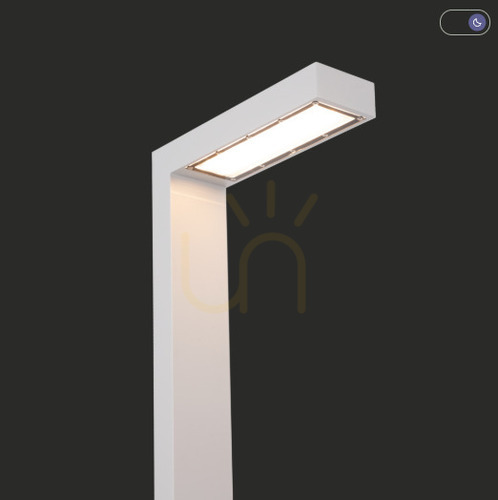
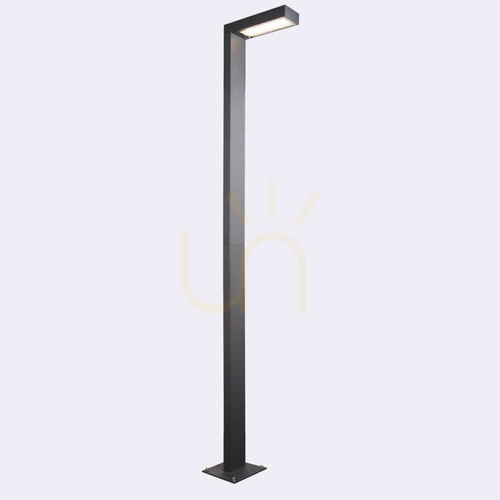
Asker Pro 5216AL is a bollard light shaped like an upside-down L: a 55 cm square column ends in a head that projects 20 cm and shines downwards. The body is cast aluminium, powder-coated light grey RAL 9006, and a sealed clear PMMA lens sits under the head.
How it lights and how much light it gives
The built-in LED module draws 5.8 W and produces 828 lm; the complete fitting draws 7.7 W and delivers 604 lm, or 78.4 lm/W. That is enough to mark a path and the area by an entrance, not to light a whole garden. 3000 K is warm white, and CRI 80 renders plants and paving without noticeable colour shift.
The Ledil VSM lens gives an IESNA Type V distribution, a round pool of light all around the bollard. Only 1% of the flux escapes upwards (ULOR), which matters wherever light pollution has to be kept down.
Dimming, driver and servicing
The Philips Xitanium TE driver is built in and allows phase dimming, but only with a trailing-edge (RC) dimmer. A leading-edge dimmer, the kind made for incandescent lamps and wire-wound transformers, may cause flicker. The LED module and the driver can only be replaced by a qualified service technician, using the manufacturer's repair kit ZS5216zx0009. The LEDs are rated L90 at 109,000 h and the driver at 50,000 h.
Installation and wiring
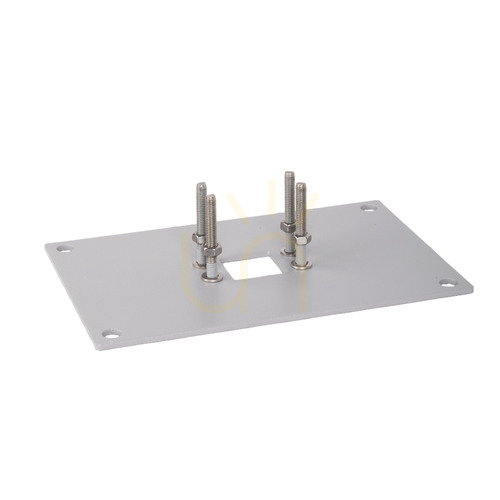
The bollard weighs 3.04 kg and is bolted down through four ø8 mm holes spaced 18 × 50 mm. Depending on the ground, the 1907ZX0009 concrete anchor, the 1908GA0009 ground anchor, the 1909GA0010 concrete-foundation adapter or the 3081XX0009 and 3090GA0009 mounting adapters are bought separately.
The terminals take conductors up to 3 × 2.5 mm², with loop-through up to 3 × 1.5 mm², so several bollards can share one circuit. The round cable can be up to ø12.5 mm. The fitting is protection class I and therefore needs an earth conductor. IP65 means dust-tight and protected against water jets, IK08 means impact-resistant, and the −20 to +45 °C operating range lets it stay outdoors all year.
Where it fits
The plain, angular form without ornament suits modern and minimalist architecture. The manufacturer intends it for gardens, private grounds and architectural use — beside a terrace, along a driveway, in a park, on a residential street or in front of a hotel or restaurant.