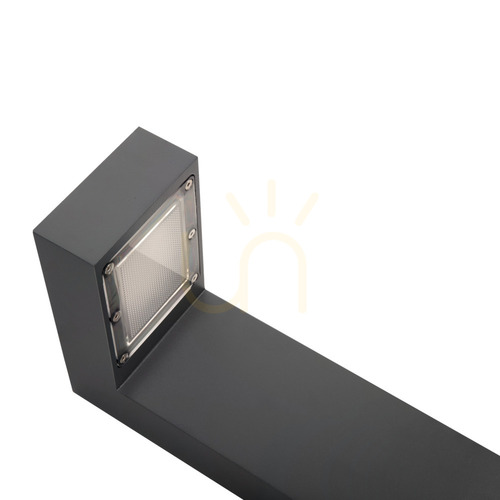
Norlys Asker Small Pro 1721CS is an outdoor wall light with a horizontal, box-shaped body of cast aluminium, powder-coated in a corten colour close to RAL 8011 – a rust-toned paint, not bare weathering steel. Clear textured polycarbonate covers on the top and bottom faces let light out upwards and downwards at the same time, so two bright bands appear on the façade – above and below the fitting. Two LED modules and a DALI2/TD driver are built in.
Size and wall mounting
The body is 22.5 cm wide and 11 cm high and projects 8.5 cm from the wall – compare this with the free strip of wall beside a door, window or corner. It is screwed on through two ø4.5 mm holes spaced 180 × 60 mm and weighs 1.34 kg net.
The terminals take conductors up to 5 × 2.5 mm², and further lights can be looped through with cable up to 5 × 1.5 mm². An EPDM gland seals a round cable 7 to 10.5 mm in diameter. The fitting is protection class I, so it must be connected to a protective earth.
How much light and what kind
The LED modules draw 7.8 W in total and produce 1306 lm; at 9.9 W the whole fitting emits 852 lm, which is 86.1 lm/W. 3000 K is a warm white, and SDCM3 colour consistency means several lights on one wall shine in the same shade.
Brightness is dimmed from 1 to 100% with a DALI2 controller or, in Touch DIM mode (Norlys marks it DALI2/TD), with a push button or sensor wired to the DALI terminals – an ordinary on/off switch cannot do this, so control has to be planned together with the wiring. Norlys rates the modules at L80 above 72,000 h, more than 65 years at three hours a day, and the driver at 100,000 h. Modules and driver are replaced only by a professional service; the service kit is ZS1721zx0009.
Where it fits
IP65 means the fitting is dust-tight and resists water jets, IK08 means an impact-resistant body, and the covers are UV-stabilised, so the light can hang on an exposed outside wall. Norlys intends it for lighting walls and façades – by the front door, on a balcony, on a garden wall, and on hotel and restaurant frontages. The plain body, showing only the edges of its covers, suits modern, minimalist architecture.