
LED flush ceiling lights – how to choose one? Size, power and colour
The flush ceiling light is the most discreet of ceiling lamps – and one of the most frequently chosen: it hugs the ceiling, fits everywhere, shines evenly and gets in nobody’s way. The trouble starts at the choosing stage, because one word covers lamps from 10 to 100 cm in diameter, from 600 to 6,000 lumens, with replaceable bulbs and with permanently built-in diodes, for the living room, the bathroom and outdoors. In this guide we walk through every decision in order: when a flush light instead of a chandelier, what diameter for which room, how many lumens you really need, what colour temperature and what about dimming – so you buy your ceiling light once, and well.

Table of contents
- When a flush light instead of a chandelier?
- Integrated LED or replaceable bulb?
- What diameter for which room?
- How many lumens and how many watts?
- Light colour: 2700, 3000 or 4000 K?
- Dimmable LED ceiling lights and controls
- A ceiling light for the bathroom, a child’s room and outdoors
- Installation – on the ceiling and on a slope
- Frequently asked questions
- Summary
When a flush light instead of a chandelier?
The flush ceiling light beats the chandelier wherever the distance to the ceiling and calmness of form matter:
- Low rooms – with a ceiling below ~2.6 m a hanging chandelier eats space and sightlines; a flush light a few to a dozen centimetres high leaves the room its full height.
- Circulation areas – the hallway, corridor, stairs: nobody admires the lamp here; it should be bright, with nothing dangling.
- Bedrooms and children’s rooms – nothing hangs, nothing swings, and a full diffuser gives soft, scattered light with no glare from the bed.
- Bathrooms and outdoor zones – sealed, higher-rated flush lights are the standard where moisture rules out open fittings.
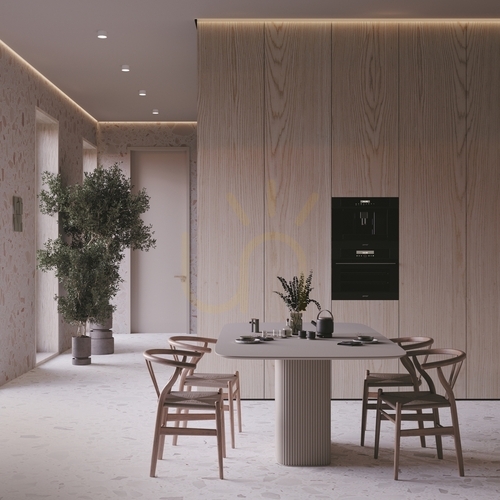
- Minimalist interiors – a flat disc or square on the ceiling doesn’t compete with the architecture.
The chandelier stays the better choice when the ceiling is 2.7 m or more and the lamp is meant to adorn the living or dining room. In many homes the duo works best: a chandelier in the living room, flush lights everywhere else. You’ll find both worlds in the Flush Ceiling Lights and Ceiling Lights categories.
Integrated LED or replaceable bulb?
This is the most important technical split among ceiling lights:
- The integrated LED flush light – diodes built in permanently, the driver inside the housing. Pros: the lowest profile (even 3–5 cm), an even sheet of light with no bulb shadows, often higher efficacy and CCT/dimming features. Con: you can’t replace the source like a bulb – when the driver dies after years or the output drops, you replace the driver (if it’s serviceable) or the fitting. Choose reputable makers with a lifespan stated as L70/L80 (e.g. 20,000–30,000 h), a sensible warranty and an available driver.
- The bulb-based flush light (E27/E14/GU10/GX53) – the classic construction with a diffuser shade. Pros: you swap a bulb in a minute, and you decide the power, colour and smart features; the fitting can serve for decades. Con: a taller profile, and in some shades visible “hot spots” from the point sources.
The practical rule: for the bathroom, hallway and interiors where a flat profile and even sheet matter – integrated LED; where you value serviceability and flexibility (bedroom, kids’ rooms, living room) – a bulb-based flush light with a milky diffuser. The shade material matters too: glass looks noblest and never yellows, good plastic is lighter and more drop-resistant, and fabric shades (handmade felt or linen flush lights) warm an interior like a lampshade.
Whatever the construction, check four more things on the product sheet: CRI ≥ 80 (90+ where you look in a mirror), a decent flicker-free driver (a cheap one tires the eyes and whines on a dimmer), the fitting’s height (a 3–5 cm slim versus 12+ cm makes a difference under a low ceiling) and – on CCT models – memory of the last setting, so the lamp doesn’t reset to cold white with every flick of the switch.
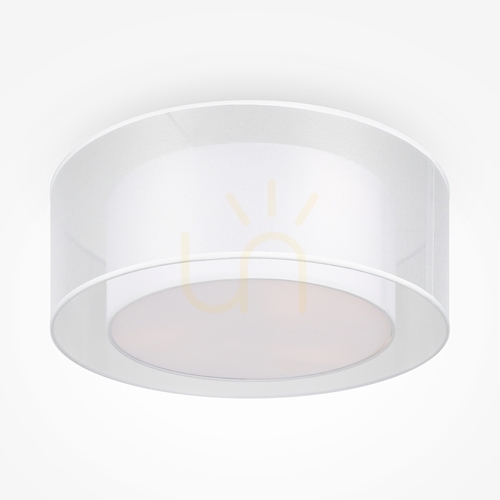

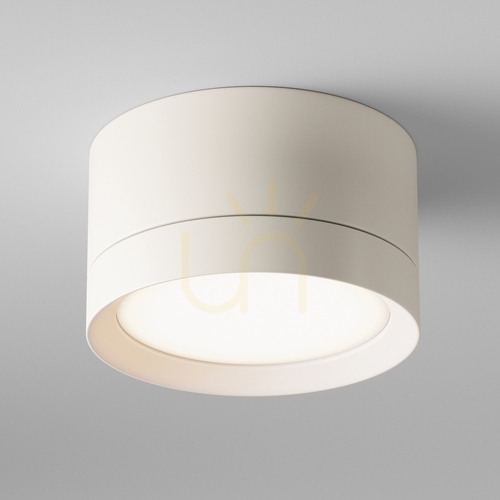

What diameter for which room?
Which ceiling light for which room? Match the size to the floor area and height – too small looks like a button on the ceiling, too big overwhelms:
- Hallway, WC, small kitchen (up to 6–8 m²): 25–35 cm diameter.
- Bedroom, child’s room, kitchen (8–15 m²): 40–50 cm.
- Living room, large bedroom (15–20 m²): 50–60 cm, or two smaller flush lights instead of one large one.
- Above 20 m² and open-plan interiors: 60+ cm or – more often – several flush lights spread evenly; a single central point leaves the edges dark.
Two practical notes: in narrow, long rooms two smaller flush lights in a line work better than one central one; and if you’re torn between two sizes, in a bright interior the larger is the safer pick – a bigger luminous surface means softer shadows and less glare at the same lumen count.
How many lumens and how many watts?
How many lumens should a ceiling light have? Count by floor area, not by watts, and keep the two measures apart: on the floor you want about 100–150 lx of general light, and when buying, look at the flux: roughly floor area × 150–250 lm in a bright interior (dark walls and furniture can demand 30–50% more). Best compare the whole fitting’s flux where the maker states it – with bulb-based flush lights, subtract the diffuser’s losses from the bulbs’ output:
- A 4 m² hallway: 600–1,000 lm.
- A 6 m² bathroom: 900–1,500 lm (plus separate light at the mirror!).
- A 12 m² bedroom: 1,800–2,500 lm – ideally dimmable, because in the evening that’s too much.
- A 20 m² living room: 3,000–5,000 lm in total, though in practice the ceiling light provides the ~2/3 base and mood lamps add the rest.
Watts today only tell you about power consumption: modern LED ceiling lights typically reach 80–130 lm/W, so 24 W can mean 2,000 or 3,000 lm. Compare lumens and the energy label class, not wattage. Remember too that a flush light provides general light – the kitchen worktop, the desk and the mirror need their own task lighting. And don’t buy “with a reserve” without a dimmer – a 5,000 lm flush light in a bedroom with no control is a floodlight, not a lamp.
Light colour: 2700, 3000 or 4000 K?
- 2700–3000 K (warm white): living room, bedroom, child’s room, hallway – wherever the light should feel domestic.
- 4000 K (neutral): the working kitchen, the bathroom for morning routines, the garage, utility rooms.
- Above 5000 K looks cold and technical in relaxation zones – leave it to garages, laundries and workshops.
The most universal are CCT flush lights with switchable colour (usually 3000/4000/6500 K from a remote or a switch on the fitting): 4000 K for the morning routine, 3000 K to wind down in the evening. The overriding rule: keep one colour at a time per room – a mix of warm and cold white on one ceiling looks like a defect. How to read kelvins and how the colours differ in practice we covered in detail in our post on light colour.
Dimmable LED ceiling lights and controls
A dimmable LED ceiling light is the cheapest way for one lamp to handle both cleaning and a film evening:
- Dimming from a wall dimmer – requires a fitting explicitly marked as dimmable and an LED-ready dimmer with a minimum load below the fitting’s wattage; safest to stick to pairings proven by the manufacturer, otherwise the result is flicker and hum.
- Remote / app – CCT+DIM flush lights with their own remote dim smoothly with no wiring changes: the simplest route in already-renovated flats.
- Smart (Wi-Fi/Zigbee) – phone control, scenes, schedules; in an E27 flush light a smart bulb gives the same effect for a fraction of the price.
- Motion sensor – in the hallway, staircase and garage a flush light with a built-in sensor switches off after the household; for the bathroom pick presence-sensor versions that don’t go dark while you lie still in the bath.
A ceiling light for the bathroom, a child’s room and outdoors
- Bathroom: choose flush lights rated at least IP44; directly over the bath and shower enclosure IP65 is safer. The IP number alone isn’t everything though – bathroom zones 0/1/2 carry their own voltage and installation requirements, so leave the wiring to an electrician. Which zone demands what, we explain in our post on IP ratings in the bathroom. A ceiling light still leaves shadows under the eyes at the mirror – add a wall light or mirror lighting at face height.
- Child’s room: a flush light is the safest children’s lamp – nothing dangles or tempts, and a full diffuser survives a football hit better than a chandelier. Colour 2700–3000 K, and strictly a soft, milky diffuser with no exposed diodes. The complete children’s room lighting plan – flush light, wall light and night light – we described in our post on children’s room lighting.
- Outdoors: exterior flush lights for the soffit, porch or above the front door should be IP44 and up (rain-exposed – IP54/65) with a UV-resistant housing; motion-sensor versions make them a convenient welcome light.


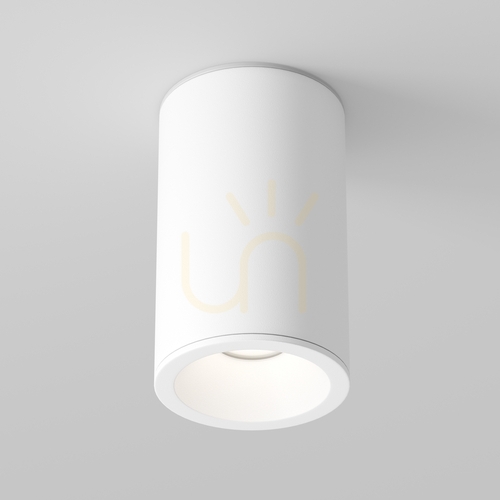
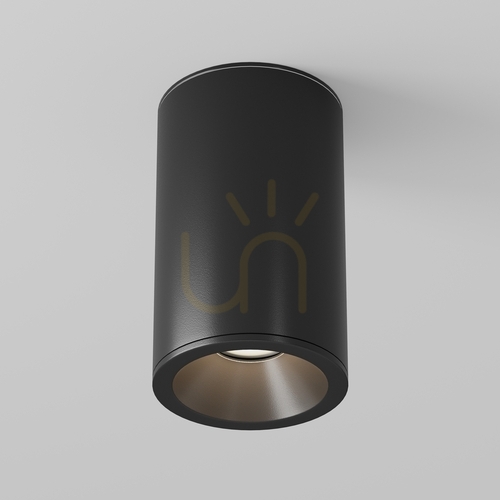
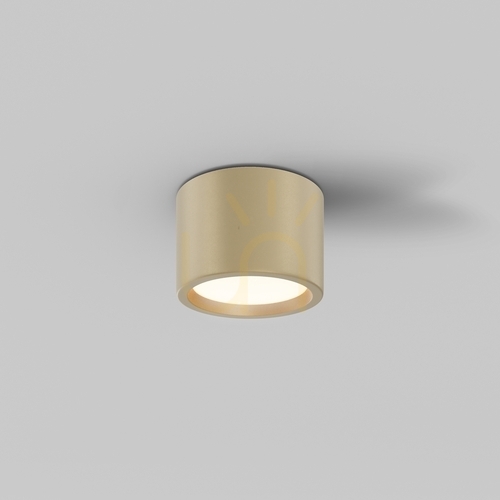


In children’s rooms the hand-painted collection of flush lights works beautifully:


Installation – on the ceiling and on a slope
- Standard installation is a base screwed to the ceiling and a diffuser attached with clips or a bayonet; the wires join the ceiling box with a push-in connector. A concrete slab needs a drill and plugs; plasterboard needs board anchors and a light fitting.
- Switch the circuit off at the consumer unit and confirm the absence of voltage with a two-pole voltage tester; metal class I fittings require the protective earth (PE) conductor to be connected. Without experience, leave the hook-up to an electrician – it’s fifteen minutes of a professional’s time.
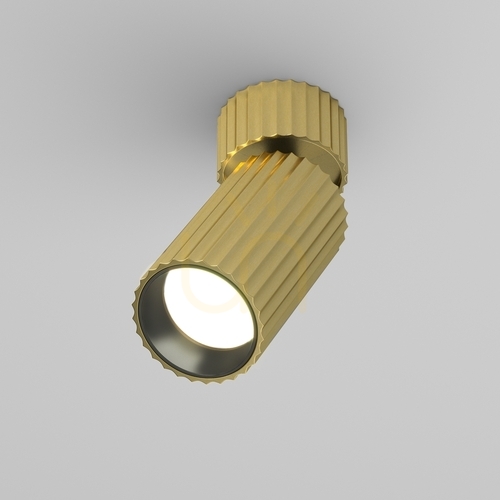
- On a slope mount only models the manufacturer approves for inclined surfaces – it’s not just about the beam direction, but also the diffuser’s fixing and the fitting’s cooling; directional surface-mounted spots are the alternative. In a sloped bathroom make sure the IP zoning still holds.
- Leave service access – in LED flush lights with an external driver, that driver is the part you’ll one day replace; don’t build it in permanently.
Frequently asked questions
How many lumens for a bedroom ceiling light, and how many for a living room? A 12 m² bedroom: 1,800–2,500 lm, ideally dimmable. A 20 m² living room: 3,000–5,000 lm in total, of which the ceiling light usually gives ~2/3 and mood lamps the rest. Count roughly 150–250 lm per m² of source flux in a bright interior, more with dark walls.
Can an LED ceiling light be dimmed? Only models marked as dimmable – paired with an LED-ready dimmer, or with their own remote/app (CCT+DIM). An ordinary LED flush light on a classic dimmer will flicker and may get damaged.
What happens when the diodes in an LED flush light burn out? Integrated diodes can’t be swapped like a bulb – servicing comes down to replacing the driver (if external and available) or the whole fitting. So with integrated LED pick proven makers, and where you want the easiest serviceability – an E27 bulb-based flush light.
What ceiling light for the bathroom? At least IP44, and directly over the bath and shower better IP65; colour 3000–4000 K. Remember separate light at the mirror – a ceiling light always casts shadows under the eyes.
Can a flush light go on a sloped attic ceiling? Only models the manufacturer approves for inclined surfaces – a classic flush light on a slope shines at the wall. Directional surface-mounted fittings with angle adjustment are the alternative.
A flush ceiling light or an LED panel? The flush light is the lamp “with a shade’s character” for living interiors; the panel delivers an even sheet of working light and reigns in fitted kitchens and offices. In living rooms choose the flush light; in purely working zones – the panel.
Summary
A good ceiling light is the result of four decisions taken in this order: the construction (integrated LED where profile and an even sheet matter; a replaceable bulb where serviceability does), the diameter matched to the floor area (25–35 cm in circulation areas, 40–50 cm in rooms, 50–60+ cm in living rooms), the flux counted at 150–250 lm/m² instead of watts, and the colour – 2700–3000 K in domestic zones, 4000 K in working ones – ideally in a CCT version with dimming, which turns one lamp into three. For the bathroom and outdoors you add the right IP rating, in a child’s room a milky diffuser, and the 230 V hook-up goes to an electrician. Chosen like that, your ceiling light will quietly do its job for years – exactly the way it likes to.
Przemysław Doliński


Maybe you will be interested in products from these categories?
Flush Ceiling Lights, Ceiling Lights
Tags & Blog Categories