
Lumens per square metre – table and formula
How many lumens per square metre: 160–300 lm/m² from the fittings in living rooms, bedrooms and hallways, 250–400 lm/m² in kitchens and 300–500 lm/m² in bathrooms. Worktops, mirrors and desks get their own light on top. We have worked this out for six typical rooms, from a 6 m² bathroom to a garage, down to the number of ceiling lights, bulbs and downlights. We also show which figure on the product page goes into the formula, because the lumens of the LEDs and of the finished fitting can differ by as much as half.
Contents
- How many lumens per square metre do you need?
- Lumen, lux, candela and luminance – what is the difference
- How many lux in which room – table
- Lumens per square metre – the formula and the margin for losses
- Examples: bedroom, living room, kitchen, bathroom, garage, desk
- How many bulbs, ceiling lights or downlights?
- Fixture lumens vs bulb lumens
- Lumens vs watts
- Dimming – the margin that never gets in the way
- How to check brightness: product page and lux meter
- Common mistakes
- Frequently asked questions
- Summary
How many lumens per square metre do you need?
Count the lumens coming out of the fittings: lux from the table × area in m² × 1.6–2. The multiplier covers the light absorbed by walls and shades and the drop in output as LEDs age. A 15 m² room at 100 lx therefore needs about 3,000 lm, which is one larger ceiling light. In our Flush Ceiling Lights category, choose it by the “Luminous flux of luminaire” field.
Lumen, lux, candela and luminance – what is the difference
The four units on packaging and in guides describe four different things. A garden sprinkler makes them easy to picture. Lumens tell you how much water comes out of it in total, lux how much lands on each square metre of lawn, and candelas how strong the jet is in one direction.
Lumen (lm) – how much light a source emits
Luminous flux is the total amount of light a bulb or lamp sends out in all directions, counted the way the human eye sees it. The eye is most sensitive to yellow-green, so the same radiant power produces more lumens in green than in blue or red. On a bulb’s packaging it is the most important number: 806 lm is the brightness of the old 60 W incandescent bulb. What lumens do not tell you is where that light ends up – on the table, on the wall or on the ceiling.
Lux (lx) – how much light falls on a surface
Illuminance says how much light reaches a surface: 1 lux is 1 lumen spread evenly over 1 m². Lux is what decides whether you can see the knife clearly at the worktop or read small print at the desk. It depends on the flux, but also on distance and on where the lamp directs its light. The same bulb gives several hundred lux on a table when it hangs low in a shade that points down, and a few dozen when it shines at the ceiling. For scale:
- a full moon – a fraction of a lux,
- a living room in the evening with the lamps on – usually from a few dozen to about 150 lx,
- an office workstation – 500 lx,
- an overcast day outdoors – from about one thousand to over ten thousand lx,
- full summer sun – up to about 100,000 lx.
Lux vs lumen – what is the difference? The lumen measures the light a source sends out, the lux the light that has actually arrived on a particular surface.
Candela (cd) – how strongly a source shines in one direction
Luminous intensity describes how much light a source sends in a given direction – more precisely, how many lumens fall within a unit “cone” of space, the steradian (1 cd = 1 lm/sr). The candela is one of the seven base units of the SI system, and its name is no accident: the flame of an ordinary candle has an intensity of roughly one candela.
Candelas matter wherever light is concentrated into a beam – in downlights, spotlights and torches. Two GU10 bulbs from our range show it well. The model with a 38° lens and 460 lm of flux lists 830 cd, while the model with a frosted front, a 120° beam and 520 lm lists only 160 cd. Similar flux, yet more than five times the intensity along the beam axis.
Candelas make it easy to work out the lux under a spotlight: illuminance on the beam axis = intensity ÷ distance². This holds for a surface square-on to the beam, at a distance many times larger than the source itself. A downlight in a 2.6 m ceiling shines on a kitchen worktop (0.9 m) from 1.7 m away. So 830 cd gives about 290 lx in the centre of the pool of light, and 160 cd about 55 lx. That is why narrow beams pick out particular spots – an island, a table, a painting – while wide beams give even general light. Torch makers use the same principle to state range: under the ANSI FL1 standard it is the distance at which illuminance drops to 0.25 lx. A 10,000 cd torch therefore has a range of about 200 m.
Luminance (cd/m²) – how bright a surface looks
Luminance is the luminous intensity per square metre of a glowing or lit surface, seen from a given direction. It is the quantity closest to what the eye perceives. Screen brightness for TVs and monitors is given in cd/m² (in spec sheets: nits).
Luminance explains two things. First, glare: the same flux coming out of a small bare LED has an enormous luminance and dazzles, while spread over a large opal diffuser it gives soft light. In offices EN 12464-1 limits the glare of the whole installation with the UGR index, and the limit for paperwork and computer work is 19. Second, luminance explains why a dark interior looks dark. A matt white wall (reflecting about 80% of light) lit to 200 lx has a luminance of about 50 cd/m². A matt dark grey one (about 20%) at the same 200 lx has about 13 cd/m². The illuminance is identical, but four times less light comes back to the eye – hence the extra lumens for dark finishes.
| Quantity | Unit | What it tells you | Where you find it |
|---|---|---|---|
| Luminous flux | lumen (lm) | how much light a source emits | bulb packaging, lamp product page |
| Illuminance | lux (lx) | how much light falls on 1 m² | recommendations and standards, lux meter |
| Luminous intensity | candela (cd) | how strongly a source shines in one direction | downlight, spotlight and torch specs |
| Luminance | cd/m² | how bright a surface looks | screens, glare assessment |
How many lux in which room – table
There is no binding illuminance standard for homes. The values below are recommendations based on lighting designers’ practice. Where the task resembles professional work (a desk, a kitchen worktop), the reference point is the workplace standard EN 12464-1. That standard covers offices, workshops and commercial kitchens, not homes – but it shows well how much light the eye needs for a given job.
The second column is the illuminance on the surface where you do something (the floor in a hallway, the worktop, the desk). The third shows how many lumens per square metre of floor the fittings have to deliver, already including the margin for losses explained in the next section. For task zones it is lumens per metre of worktop or per lamp. If you plan in feet, divide by 10.76: 160–300 lm/m² is about 15–28 lumens per square foot.
| Room / task | Recommended illuminance | Light from fittings (approx.) |
|---|---|---|
| Hallway, corridor, storage room | about 100 lx | 200–250 lm/m² |
| Bedroom – general light | about 100 lx (dimmable) | 160–200 lm/m² |
| Living room – general light | 100–150 lx | 160–300 lm/m² |
| Reading in an armchair or in bed | 300–500 lx on the book | a 400–800 lm lamp aimed at the book |
| Kitchen – general light | 150–200 lx | 250–400 lm/m² |
| Kitchen – worktop | 300–500 lx | 300–600 lm per metre of worktop |
| Bathroom – general light | 150–200 lx | 300–500 lm/m² |
| Bathroom – mirror | 300–500 lx on the face (vertical) | 600–1,000 lm at the mirror |
| Desk, homework, home office | 500 lx on the desk | a 400–800 lm desk lamp + general light |
| Garage – parking | 75–100 lx | 150–250 lm/m² |
| Garage – workshop, workbench | 300–500 lx | 600–1,000 lm/m² or a lamp over the bench |
Illuminance is an average – it will be brighter under the lamp and darker in the corners. With light walls and a white ceiling the lower end of the range is enough; with dark finishes aim for the upper end. As we age, the eye needs noticeably more light for the same task. If older people live in the home, go for the upper end – especially for reading and in the kitchen.
Lumens per square metre – the formula and the margin for losses
How many lumens per square metre you need follows directly from the definition of the lux: lumens = lux × area in m². A 12 m² room that should have 100 lx needs 1,200 lm in theory. In theory – because the formula assumes all the light from the lamp falls evenly on the floor. In a real room it does not:
- Walls, ceiling and furniture absorb part of the light. Matt white paint reflects about 70–80% of the light that falls on it, light wood roughly half, dark colours 10–20%. Every reflection is a loss.
- Small and narrow rooms lose more. In a 6 m² bathroom or a narrow hallway the walls are close to the lamp and make up a large share of all surfaces, so more of the light hits them first. For the same target in lux, a small bathroom usually needs more lumens per square metre than a living room.
- Ceiling colour matters. Flush ceiling lights and lamps with shades open at the top also light the ceiling, and uplighter floor lamps light nothing else. A white ceiling sends that light back into the room, a dark one swallows it. Under a dark timber or dark concrete ceiling, indirect light loses most of its effect.
- LEDs age and shades get dirty. LED output drops over time – manufacturers state this as, for example, L70 or L80: the number of hours after which output falls to 70 or 80% of its initial value. Add dust and insects in the shades. Designers allow for this with a maintenance factor of around 0.8. Standards quote “maintained” illuminance – the level the lighting should not fall below during its whole service life.
Suppose about 60–80% of a fitting’s output reaches the surface you want to light. Deduct another 20% for LED ageing and dirt and you are left with about 50–65% of the output to plan with. Lighting designers write this as: flux = illuminance × area ÷ (utilisation factor × maintenance factor). For typical homes it simplifies to a practical formula:
lumens from fittings = lux × m² × 1.6–2
- ×1.6 – a room of about 20 m² or more with light walls and a white ceiling, ceiling height about 2.5–2.7 m, fittings without dense shades,
- ×2 – a typical 9–20 m² room, or a furnished interior with a rug and some darker surfaces,
- ×2–2.5 – small rooms (bathroom, WC, hallway), dark walls or floor, ceilings above 3 m, light mainly bounced off the ceiling.
This is an approximation, not a guaranteed result. For ceiling lights, though, the 20–25% margin you see in many guides is usually not enough, because it assumes almost all the light lands where it is needed. A task lamp hanging just above a worktop is different: it delivers a larger share of its flux to the target. The formula gives lumens coming out of the fittings, not out of the bulbs. If the sources sit inside shades, you need more of them (see the section on fixture lumens).
Work zone by zone, not for the whole home at once. In an open-plan living room with a kitchen, calculate the living and kitchen parts separately; in an L-shaped room, both rectangles. For a worktop, desk or table, use the area of that surface, not the whole room. The formula only gives the total – not the placement, evenness or glare. With high ceilings, purely indirect lighting or strict requirements (an office, a treatment room), have the lighting calculated in lighting design software using the luminaire manufacturer’s data.
Examples: bedroom, living room, kitchen, bathroom, garage, desk
This is the formula in practice: how many lumens per square metre and in total typical rooms need. Results are rounded, as you will be choosing from fittings with fixed outputs.
A 12 m² bedroom
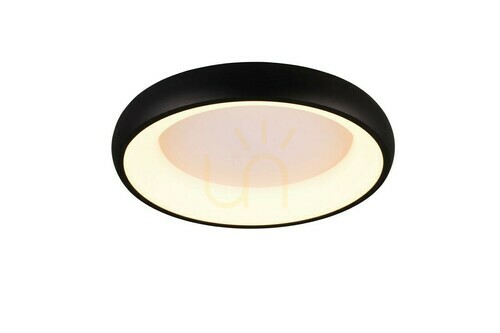
Target: about 100 lx of general light. 12 m² × 100 lx = 1,200 lm, and in a room this size the multiplier is about 2 – about 2,400 lm from the fittings. In practice that is one LED flush ceiling light with that output, or a pendant with three E27 bulbs of 1,055 lm each. That is about 3,200 lm in the bulbs, and some of it stays inside the shades. For reading, add a bedside lamp or wall light of about 400–500 lm on each side of the bed. The ceiling light in a bedroom should be dimmable, because 20–30% of its brightness is enough in the evening.
A 20 m² living room – how many lumens for a living room?
A 20 m² living room needs about 3,200–6,000 lm from the fittings in total: 20 m² × 100–150 lx = 2,000–3,000 lm, multiplied by 1.6–2. About 3,200 lm is enough in a light interior with a white ceiling. Nearer 6,000 lm is needed with a dark floor, dark furniture or a 3 m ceiling.
Spread this over several sources rather than one central lamp. For example: a flush or ceiling light of about 3,000 lm, an 800–1,500 lm floor lamp by the armchair, and wall lights or LED strip giving 500–1,000 lm. The alternative is 8–10 downlights of about 400–450 lm each, placed in zones, plus mood lamps. A single central lamp of 5,000 lm does “hit the number in the table”, but it leaves the corners dark and dazzles when you look up.




A 9 m² kitchen and the worktop
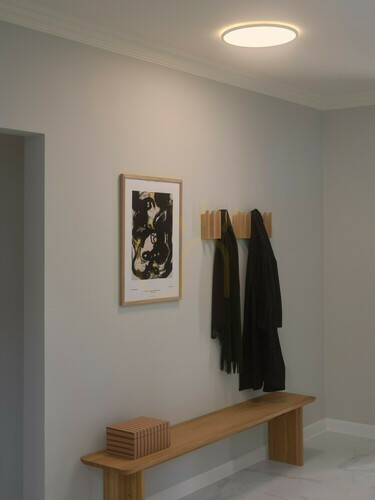
General light at 150–200 lx: 9 m² × 150–200 lx = 1,350–1,800 lm, and a small kitchen needs a multiplier of about 2 – about 2,700–3,600 lm. Because the worktop gets its own light, the general light can sit nearer the lower end: for example six downlights of about 450 lm each or a flush ceiling light of about 3,000 lm.
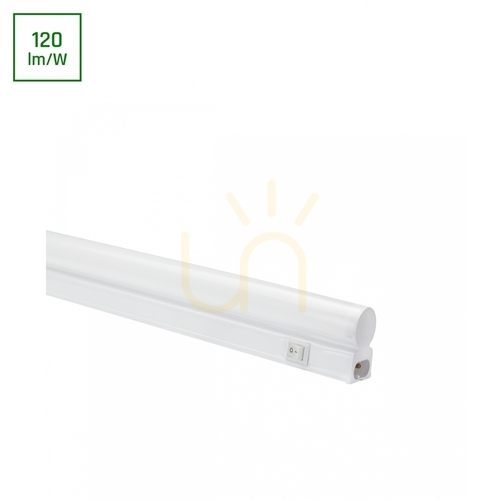
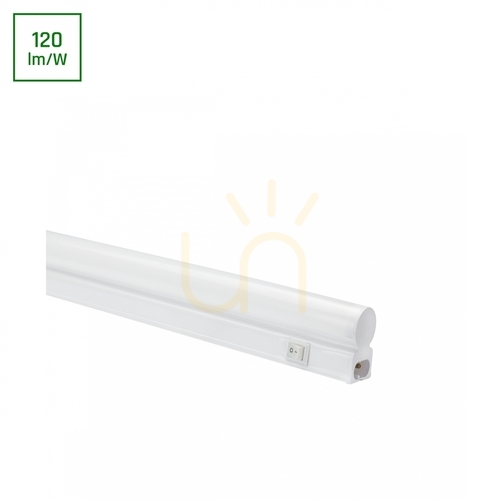
The worktop: 3 m of worktop, 60 cm deep, is 1.8 m². At 500 lx: 1.8 m² × 500 lx = 900 lm, multiplied by 1.6–2 – about 1,400–1,800 lm from under-cabinet fittings, or roughly 500–600 lm for every metre of worktop. The illuminance you actually get depends on where the fitting sits under the cabinet and how wide it shines. Under-cabinet light falls from close range and, unlike a ceiling light behind you, casts no head shadow on the chopping board. Stick-on battery lights under the cabinet usually give 100–250 lm, which makes them orientation lights, not task lights. For the worktop choose 3000–4000 K and a high CRI; you will find fittings in our Under Cabinet Lighting category.



A 6 m² bathroom
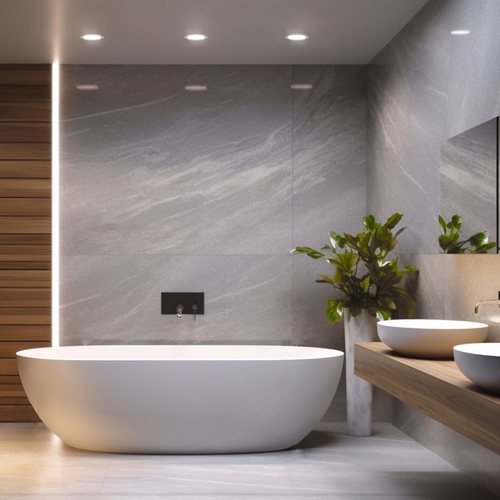
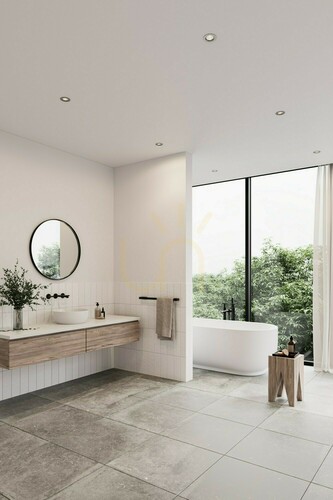
General light at 150–200 lx: 6 m² × 150–200 lx = 900–1,200 lm. A small bathroom has a lot of wall close to the lamp, so the multiplier is closer to 2, although light, glossy tiles help a little. That gives about 1,800–2,400 lm of general light, plus 600–900 lm at the mirror. Because the mirror light also brightens a small room, the ceiling can sit nearer the lower end. A 1,600–2,000 lm bathroom ceiling light with a wall light or illuminated mirror will do, or 4–5 downlights of about 400 lm each and separate mirror lighting. At the mirror, light should come from the sides or the front, not only from above – otherwise shadows appear under the eyes and chin.
Bathroom fittings are chosen according to the zones defined around the bath and shower by the bathroom wiring rules (HD 60364-7-701, based on IEC 60364-7-701; in the UK, BS 7671 Section 701). Each zone has its own requirements for the IP rating, the type of equipment and its supply. Choosing fittings for each zone, installing and connecting them is a job for a qualified electrician.
An 18 m² garage and a workshop corner
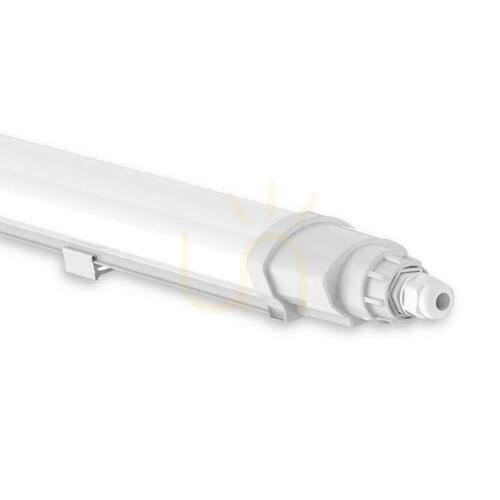
A single garage of 3 × 6 m. For parking and unloading the boot, 75–100 lx is enough: 18 m² × 100 lx = 1,800 lm. Grey concrete walls and a dark floor absorb a lot, so the multiplier is 2–2.5 – about 3,600–4,500 lm. That is one 120 cm waterproof batten (about 4,000–4,500 lm) or, for more even light, two shorter ones of about 2,000 lm each.
If you do DIY in the garage, the workbench needs 300–500 lx. Lighting the whole garage to 300 lx takes about 11,000 lm (18 × 300 × 2) – two or three long fittings. It is usually more sensible to keep 100–150 lx of general light and hang a separate 2,000–4,000 lm linear fitting in 4000 K over the bench. Waterproof (IP65) battens cope well with the dust and damp of an unheated garage – you will find them in our Waterproof Batten Lights category.




Desk and home office
At home there is no need to light the whole room to the 500 lx that EN 12464-1 requires in offices for writing, reading and computer work. A well-placed 400–800 lm lamp aimed at the desk is usually enough. Right-handers should put it on the left so the hand does not shade the page. Add 150–200 lx of general light so the eye does not keep adjusting between a bright desk and a dark background. In a 12 m² study that means about 3,600–4,800 lm from a flush ceiling light or an LED panel. Desk lamps are in our Desk Lamps category.
How many bulbs, ceiling lights or downlights?
Once you have the result in lumens, divide it by the output of one fitting and round up. If you are counting bulbs, divide by their output minus the losses in the shade. These are small in open downlight housings and considerable in lamps with dense shades (more in the section on fixture lumens). Typical values:
- E27 bulbs – usually 470–1,521 lm, stronger LEDs 2,000 lm and more,
- GU10 bulbs for downlights – usually 350–500 lm; ES111 reflector lamps (often sold as AR111 GU10) – 800–1,800 lm,
- downlights with integrated LED – usually 300–800 lm,
- LED flush ceiling lights – from about 900 lm (small, 30–35 cm) to 5,000–7,000 lm (large, 80–100 cm),
- 60 × 60 cm LED panels – in our range usually 3,500–4,800 lm,
- waterproof battens – about 2,000 lm (60 cm), 2,400–4,800 lm (120 cm), 3,000–8,400 lm (150 cm).
The kitchen from the example above needs about 2,700 lm: with 450 lm downlights that is 6 of them, with 350 lm downlights 8. In a 12 m² study a single 60 × 60 cm panel takes over the job of a ceiling light.
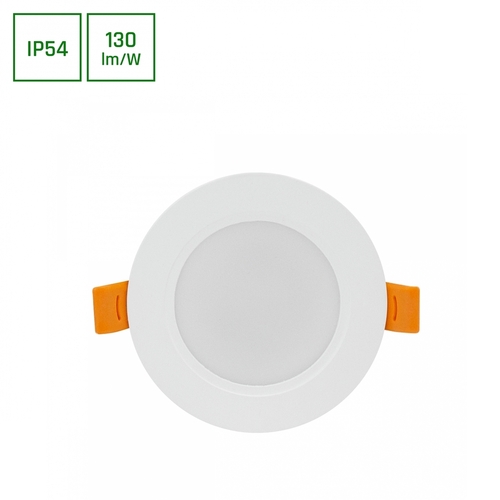
The number of pieces does not settle the spacing. Evenness depends on the beam angle, the mounting height and whether the pools of light from neighbouring fittings overlap. Downlights and other fittings for false ceilings are in our Recessed Ceiling Lights category.



Fixture lumens vs bulb lumens
The number on a bulb’s packaging is the output of the bare source. Inside a lamp, part of the light is stopped by the glass or shade, and part goes where it is not needed. Clear glass and open lampholders lose little, opal glass and diffusers more. Dense fabric shades and shades that enclose the source on all sides lose the most – in extreme cases as much as half.
Direction matters too. A pendant over a table with an opaque shade that is light inside sends little light to the walls, but on the table top it gives more lux than a bare bulb would. That is no loss if the table is the goal. For general light, though, what counts is what reaches the whole room.
For fittings with integrated LEDs, manufacturers state either the output of the LEDs alone or of the complete fitting – and these can be very different numbers. In our range there are flush ceiling lights whose product pages show both values: 5,250 lm for the LEDs and 3,310 lm for the fitting in one case, 8,040 lm and 3,900 lm in another. Use the luminaire output in the formula. If the maker of a lamp that takes bulbs does not state it, add a margin to the bulb output. It is small for clear glass and substantial – a third or more – for opal glass and fabric shades.
Lumens vs watts
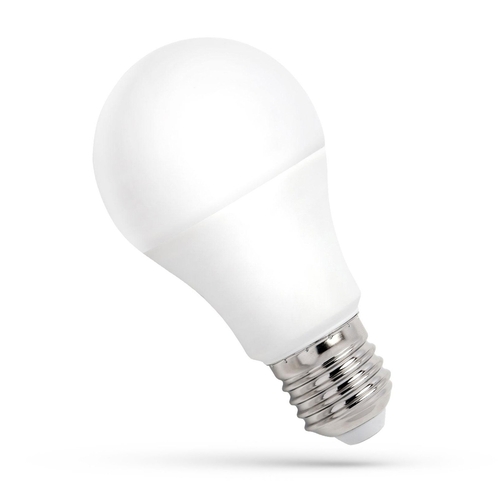
Watts tell you how much electricity a source draws, lumens how much light it gives. They are linked by luminous efficacy in lumens per watt (lm/W). A traditional incandescent bulb managed about 10–15 lm/W, a halogen about 15–25 lm/W, and today’s LEDs typically reach 80–150 lm/W. Under EU Regulation 2019/2015, a light source only gets energy class A from 210 lm/W. Our range includes two E27 bulbs of almost identical brightness: one gives 806 lm at 3.8 W, the other 820 lm at 9 W. The same light, more than twice the power draw.
So compare bulbs by lumens and treat watts as energy-use information. For orientation, the equivalents of old incandescent bulbs:
- 25 W – about 250 lm,
- 40 W – about 470 lm,
- 60 W – about 806 lm,
- 75 W – about 1,055 lm,
- 100 W – about 1,521 lm.
Bulbs with a range of outputs are in our Light Bulbs category.







Dimming – the margin that never gets in the way
Recommendations come as ranges, and rooms differ in wall colour, furniture and time of day. So size the general light to the upper end of the range and dim it: full brightness for cleaning, 30–50% in the living room in the evening, 5–15% for a film. A dimmed LED also draws less power.
For this to work, you need three things:
- a bulb or fitting marked as dimmable – non-dimmable LEDs must not be connected to a dimmer: they flicker, buzz or do not respond, and their driver can be damaged,
- a dimmer compatible with the specific bulb or the fitting’s driver. It needs the right dimming method (for LEDs most often trailing edge) and a minimum and maximum LED load matched to the number of sources. Makers of fittings and bulbs often publish a list of compatible models,
- one control method for ceiling lights with a remote or app – use an external dimmer only if the manufacturer explicitly allows it. Some of these lamps can instead change brightness in steps with an ordinary wall switch (for example 100%, 50%, 10%).
Replacing a switch with a dimmer is work on the 230 V installation – leave it to a qualified electrician.
How to check brightness: product page and lux meter
On a Lunares product page, look for these fields:
- “Luminous flux” – usually the output of the source, meaning the bulb or the LEDs alone. For lamps with built-in LEDs manufacturers sometimes give the output of the whole fitting here, so if there is no separate field, check the description or the data sheet,
- “Luminous flux of luminaire” – the lumens coming out of the lamp; if it is given, this is the figure for the formula,
- “Light beam angle” – how wide the source shines; narrow beams (up to about 40°) for accents and particular spots such as an island or table, wide ones (90–120°) for general light,
- “Rated peak luminous intensity (cd)” – the candelas on the beam axis; from them you can calculate the lux under a downlight,
- “Luminous efficacy” (lm/W) – how much light you get from each watt.
The easiest way to check a finished room is with a lux meter – an inexpensive instrument. Phone apps use the light sensor on the front of the device and give a rough idea, but they can be well off. Measure in the evening with the curtains closed, at the height where you work: kitchen worktop about 90 cm, desk about 75 cm, at floor level in a hallway. Take readings in several places and compare the average with the table.
Common mistakes
- Counting in watts. Power tells you about electricity use, not brightness – two 9 W bulbs can give very different amounts of light.
- Confusing lux with lumens. “I need 500 lux, so I’ll buy a 500 lm lamp” – that lamp gives 500 lx on just one square metre, and only if all its light lands there.
- Accidentally mixed colour temperatures in one room. Warm bulbs next to cool downlights usually look like a mistake. Unless you are deliberately planning two scenes, stick to one colour temperature per room.
Frequently asked questions
Is 500 lumens a lot?
It is roughly the brightness of an old 40 W bulb. Enough for a bedside lamp, a desk lamp or as one downlight in the ceiling. As the only general light, it covers roughly 2–2.5 m² at 100 lx – a small WC or a pantry, for example.
How many watts is 8,000 lumens?
It depends on the efficacy of the source. A typical LED gives 8,000 lm at about 55–100 W, a halogen only at about 400–500 W – the draw of a powerful site floodlight. In a garage or workshop, 8,000 lm means two or three 120 cm waterproof battens, not a single lamp.
Lux vs lumen – how do you convert?
1 lx is 1 lm spread over 1 m², but only for light that has actually reached the surface. A 2,000 lm lamp in a 10 m² room therefore does not give 200 lx but about 100 lx, because walls and shades absorb part of the flux. Under a single spotlight, lux is worked out from candelas, as in the section on the candela.
What is a candela and how many candelas does a bulb have?
The candela is the unit of luminous intensity – the strength of light in one direction – and is roughly what a candle flame gives. An ordinary LED bulb shining in all directions has a few dozen candelas. A narrow-beam GU10 downlight has a few hundred to about a thousand, and ES111 reflector lamps from about a thousand to several thousand.
Can you have too many lumens?
Yes. A 5,000 lm ceiling light in a bedroom with no dimming gives far more light than you need in the evening, and strong bare sources in the field of view cause glare. Excess stops being a problem once the lamp can be dimmed: the spare lumens help when you clean and do not tire your eyes at night.
Summary
Choose a lamp by the luminaire output, not by watts or bulb lumens. Look up how many lumens per square metre your room needs in the table, multiply by the floor area and compare the result with the “Luminous flux of luminaire” field on the product page. In a room of up to about 15 m², one dimmable flush ceiling light from the upper part of the range is enough. In a living room or kitchen, do not look for one powerful lamp: split the lumens between ceiling light and fittings by the worktop, armchair or mirror. Have the electrician fit the dimmer when the lamps go up.
Dawid Skłodowski


Maybe you will be interested in products from these categories?
Light Bulbs, Flush Ceiling Lights, LED panels
Tags & Blog Categories