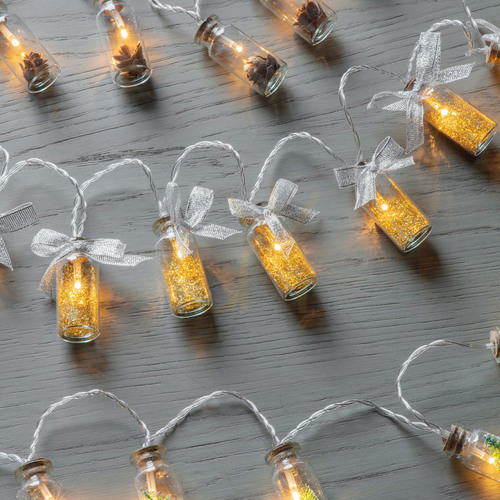
Battery Christmas lights run from a small battery pack instead of a plug – usually AA or AAA cells, a coin cell on the tiniest sets, or a built-in rechargeable pack topped up over USB. That frees them from the wall socket, so a wreath on the front door, a garland on the mantelpiece or a tree in the middle of the room can glow without a trailing cable.
The trade-off is simple: you gain freedom of placement and lose length and brightness compared with mains strings, and every few weeks the batteries need swapping. For smaller decorations that is an easy deal; for a two-metre tree in the bay window it may not be.
Are battery Christmas lights any good?
For the right job, very. Most battery sets carry somewhere between 10 and 100 LEDs over 1–10 m. LEDs draw so little current that a set of AA cells can keep a micro-LED string lit for anything from dozens to a few hundred hours. Where they fall short is scale: a big, densely lit tree needs hundreds of bulbs, and that is mains territory.
Common styles:
-
Wire fairy lights – micro LEDs on fine copper or silver wire that bends round branches, stair spindles and jars and all but disappears by day.
-
Cable strings on green or clear flex – sturdier for wrapping a tree year after year.
-
Shapes and figures – stars, snowflakes, baubles, pine cones, lit wreaths and window silhouettes.
Warm white (around 2700–3000 K) gives the cosy, candlelit look most people want indoors. Cool white (around 6000–6500 K) reads crisp and frosty, and multicoloured sets bring back the nostalgic look of childhood Christmases.
Choosing the power source
‘Battery-operated’ covers several quite different set-ups. Which one suits you depends on where the lights go and how often you use them.
| Power option |
Voltage per cell |
Strengths |
Watch out for |
| Alkaline AA or AAA |
1.5 V |
Fits almost every set, easy to replace |
Loses capacity in frost; can leak if left in over summer |
| Lithium AA or AAA (single-use) |
1.5 V |
Copes far better with cold porches and gardens |
Never try to recharge them |
| Rechargeable NiMH |
1.2 V |
Good value for lights used every evening |
Lower voltage may dim the set; only if the maker allows |
| Coin cell (CR2032) |
3 V |
Tiny, for jars and small table pieces |
Short runtime; dangerous if swallowed by small children |
| Built-in USB pack |
3.7 V (lithium-ion) |
Recharge from a phone charger, no spare cells to buy |
Set goes dark while charging unless it also runs from USB |
Whatever you pick, use the cell type printed on the battery box and never mix old with new, or alkaline with lithium, in the same pack.
How the 6-hour timer works
Many battery sets have a 6/18 timer: six hours on, eighteen off, repeating daily from the moment you switch it on. Turn it on at the time you want the lights to come on each evening – say 4 pm as it gets dark – and they will do the rest. Running a quarter of the day rather than all of it stretches one set of batteries across several weeks of December evenings.
Where they work best
Think of all the spots a plug never reaches: the banister, a mantelpiece without a nearby socket, a sideboard centrepiece, a glass cloche, a front-door wreath, a child's bedroom where you would rather not have cables. Tuck the battery box somewhere you can reach without undressing the decoration.
Outside, choose only sets sold for outdoor use – at least IP44 – with a sealed battery box. Hang the box under the porch roof or a window sill with the opening facing down so rain cannot pool in it, and fit lithium cells if the frost bites.
FAQ
What are the drawbacks of battery operated Christmas lights?
Shorter strings, fewer LEDs, a dimmer glow than mains sets and the ongoing job of replacing batteries. Cold weather shortens battery life further. For a large tree or a whole house front, mains or solar is usually more practical.
What should I look for in battery-operated outdoor Christmas lights?
An outdoor rating of IP44 or higher on both the string and the battery box, a lead long enough between box and first bulb to hide the box out of the rain, a timer and, ideally, a remote so you are not climbing a ladder each night.
How long do batteries last in Christmas lights?
It depends on the number of LEDs, the cells used, the temperature and how many hours a day the lights are on. Expect anything from dozens to a few hundred hours of light per set; with the timer that usually means several weeks.
Can you use battery Christmas tree lights on a real tree?
Yes. LEDs at battery voltage barely get warm, so they sit safely against needles. Pick a string long enough for the tree's height – battery sets rarely run beyond 10 m, so taller trees may need two or three sets.
Can I leave battery lights on overnight?
They are low-voltage and run cool, so it is not a fire risk in normal use, but the batteries will drain fast. Use the timer instead and let the lights switch themselves off.
What do I do with the batteries after Christmas?
Take them out before you box the lights away, as spent cells can leak and corrode the contacts. Used batteries go to a battery recycling point – most supermarkets have one – rather than the household bin.
If your tree stands near a socket, the wider world of Christmas lights is worth a look too. Decorating the porch or front garden instead? Read more about outdoor Christmas lights.